Is Cognigy the Right Enterprise AI Platform for Your Business?
Take This 2-Minute Quiz to Find Out!
Navigating the complexities of enterprise conversational AI can be daunting, but with our comprehensive Cognigy FAQs, we aim to demystify how this powerful platform can transform your customer care operations. As customer service managers and CX leaders, you’re constantly seeking solutions to elevate your customer experience and drive efficiency.
Cognigy stands out as a leading enterprise AI solution for sophisticated AI-Powered Customer Support, offering robust automation and deep integration capabilities. This article, brought to you by the experts at Best AI Customer Care Central, dives deep into the most frequently asked questions about Cognigy.

We explore its unique value, how it leverages Generative AI safely, its integration prowess, and the vital role of security and data privacy in enterprise deployments. We’ll equip you with the insights needed to make informed decisions and confidently embark on your journey towards advanced customer service automation. Let’s explore how Cognigy can evolve your contact center from a reactive cost center into a strategic growth engine.
Key Takeaways
- Enterprise-Grade Platform: Cognigy differentiates itself from standard chatbots through advanced NLU, Generative AI, and deep system integrations that enable transactional capabilities beyond simple information retrieval
- Dual Experience Focus: The platform addresses both customer experience (CX) and agent experience (AX) through automation, Agent Copilot features, and comprehensive analytics
- Omnichannel Excellence: Unified deployment across voice, digital channels, and employee-facing applications from a single conversational AI platform
- Enterprise Security Standards: SOC 2 Type II, ISO 27001, GDPR, CCPA compliance with HIPAA-ready capabilities for regulated industries
- Controlled Generative AI: Uses Retrieval-Augmented Generation (RAG) technology with enterprise-safe guardrails to prevent AI hallucination while enhancing conversation quality
Experience the power of Cognigy’s advanced conversational AI platform in action with this comprehensive demo showcasing its enterprise-grade capabilities and real-world applications:
What is Cognigy, and how does it differ from a standard chatbot?
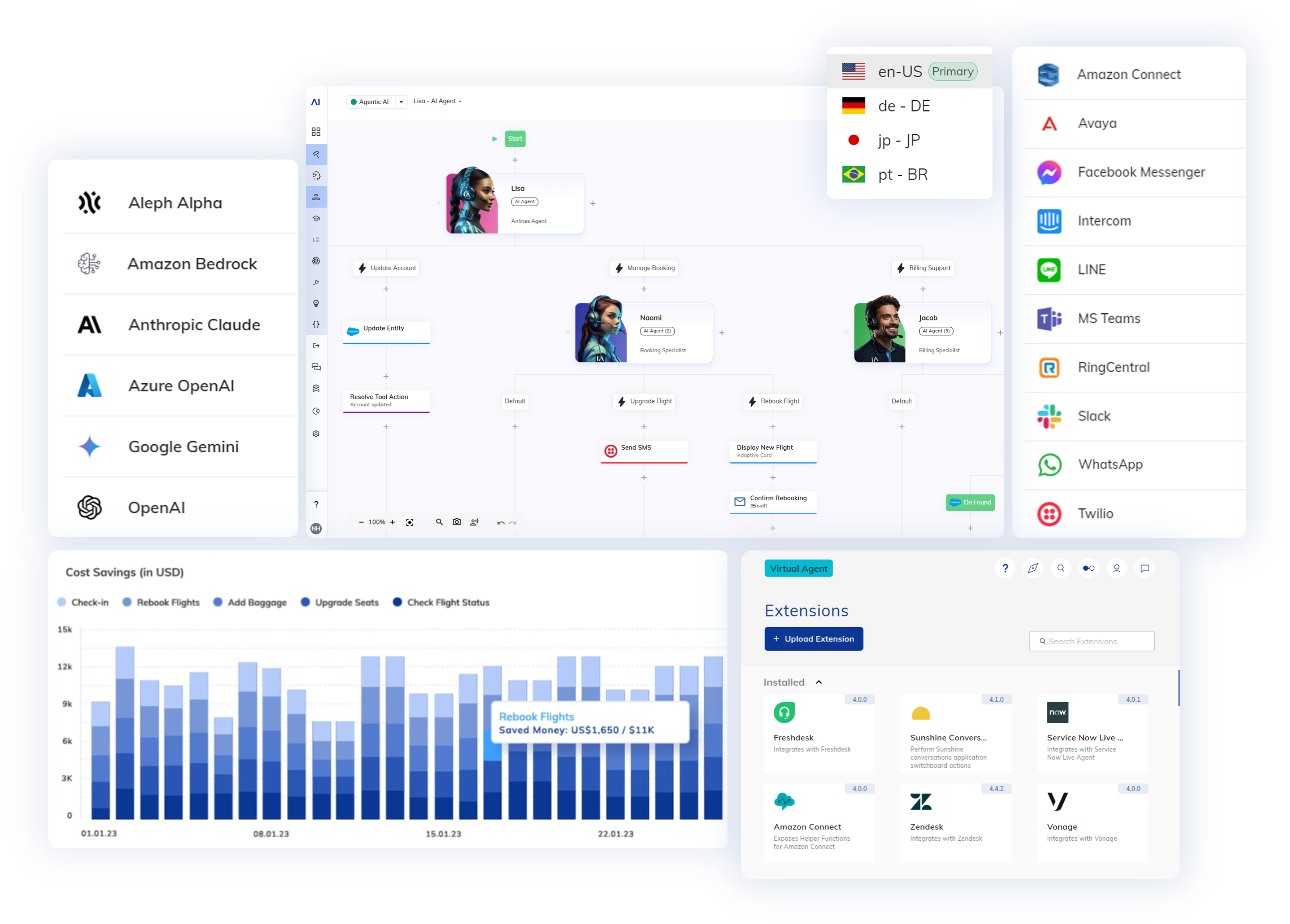
Cognigy is an enterprise-grade conversational AI platform designed to automate and enhance customer and employee communication across multiple channels. Unlike standard rule-based chatbots that can only handle simple, predefined queries, Cognigy leverages advanced Natural Language Understanding (NLU) and Generative AI to manage complex, multi-turn conversations with human-like comprehension.
The fundamental difference lies in its architecture and capabilities. Standard chatbots often operate in isolation, whereas Cognigy is built as a central orchestration layer that connects deeply with your core business systems like Salesforce, Zendesk, or SAP. This enables it to perform transactional tasks such as checking order statuses, updating account information, or booking appointments, rather than simply providing static information.
Cognigy is a true omnichannel platform, allowing you to deploy a single, consistent conversational AI agent across voice channels (phone systems), digital text channels (web chat, WhatsApp, social media), and employee-facing applications. This unified approach ensures a seamless customer experience and operational efficiency that disparate, single-channel chatbots cannot achieve.
The platform empowers both business users through its visual, low-code Flow Editor and developers through robust API capabilities and custom coding options. For a deeper understanding of how Cognigy compares to other solutions, explore our comprehensive Cognigy Review that breaks down its capabilities and real-world performance.
What specific business problems does Cognigy solve for enterprise contact centers?
Cognigy directly addresses the most pressing challenges facing modern enterprise contact centers, transforming them from reactive cost centers into proactive, efficient growth engines. The platform focuses on solving issues related to high operational costs, inconsistent service quality, and poor agent and customer experiences.
Specifically, Cognigy tackles high ticket volume and agent burnout by automating repetitive inquiries like “Where is my order?” or “What’s my account balance?” This frees human agents to focus on complex, high-value interactions requiring empathy and critical thinking, reducing burnout and improving job satisfaction. The platform eliminates customer wait times through instant, AI-powered self-service available 24/7, significantly boosting Customer Satisfaction (CSAT) and First Contact Resolution (FCR) rates.
The Agent Copilot feature provides real-time guidance, knowledge base suggestions, and automated summaries to human agents during live interactions. This ensures every agent, regardless of experience level, provides accurate and consistent information while reducing Average Handle Time (AHT).
Cognigy also acts as an integration hub, connecting disparate backend systems to provide both AI and human agents with a unified customer view, eliminating the need to switch between multiple applications to resolve issues. This comprehensive approach addresses the dual experience imperative, improving both customer experience (CX) and agent experience (AX) simultaneously.
Who is the ideal user for Cognigy? Is it for developers or business users?
Cognigy is designed for a hybrid audience, positioning itself as a low-code platform that empowers business users while providing the depth required by professional developers. This dual approach makes it ideal for enterprise teams where collaboration between IT and business departments is essential for success.
Business users such as CX designers, business analysts, and conversation designers can leverage the visual, drag-and-drop Flow Editor to design and build conversation flows without writing any code. They can define intents, create dialogues, and map out the customer journey using an intuitive graphical interface. This allows those closest to the customer experience to have direct control over the AI’s behavior and iterate quickly on conversation design.
For more complex requirements, the platform offers robust tools for developers and IT professionals. They can write custom JavaScript or TypeScript code within nodes, create complex integrations with enterprise systems using REST APIs, and manage sophisticated data transformations. The platform’s extensibility ensures it can be tailored to meet unique and demanding technical specifications, including custom authentication flows and complex business logic.
Cognigy’s value is maximized when cross-functional teams collaborate effectively. Business users can typically handle 80% of conversation design and maintenance, while developers are brought in for the 20% involving intricate integrations, custom logic, and ensuring enterprise-grade security and scalability. This collaborative model accelerates development cycles while maintaining technical rigor.
To see practical applications of these capabilities, check out our detailed Cognigy Tutorials and Usecase guide that demonstrates real-world implementations for both business users and developers.
How does Cognigy use Generative AI, and what safeguards are in place for accuracy and brand safety?
Cognigy incorporates Generative AI to enhance conversation quality and expand automation capabilities within a controlled, enterprise-safe framework. Unlike open-ended consumer tools, Cognigy’s Generative AI is grounded in your company’s specific knowledge and data to ensure relevance and factual accuracy.
The platform uses Generative AI through its Knowledge AI feature, which employs Retrieval-Augmented Generation (RAG) technology. Instead of manually creating FAQs, you can feed existing knowledge bases, PDFs, and website content into Cognigy. The AI finds the most relevant information from these verified sources and generates natural, human-like answers based only on that content. This approach prevents the AI from “hallucinating” or fabricating information, a critical safeguard for enterprise applications.
Cognigy also uses Generative AI to create dynamic conversational turns, rephrase questions for better understanding, generate real-time summaries of interactions, and assist developers by suggesting example sentences for intents or creating response variations. To ensure brand safety and accuracy, all Generative AI responses are constrained to customer-provided knowledge sources.
The platform includes strict controls for developers to define off-limits topics and implement guardrails against inappropriate or off-brand responses. Every AI action can be logged and reviewed, providing full transparency and control over customer interactions. This comprehensive approach balances the power of Generative AI with the control and accountability required for enterprise deployments, ensuring that automation enhances rather than compromises your brand reputation.
How does Cognigy integrate with essential business systems like CRM platforms and contact center software?
Cognigy’s ability to deeply integrate with core business systems is a primary differentiator and cornerstone of its value proposition. The platform is designed as an orchestration engine rather than an isolated application, providing a flexible, multi-layered approach to integration that ensures seamless data flow with CRMs like Salesforce and HubSpot, ticketing systems like Zendesk, and Contact Center as a Service (CCaaS) platforms like Genesys or NICE.
The integration architecture includes pre-built extensions available through Cognigy’s marketplace for popular systems. These extensions provide ready-to-use nodes within the Flow Editor that handle authentication and common API calls (such as “Get Contact” or “Create Case”) with minimal configuration. For systems without pre-built extensions, developers can easily make HTTP requests to any REST or OData API, which is the most common method for custom integrations.
For voice integrations, Cognigy’s Voice Gateway connects to telephony systems using the standard SIP protocol, allowing it to function as a sophisticated voicebot, handle IVR deflection, and perform seamless, context-aware transfers to human agents. This comprehensive integration capability means Cognigy can maintain a complete view of the customer’s history and take meaningful action, transforming it from an informational chatbot into a transactional resolution engine.
A critical best practice is implementing bi-directional workflows rather than treating integrations as one-way data retrieval. For example, don’t just pull order status from your e-commerce platform—update the conversation transcript and outcome as a new activity on the customer’s timeline in Salesforce. This enriches your CRM data, giving human agents full context for future interactions and providing invaluable data for business intelligence.
What are the key differences between Cognigy and other platforms like Kore.ai or LivePerson?
While Cognigy, Kore.ai, and LivePerson all operate in the enterprise conversational AI space, they differ significantly in their core focus, architecture, and ideal use cases. Understanding these distinctions is crucial for selecting the right tool for your specific business needs.
Cognigy and Kore.ai are both strong in low-code development and built for enterprise complexity. However, Cognigy often receives praise for its highly intuitive visual flow editor and unified approach to both voice and digital channels from a single platform. Kore.ai is also powerful, with a strong focus on industry-specific “process assistants” and pre-built templates. The choice often comes down to which user interface your team prefers and the specific pre-built components available for your industry. Cognigy’s architecture is generally seen as slightly more flexible for developers who need to build highly custom solutions from the ground up.
LivePerson’s strength originates from its deep roots in live chat and agent-facing tools. Its Conversational Cloud excels for businesses looking to optimize their existing human agent workforce with AI enhancements, routing, and analytics. Cognigy, conversely, was built from the ground up as an automation-first platform designed to build and deploy powerful, standalone virtual agents that can fully resolve complex issues without human intervention. While Cognigy has robust agent handoff and Agent Copilot features, its core DNA is automation, whereas LivePerson’s is agent enablement.
Choose LivePerson if your primary goal is optimizing a large human agent team. Select Kore.ai if you need industry-specific process templates out-of-the-box. Choose Cognigy if your goal is building a highly flexible, powerful, and custom automation engine for both voice and digital channels. For a comprehensive comparison of these platforms and other leading solutions, explore our guide to Cognigy Top Alternatives and Competitors.
What level of security and data privacy does Cognigy provide, and what compliance standards does it meet?
Cognigy provides enterprise-grade security and data privacy designed to meet the stringent requirements of global enterprises in regulated industries. The platform is architected with a security-first mindset and adheres to major international compliance standards, making it a trusted choice for handling sensitive customer data and personally identifiable information (PII).
Cognigy is independently audited and certified for SOC 2 Type II and ISO/IEC 27001, which are gold standards for security, availability, and process integrity. These certifications demonstrate a formal commitment to protecting customer data through rigorous security controls and processes. The platform is fully compliant with GDPR (General Data Protection Regulation) for EU citizens and CCPA (California Consumer Privacy Act), including features for data anonymization, data redaction, and the “right to be forgotten,” allowing businesses to easily manage customer data requests.
For healthcare applications, Cognigy’s platform is HIPAA-ready, meaning it is equipped with the necessary technical safeguards, administrative controls, and security configurations to allow customers (covered entities) to build HIPAA-compliant solutions. Cognigy is able to sign a Business Associate Agreement (BAA), which is a legal requirement for vendors handling protected health information (PHI).
Cognigy employs role-based access control (RBAC), allowing administrators to define highly specific permissions for every user. You can control who can build flows, view conversation transcripts, access analytics, or manage system settings, ensuring a “least privilege” security model. All data is encrypted both in transit (using TLS 1.2+) and at rest. The platform includes built-in data redaction capabilities to automatically identify and mask sensitive information like credit card numbers or social security numbers from conversation logs.
Compliance & Security Disclaimer: Achieving HIPAA compliance is a shared responsibility. While the Cognigy platform provides the necessary security controls and is considered “HIPAA-ready,” customers are ultimately responsible for ensuring their specific implementation, data handling procedures, and operational processes fully comply with HIPAA regulations. It is essential to work with qualified legal and compliance professionals to validate any solution that handles Protected Health Information (PHI).
Can Cognigy manage customer conversations across both voice and digital channels?
Yes, Cognigy is fundamentally an omnichannel platform, which is one of its core strengths. It allows you to build a single conversational AI application (a “virtual agent”) and deploy it consistently across a wide array of voice and digital channels. This eliminates the need to build and maintain separate bots for your website, mobile app, phone system, and social media platforms.
This omnichannel capability works by separating the conversational logic (the “brain”) from the channel-specific endpoints. You design the conversation flow once in the Cognigy Flow Editor, then connect that flow to different endpoints for digital channels including web chat, Facebook Messenger, WhatsApp, SMS, and other text-based platforms. Cognigy automatically adapts the interaction to the capabilities of each channel, such as using rich carousels in web chat versus plain text for SMS.
Through its Voice Gateway, Cognigy connects to contact center phone systems using the industry-standard SIP protocol. This allows the same virtual agent to function as a sophisticated voicebot capable of understanding spoken language, responding with text-to-speech (TTS), and performing complex IVR functions. The platform handles real-time speech-to-text transcription and natural language understanding for voice interactions.
The key benefit is providing a seamless and consistent customer experience across all touchpoints. A customer can start a conversation on WhatsApp and, if they later call in, the virtual agent (and any human agent it transfers to) can have the full context of that prior interaction. This consistency is critical for building trust, reducing customer effort, and improving resolution rates. The unified approach also simplifies maintenance, as updates to conversation logic automatically propagate across all channels.
What is Cognigy’s Agent Copilot, and how does it empower human support agents in real-time?
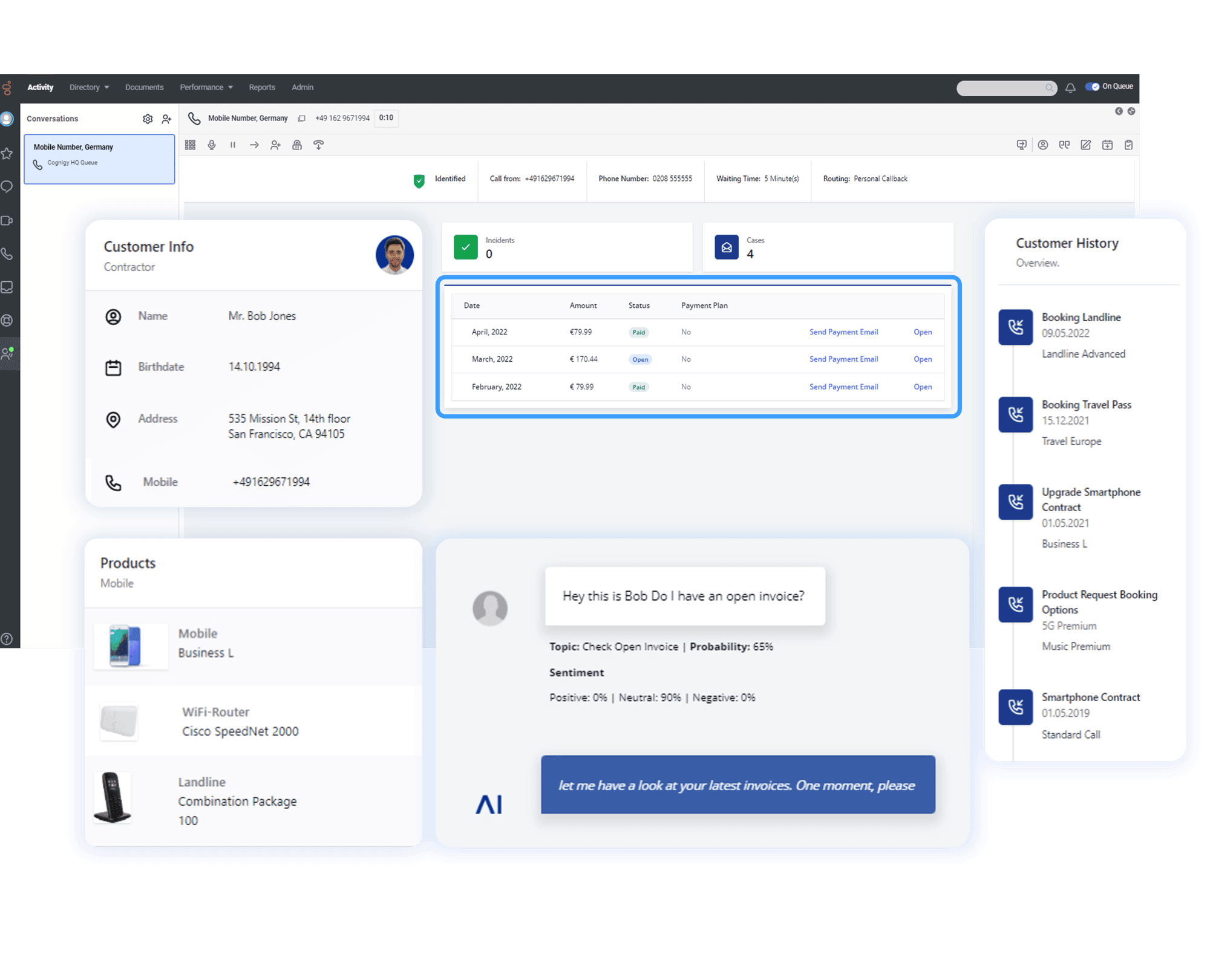
Cognigy’s Agent Copilot is an AI-powered assistant that works alongside human agents in real time to help them resolve customer issues faster, more accurately, and more consistently. It is designed to address the “dual experience” imperative of customer service, improving both the customer experience (CX) and the agent experience (AX) simultaneously.
Agent Copilot functions as a real-time intelligence layer within the agent’s desktop during live conversations, whether voice or chat. For voice calls, it transcribes the conversation in real-time, allowing the AI to understand the context of the discussion as it happens. Based on the live conversation, Agent Copilot proactively searches the company’s knowledge base and surfaces the most relevant articles, FAQs, or step-by-step guides directly to the agent. This eliminates the need for agents to manually search for information while customers wait.
The system can suggest the best next response or action for the agent to take, ensuring compliance with company policies and maintaining a consistent brand voice. At the end of an interaction, Agent Copilot can instantly generate a concise summary of the conversation. This drastically reduces the agent’s after-call work (ACW) and ensures high-quality data is captured in the CRM or ticketing system.
By augmenting human capabilities with AI, Agent Copilot helps reduce new agent ramp-up time, lowers Average Handle Time (AHT), and increases First Contact Resolution (FCR), making the entire support team more effective. The tool is particularly valuable for handling complex scenarios where human empathy and judgment are required but where agents still need quick access to accurate information. This creates a powerful synergy between human expertise and AI efficiency.
What are the known limitations or most common challenges when implementing Cognigy?
While Cognigy is an extremely powerful and flexible platform, a successful implementation requires careful planning and a clear understanding of potential challenges. Being transparent about these limitations is key to setting realistic expectations and ensuring long-term success.
Integration complexity is a common challenge. While Cognigy has excellent integration tools, the responsibility for connecting to complex, legacy, or poorly documented internal systems falls on the implementation team. A project can be significantly delayed if the APIs for the systems you need to connect to are unreliable or not well-understood. The platform cannot fix pre-existing data or API problems in your legacy systems.
Cognigy requires a robust content and knowledge strategy. The Knowledge AI feature is only as good as the content it’s given. If your internal knowledge base is outdated, poorly structured, or contradictory, the AI will inherit those problems. A successful project often requires a parallel effort to clean up and organize source documentation before feeding it to the AI.
Scope creep is a frequent issue. The platform is so capable that there is a strong temptation to try and automate everything at once. The most successful implementations start with a narrow, well-defined use case (such as automating the top 3-5 most common inquiries), prove its ROI, and then expand iteratively. Trying to build a “do-everything” bot from day one is a common recipe for failure.
Conversational AI is not “set it and forget it.” A conversational AI agent is like a digital employee that needs continuous monitoring, management, and training. You must have a team in place to review conversation logs, identify areas where the AI is failing or misunderstanding users, and use those insights to improve the NLU model and conversation flows over time.
The single biggest mistake is underestimating the need for a dedicated “AI Trainer” or “Conversation Designer” role post-launch. Many companies focus all resources on the initial build but fail to allocate headcount for ongoing optimization. This continuous improvement cycle is what separates a mediocre bot from a truly excellent one.
What does a typical Cognigy implementation project look like, from kickoff to go-live?
A typical Cognigy implementation project follows a structured, phased approach designed to mitigate risk and accelerate time-to-value. While timelines vary based on complexity, a standard project for a well-defined initial use case often takes between 8 to 16 weeks from official kickoff to public go-live.
The Discovery and Design phase (Weeks 1-3) involves intensive workshops with key stakeholders to finalize the primary use case, define the target user persona, map out desired conversation flows, and identify necessary data integrations. The output is a detailed solution design document that serves as the project blueprint.
During the Core Build and Integration phase (Weeks 4-9), the development team builds conversation flows in the editor, trains the initial NLU model with intents and examples, and critically, builds and tests the API integrations to backend systems like your CRM or order management system. This phase requires close collaboration between business users who understand the customer journey and technical teams who handle system integrations.
User Acceptance Testing (UAT) (Weeks 10-12) involves a group of internal business users and subject matter experts rigorously testing the virtual agent. They run through dozens of test scripts to identify bugs, logical errors in the conversation, or areas where the NLU is not performing as expected. This feedback is crucial for refinement before public launch.
Deployment and Go-Live (Week 13) occurs once UAT is signed off. The solution is deployed to the production environment after a final series of checks and balances before the virtual agent is made available to a limited group of real customers in a “pilot” or “soft launch.”
After public launch, the project team enters a Hypercare and Optimization phase (Weeks 14+), closely monitoring the virtual agent’s performance, analytics, and user feedback. This phase is dedicated to fixing any initial issues and beginning the ongoing cycle of performance tuning and optimization based on real-world conversations. This continuous improvement is essential for maximizing ROI and ensuring the virtual agent evolves with your customers’ needs.
What are Cognigy’s pricing models and how is the cost structured?
Cognigy’s pricing is tailored for enterprise customers and is based on the value and volume of interactions the platform handles, rather than a simple per-agent or per-seat model. This value-based approach is designed to scale as the platform’s impact on your business grows. While you would need to contact their sales team for a custom quote, the pricing model generally consists of several core components.
The primary cost structure is typically based on “Conversations” or “Interactions.” A conversation is usually defined as a unique session between a user and the virtual agent within a specific timeframe (such as 24 hours). This aligns the cost directly with platform usage and business value.
The key factors influencing the final price include conversation volume, which is the total number of conversations you anticipate handling per month or per year. This is the largest pricing factor, with tiers available for different volumes and the cost per conversation decreasing as volume increases. Channel mix also affects pricing, as voice conversations are typically priced higher than digital (text) conversations because they involve more complex technologies like speech-to-text (STT) and text-to-speech (TTS), which consume more resources.
The annual license fee may also be influenced by which specific platform components you need, such as the core Conversational AI platform, Agent Copilot, Voice Gateway, and any premium extensions. Different tiers of professional services, technical support, and dedicated customer success management are available, which can affect the overall package price.
It is important to approach pricing not as a cost, but as an investment, with a clear understanding of the ROI you expect to achieve through metrics like reduced Average Handle Time (AHT), increased ticket deflection rates, and improved Customer Satisfaction (CSAT) scores. For detailed pricing information tailored to your specific needs, you should request a personalized demo and quote from Cognigy’s sales team.
What kind of support, training, and professional services does Cognigy offer to new customers?
Cognigy provides a comprehensive ecosystem of support, training, and professional services designed to ensure customers are successful from onboarding through long-term optimization. They understand that deploying an enterprise AI platform is a significant investment and offer resources to de-risk that investment and accelerate time-to-value.
Technical support is available to all customers through a standard package that includes the ability to submit tickets for platform issues, bugs, or technical questions. This is managed through a support portal with defined Service Level Agreements (SLAs) for response times based on issue severity. Enhanced, 24/7 support packages are also available for mission-critical deployments where downtime could significantly impact business operations.
Training and enablement are delivered through the Cognigy Academy, a free online learning portal offering a wealth of self-paced courses from foundational training for beginners to advanced topics for experienced developers. The academy includes video tutorials, documentation, and hands-on exercises. Cognigy also offers private, instructor-led training sessions tailored to the specific needs of your team, which can be particularly valuable for accelerating team onboarding and ensuring best practices are followed from the start.
Professional services are available for customers who need more hands-on assistance. Cognigy’s professional services team or one of their certified implementation partners can provide expert guidance ranging from full, end-to-end implementation of your first use case to strategic consulting on conversation design, integration architecture, or developing a long-term AI roadmap. This is highly recommended for first-time enterprise deployments to ensure you are following best practices from day one and avoiding common pitfalls.
This multi-tiered approach allows customers to choose the level of support that best matches their team’s skills, the complexity of their project, and their budget. The combination of self-service learning resources, responsive technical support, and optional hands-on professional services provides a comprehensive safety net for successful implementations.
For additional resources and insights to support your Cognigy implementation journey, be sure to visit our comprehensive Cognigy FAQs section and explore our collection of Best 10 AI-Powered Customer Support solutions to understand how Cognigy fits within the broader conversational AI landscape.

Leave a Reply