Is Zendesk AI the Right Customer Support Solution for Your Business?
This 2-Minute Quiz Reveals the Answer!
Navigating the landscape of Zendesk FAQs on AI-powered customer support can be complex, but understanding its core capabilities is crucial for modern CX leaders.
Here at Best AI Customer Care Central, we believe in cutting through the hype to provide clear, actionable insights for professionals like you.
This comprehensive guide, crafted with the expertise championed by our founder Jigar Bhansali, addresses your top questions about Zendesk’s AI offerings.
Key Takeaways
- AI-Powered Knowledge Base: Zendesk’s AI transforms static FAQs into intelligent, semantic search-driven self-service solutions that understand customer intent beyond keywords
- Optimal ROI Users: Organizations with 30%+ repetitive inquiries see strongest returns, particularly e-commerce, SaaS, and high-growth companies
- Enterprise-Grade Security: SOC 2 Type II, ISO 27001, GDPR compliance, and FedRAMP certification ensure enterprise readiness
- Generative AI Enhancement: Advanced features include conversation summarization, content expansion, and personalized customer interactions
- Investment Structure: Advanced AI costs $50-70 per agent monthly as add-on, with ROI typically achieved at 15-20% ticket deflection rates
We’ll demystify how Zendesk AI improves your traditional knowledge base, who its ideal users are, and its robust approach to multilingual support and critical integrations.
We also delve into the limitations of AI for complex issues, essential security and compliance considerations like GDPR and SOC 2, and what to expect regarding pricing and support.
By exploring these topics, you’ll gain a deeper understanding of how Zendesk’s generative AI can elevate both customer experience and self-service solutions within your AI-Powered Customer Support strategy.
Get ready to empower your decision-making and transform your customer care.
What is Zendesk’s AI-powered FAQ solution?
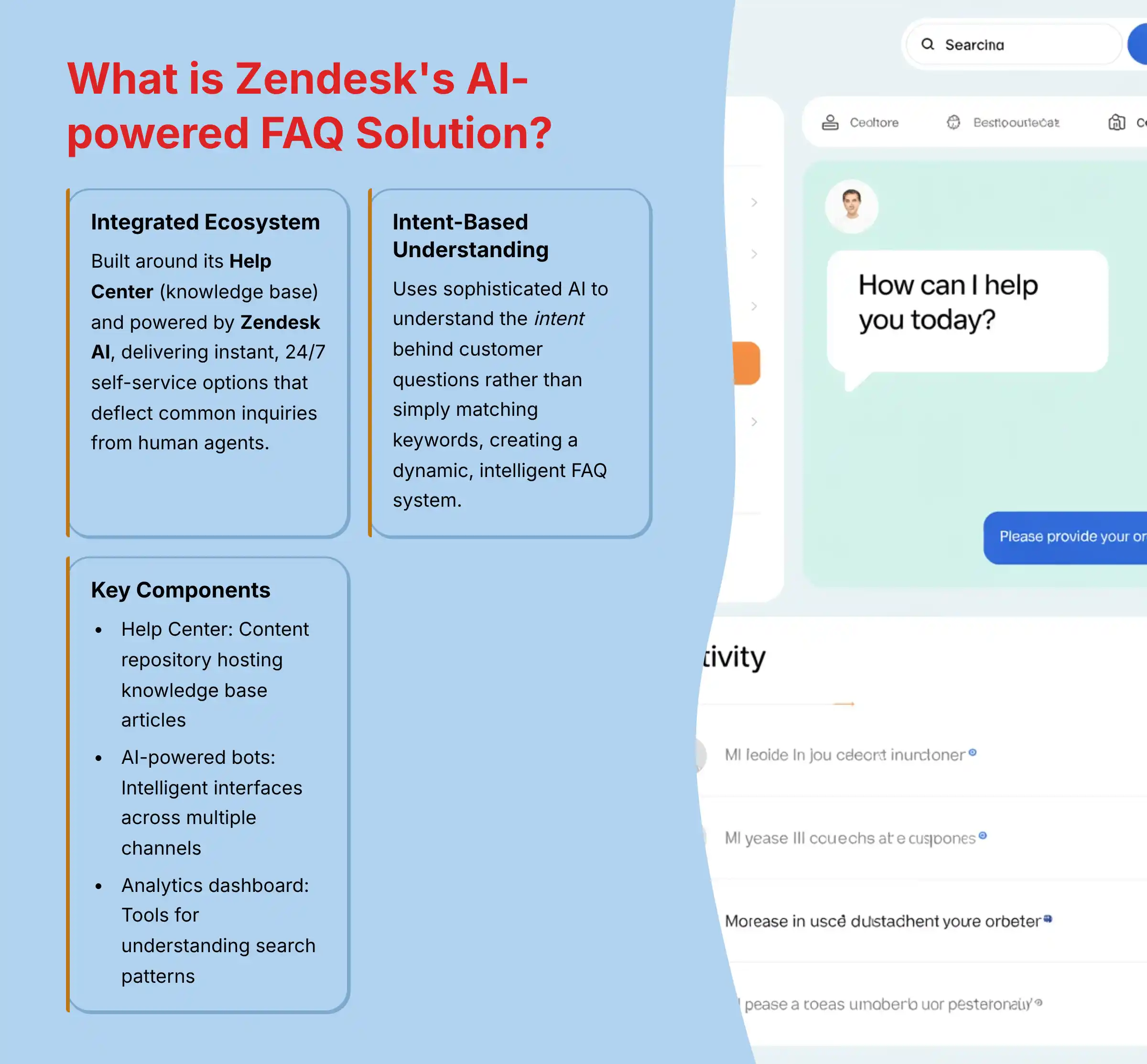
Zendesk’s AI-powered FAQ solution is an integrated ecosystem built around its Help Center (knowledge base) and powered by Zendesk AI.
This system delivers instant, 24/7 self-service options that deflect common inquiries from human agents while maintaining high-quality customer experiences.
The technology uses sophisticated AI to understand the intent behind customer questions rather than simply matching keywords.
When a customer enters a query into a chat widget or search bar, the AI analyzes the entire Help Center to identify and suggest the most relevant articles, creating a dynamic, intelligent FAQ system that proactively resolves issues.
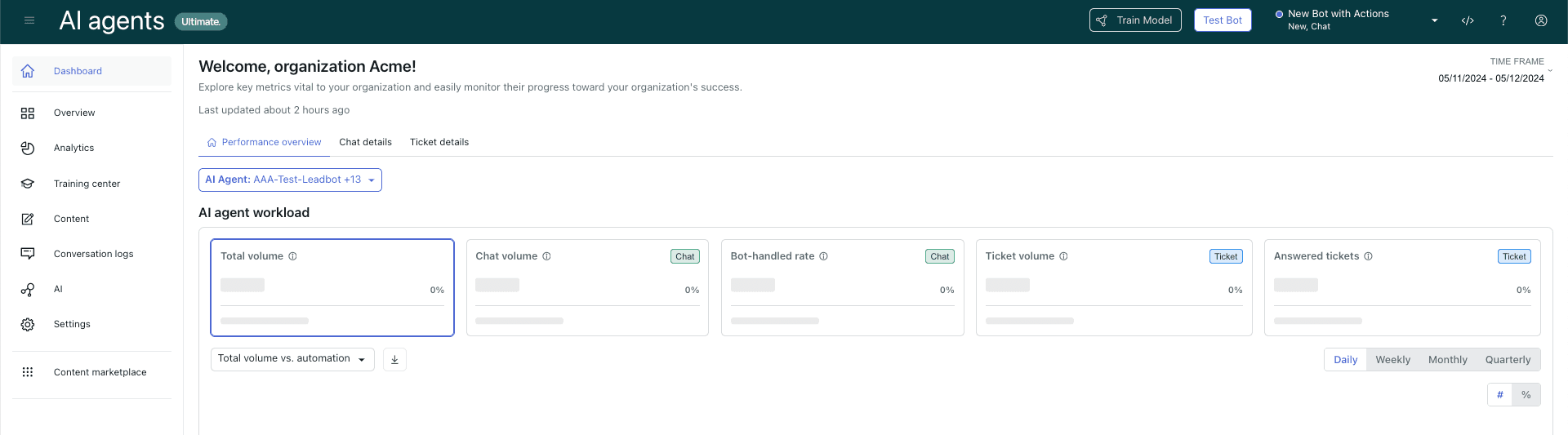
Key components include:
- Help Center: The content repository hosting your knowledge base articles
- AI-powered bots: Intelligent interfaces delivering answers across multiple channels (web, mobile, social messaging)
- Analytics dashboard: Tools for understanding customer search patterns and identifying knowledge gaps
Zendesk’s AI solution supports the dual goals of enhancing customer experience through immediate answers while simultaneously reducing operational costs for support teams.
The system can be deployed across multiple touchpoints in the customer journey, creating a consistent self-service experience regardless of how customers choose to engage with your brand.
For those seeking comprehensive Zendesk Overview and Features, this AI-powered approach represents a fundamental shift from traditional support models.
How does Zendesk AI improve a traditional knowledge base?
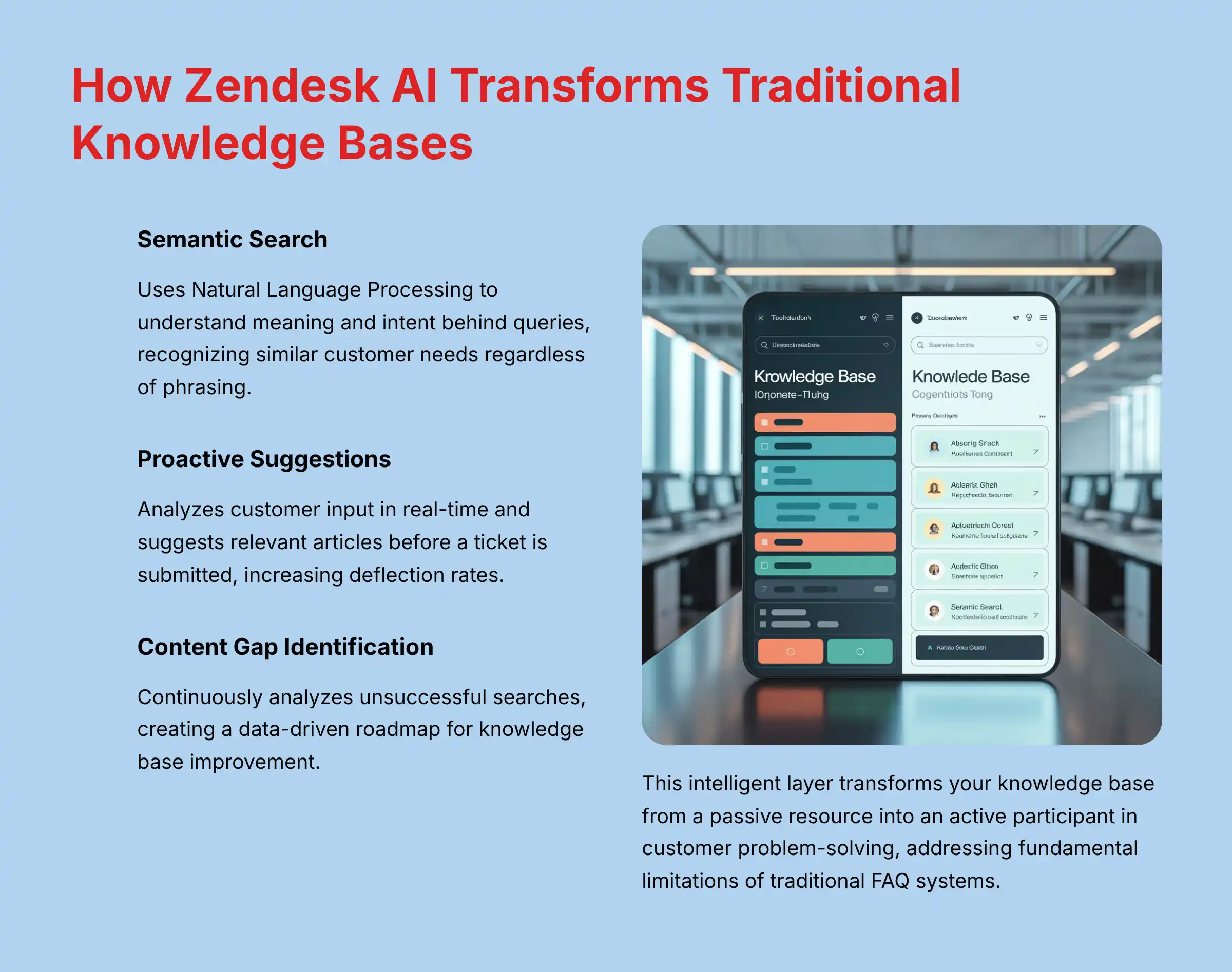
Zendesk AI transforms a static knowledge base into a dynamic, intelligent self-service engine.
While traditional knowledge bases rely on exact keyword matching and manual navigation, Zendesk AI creates a fundamentally different experience through several advanced capabilities:
- Semantic Search: The AI uses Natural Language Processing (NLP) to understand the meaning and intent behind queries. It recognizes that “my delivery hasn’t arrived,” “where is my package?” and “tracking for my order” all express the same customer need, surfacing the correct article regardless of phrasing.
- Proactive Suggestions: When integrated into contact forms and chat widgets, Zendesk AI analyzes customer input in real-time and suggests relevant articles before a ticket is even submitted, significantly increasing ticket deflection rates.
- Content Gap Identification: The system continuously analyzes unsuccessful searches and queries that didn’t yield helpful results, creating a data-driven roadmap for knowledge base improvement.
- Agent Assistance: Within the agent workspace, AI suggests relevant articles during live conversations, ensuring consistent and accurate information delivery while reducing handle time.
- Personalized Responses: The AI can tailor responses based on customer attributes, interaction history, and context, making self-service feel more personalized and relevant.
This intelligent layer transforms your knowledge base from a passive resource into an active participant in customer problem-solving, addressing the fundamental limitations of traditional FAQ systems.
Organizations evaluating this transformation should explore detailed Zendesk Tutorials and Usecase examples to understand implementation best practices.
Who is the ideal user for Zendesk’s AI self-service tools?
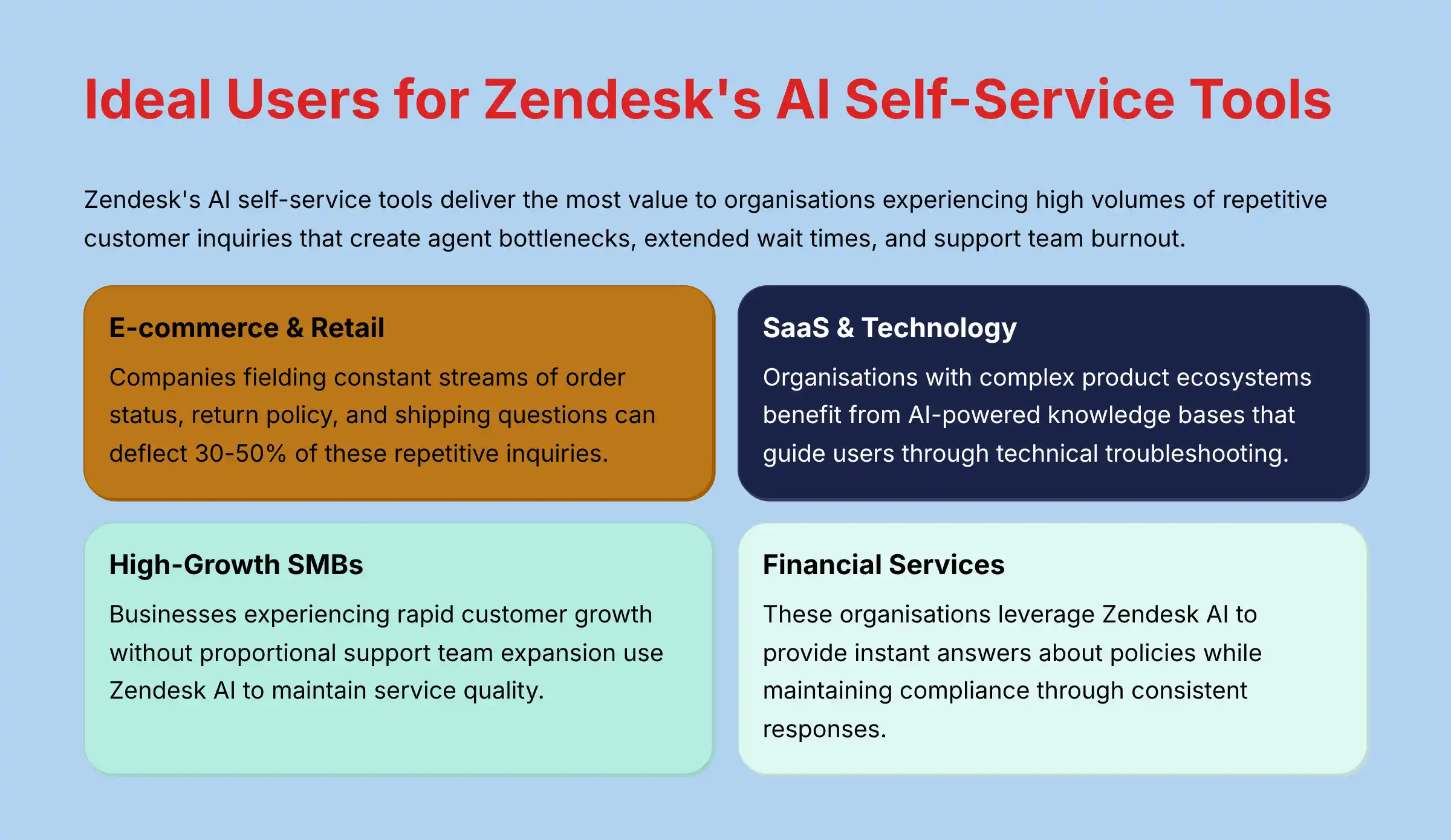
Zendesk’s AI self-service tools deliver the most value to organizations experiencing high volumes of repetitive customer inquiries that create agent bottlenecks, extended wait times, and support team burnout.
While the platform scales effectively for enterprise deployments, several business profiles see particularly strong ROI:
- E-commerce & Retail Businesses: Companies fielding constant streams of order status, return policy, and shipping questions can deflect 30-50% of these repetitive inquiries, allowing agents to focus on complex issues like personalized product recommendations or high-value order issues.
- SaaS & Technology Companies: Organizations with complex product ecosystems benefit from AI-powered knowledge bases that guide users through technical troubleshooting, feature documentation, and onboarding sequences, reducing dependency on tiered support models.
- High-Growth SMBs and Mid-Market Companies: Businesses experiencing rapid customer growth without proportional support team expansion use Zendesk AI to maintain service quality during scaling phases. The 24/7 availability prevents support backlogs during peak periods without requiring round-the-clock staffing.
- Financial Services & Insurance Providers: These organizations leverage Zendesk AI to provide instant answers about policies, account status, and procedural questions while maintaining compliance through consistent, approved responses.
The clearest indicator that your organization would benefit from Zendesk’s AI tools is if your support team spends more than 30% of their time answering the same core set of questions.
This repetition signals an opportunity to automate while elevating your human agents to handle more complex, nuanced customer needs.
Before making implementation decisions, organizations should conduct a thorough Zendesk Review to validate alignment with their specific use cases and operational requirements.
How does Zendesk handle multilingual AI support for a global knowledge base?
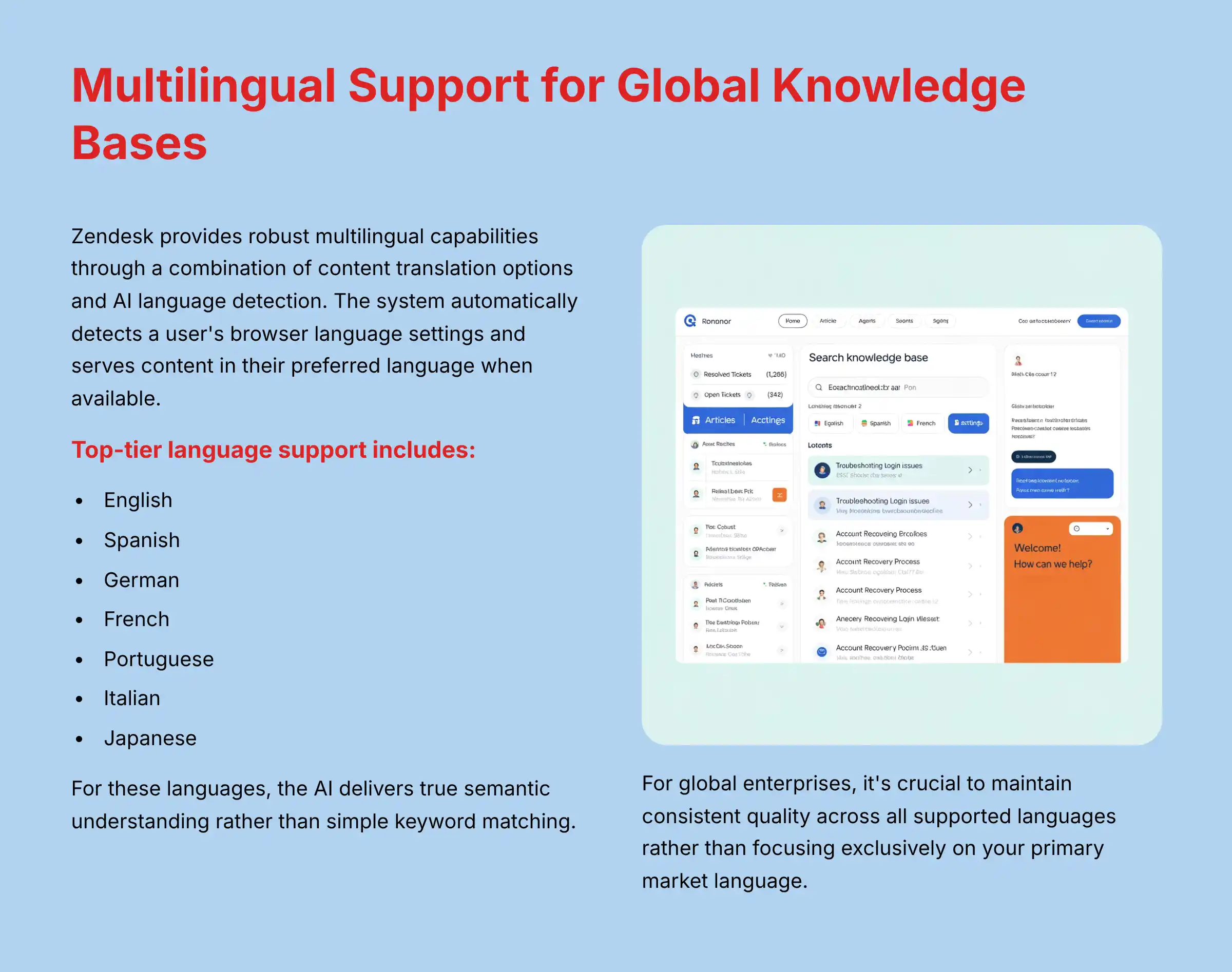
Zendesk provides robust multilingual capabilities for global knowledge bases through a combination of content translation options and AI language detection.
The system automatically detects a user’s browser language settings and serves content in their preferred language when available.

For optimal multilingual support implementation:
- Content Translation: Zendesk allows you to create multiple language versions of each Help Center article. While machine translation is available, high-quality human translation is recommended for technical or nuanced content to maintain accuracy.
- Language Detection: The AI automatically identifies the customer’s language preference and surfaces content accordingly without requiring manual language selection.
- Language-Specific AI Understanding: Zendesk AI supports over 40 languages, but performance varies by language. Top-tier language support includes English, Spanish, German, French, Portuguese, Italian, and Japanese, where the AI delivers true semantic understanding. For less common languages, the system may rely more heavily on keyword matching rather than deep intent comprehension.
- Regional Variations: The system can be configured to account for regional language variations (e.g., European Spanish vs. Latin American Spanish) when relevant to your customer base.
- Fallback Mechanisms: When content isn’t available in a customer’s preferred language, the system can be configured to offer content in a secondary language or provide clear escalation paths to human agents with appropriate language skills.
For global enterprises, it’s crucial to maintain consistent quality across all supported languages rather than focusing exclusively on your primary market language.
The effectiveness of your multilingual AI deployment directly correlates with the quality and comprehensiveness of your translated content.
What are the limitations of Zendesk’s AI for complex customer issues?
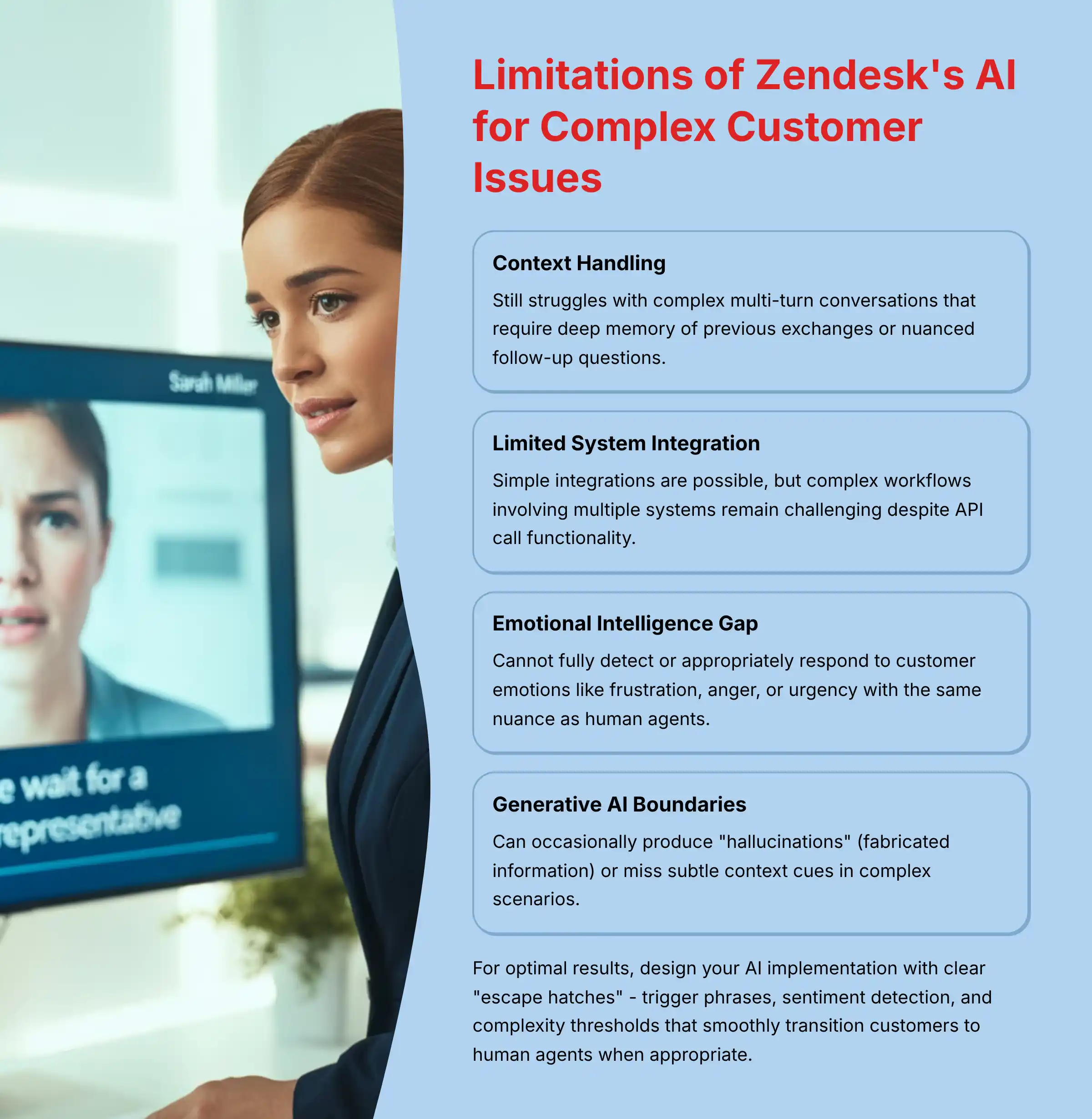
Despite significant advances in Zendesk’s AI capabilities, important limitations exist when handling complex customer scenarios.
Understanding these boundaries is essential for setting realistic expectations and designing effective escalation paths:
Key Limitations:
- Context Handling: While Zendesk AI has improved its ability to maintain conversation context, it still struggles with complex multi-turn conversations that require deep memory of previous exchanges or nuanced follow-up questions.
- Limited System Integration: Although Zendesk’s bot builder includes API call functionality, connecting to multiple backend systems for comprehensive data retrieval still requires significant development work. Simple integrations are possible, but complex workflows involving multiple systems remain challenging.
- Emotional Intelligence Gap: The AI cannot fully detect or appropriately respond to customer emotions like frustration, anger, or urgency with the same nuance as human agents. This limitation is particularly evident in highly emotional customer situations.
- Generative AI Boundaries: While Zendesk has incorporated generative AI capabilities for agent assistance (summarizing, expanding, and tone adjustment) and more conversational customer interactions, these features have limitations. The generative components can occasionally produce “hallucinations” (fabricated information) or miss subtle context cues in complex scenarios.
- Handling Exceptions: The AI struggles with edge cases and exceptions to standard policies that require human judgment or managerial approval.
For optimal results, design your AI implementation with clear “escape hatches” – trigger phrases, sentiment detection, and complexity thresholds that smoothly transition customers to human agents when appropriate.
The most successful implementations use AI as an intelligent triage system rather than attempting to automate every possible scenario.
Organizations considering alternatives should explore comprehensive Zendesk Top Alternatives and Competitors to understand how different platforms handle complex scenarios.
How does Zendesk integrate with CRMs like Salesforce or e-commerce platforms like Shopify?
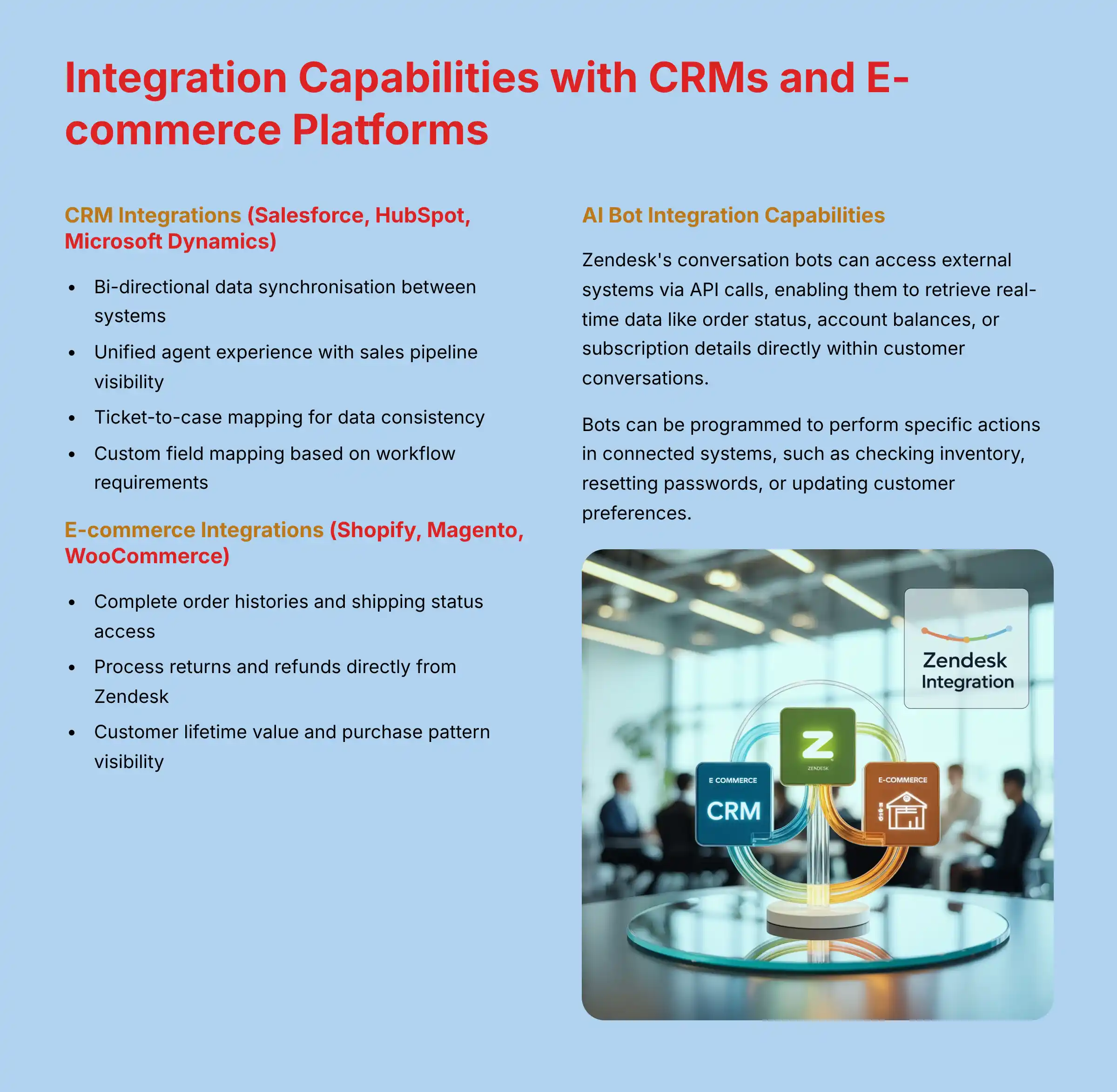
Zendesk offers comprehensive integration capabilities with major CRM and e-commerce platforms, creating a unified customer data ecosystem.
These integrations operate at multiple levels:
CRM Integrations (Salesforce, HubSpot, Microsoft Dynamics):
- Bi-directional Data Synchronization: Customer profiles, interaction history, and case data flow seamlessly between systems, creating a complete customer view.
- Unified Agent Experience: Support agents can access sales pipeline information, opportunity status, and customer value metrics directly within the Zendesk interface.
- Ticket-to-Case Mapping: Zendesk tickets can automatically create or update corresponding CRM cases, maintaining data consistency across platforms.
- Custom Field Mapping: Organizations can configure which data points synchronize between systems based on their specific workflow requirements.
E-commerce Integrations (Shopify, Magento, WooCommerce):
- Order Data Access: Agents can view complete order histories, shipping status, and product details within their Zendesk workspace.
- Action Capabilities: Support teams can process returns, initiate refunds, or modify orders directly from Zendesk without switching platforms.
- Customer Purchase Context: The integration provides visibility into customer lifetime value, purchase patterns, and product preferences to inform support interactions.
AI Bot Integration Capabilities:
- Zendesk’s conversation bots can now access external systems via API calls, enabling them to retrieve real-time data like order status, account balances, or subscription details directly within customer conversations. This feature requires configuration but is supported through the bot builder’s “Make an API call” functionality.
- Bots can be programmed to perform specific actions in connected systems, such as checking inventory, resetting passwords, or updating customer preferences.
When evaluating integration needs, consider both current requirements and future scalability.
While pre-built integrations cover many common scenarios, complex enterprise environments may require additional customization through Zendesk’s API framework or middleware solutions.
What data and analytics does Zendesk provide to measure self-service ROI?
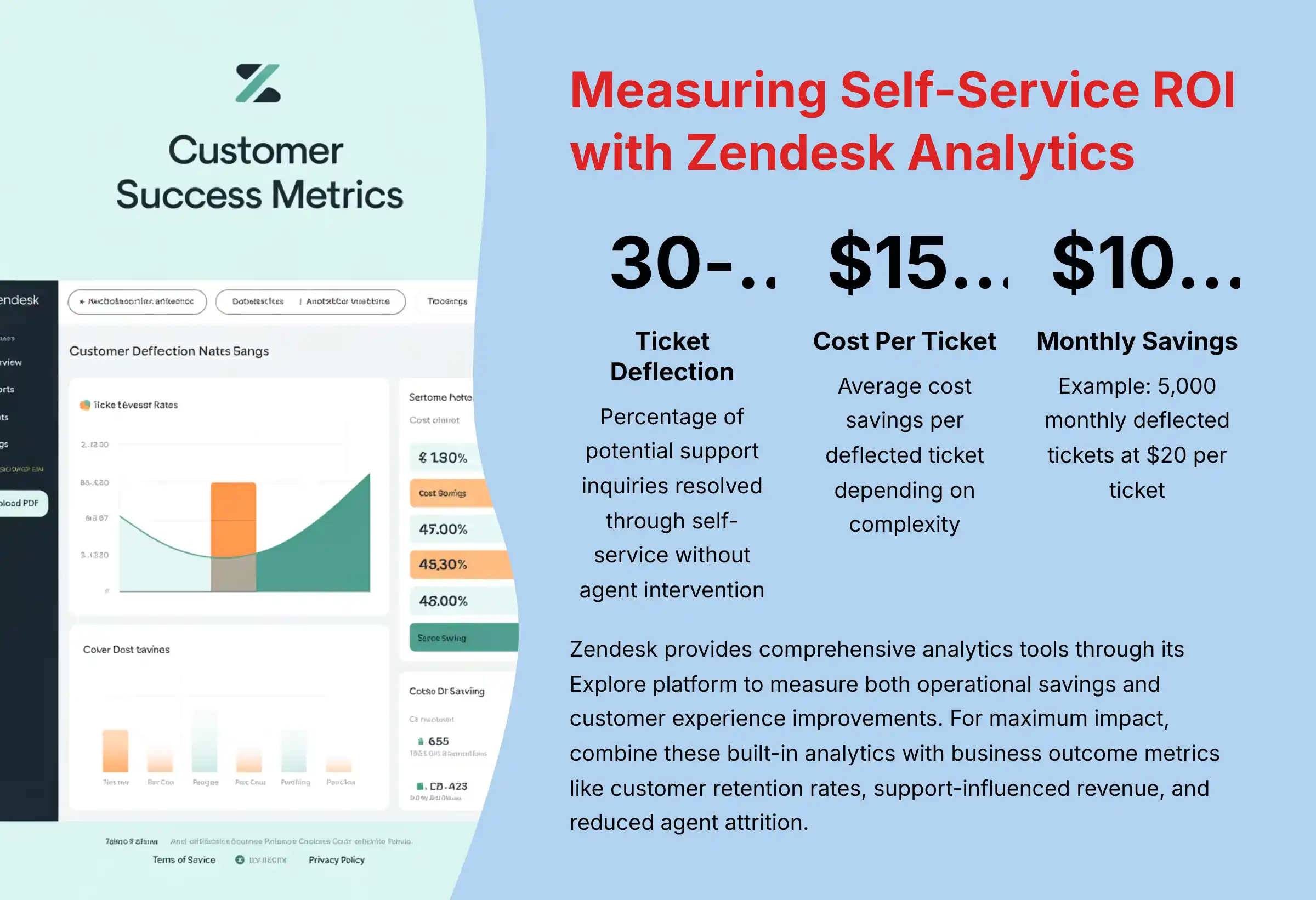
Zendesk provides comprehensive analytics tools to measure the performance and ROI of your self-service initiatives through its Explore analytics platform.
These metrics help quantify both operational savings and customer experience improvements:
Core Performance Metrics:
- Ticket Deflection Rate: The percentage of potential support inquiries resolved through self-service without agent intervention. This is calculated by tracking when customers find an answer through the Help Center or bot and subsequently abandon ticket submission.
- Self-Service Resolution Rate: The ratio of successful AI-powered resolutions to total AI interactions, measuring how effectively your AI is answering customer questions.
- Content Effectiveness: Detailed analytics on which knowledge base articles generate the highest engagement, resolution rates, and positive feedback, helping you identify your most valuable content.
- Search Analytics: Insights into what customers are searching for, including failed searches that yield no results, abandoned searches, and search terms that lead to successful resolutions.
- Customer Effort Score (CES): Measurement of how easy customers find the self-service experience, a critical indicator of satisfaction beyond mere deflection.
ROI Calculation Components:
- Cost Savings: Calculate direct cost avoidance by multiplying deflected tickets by your average cost-per-ticket (typically $15-40 depending on complexity). For example, 5,000 monthly deflected tickets at $20 per ticket represents $100,000 monthly operational savings.
- Time-to-Resolution Impact: Analytics showing how self-service affects overall resolution time compared to traditional support channels.
- Agent Productivity: Metrics illustrating how AI assistance affects agent handle time and first-contact resolution rates.
- CSAT Correlation: Data connecting self-service usage to customer satisfaction scores, demonstrating that effective self-service isn’t just cheaper—it often delivers higher satisfaction through immediate resolution.
For maximum impact, combine these built-in analytics with business outcome metrics like customer retention rates, support-influenced revenue, and reduced agent attrition to build a comprehensive ROI story that resonates with executive stakeholders.
How is Zendesk’s AI priced? Is it included in all plans?
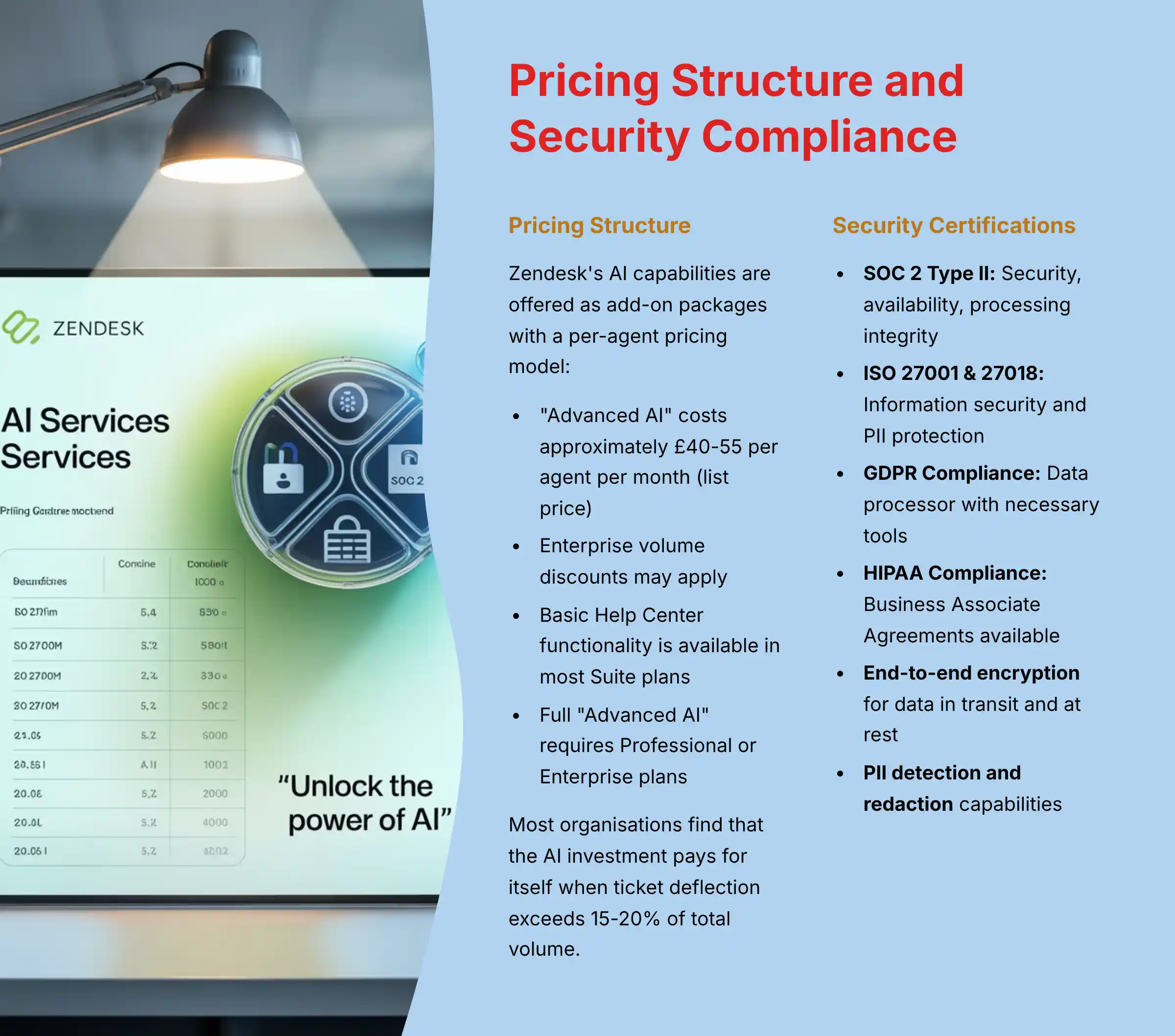
Zendesk’s AI capabilities are not included in standard subscription plans but are offered as add-on packages with a per-agent pricing model.
Understanding this structure is crucial for accurate budgeting and ROI calculations:
Core Pricing Structure:
- The primary AI offering, “Advanced AI,” is priced as a per-agent, per-month add-on to your Zendesk Suite subscription.
- As of 2025, this typically costs approximately $50-70 per agent per month (list price), though enterprise volume discounts may apply.
- This flat-fee model has replaced the legacy “per resolution” pricing structure previously used with the older Answer Bot product.
What’s Included in Different Plans:
- Basic Help Center functionality is available in most Suite plans, but without AI capabilities
- Entry-level Suite plans (Team, Growth) offer limited self-service options without advanced AI
- Professional and Enterprise plans are eligible for the full “Advanced AI” add-on package
Total Cost Considerations:
When calculating the total investment required, factor in:
- Your base Zendesk Suite subscription cost
- The per-agent monthly cost for Advanced AI multiplied by your total agent count
- Potential professional services fees for implementation and optimization
- Any additional third-party integrations or custom development needed
Deployment Recommendation:
For organizations new to Zendesk AI, consider a phased approach:
- Begin with a focused pilot using Zendesk’s trial period (typically 14-30 days)
- Measure initial deflection rates and calculate projected ROI
- Expand implementation after validating the business case
Most organizations find that the AI investment pays for itself when ticket deflection exceeds 15-20% of total volume, but this threshold varies based on your specific agent costs and ticket complexity.
Always request a current quote directly from Zendesk, as pricing structures may evolve over time.
What kind of security and compliance certifications does Zendesk hold? (GDPR, SOC 2)
Zendesk maintains an extensive portfolio of security certifications and compliance attestations, making it suitable for organizations with strict regulatory requirements across various industries:
Core Security Certifications:
- SOC 2 Type II: Zendesk undergoes regular SOC 2 Type II audits, verifying controls for security, availability, processing integrity, confidentiality, and privacy. This certification is considered essential for enterprise SaaS providers.
- ISO 27001 & ISO 27018: These international standards verify Zendesk’s information security management system (ISMS) and approach to protecting personally identifiable information (PII) in public clouds.
- ISO 27701: This certification specifically addresses privacy information management, demonstrating Zendesk’s compliance with global privacy standards.
- CSA STAR Level 2: Zendesk is certified under the Cloud Security Alliance’s Security, Trust & Assurance Registry program, validating cloud security controls.
Regulatory Compliance Frameworks:
- GDPR Compliance: Zendesk functions as a data processor under GDPR and provides necessary tools and contractual frameworks (Data Processing Agreements) to support customer compliance obligations, including data subject access requests, data portability, and the right to erasure.
- CCPA/CPRA Compliance: Zendesk offers mechanisms to help customers meet California privacy law requirements.
- HIPAA Compliance: For healthcare organizations, Zendesk can execute Business Associate Agreements (BAAs) and provides controls necessary for HIPAA compliance.
- FedRAMP (Moderate): For U.S. government agencies and contractors, Zendesk maintains Federal Risk and Authorization Management Program certification.
AI-Specific Security Considerations:
- Zendesk implements data minimization principles in its AI training and operation
- Customer data used for AI improvement can be limited through configuration options
- Privacy-preserving techniques are employed for sensitive data handling in AI workflows
Key Security Features:
- End-to-end encryption for data in transit and at rest
- Automatic PII detection and redaction capabilities
- Granular role-based access controls
- Comprehensive audit logging and monitoring
- Two-factor authentication and single sign-on options
Organizations in highly regulated industries should review Zendesk’s latest security documentation and work with their compliance teams to ensure all specific regulatory requirements are addressed in their implementation.
What level of customer support and implementation help can I expect from Zendesk?
Zendesk’s support and implementation assistance varies significantly based on your subscription plan, with progressive enhancements as you move up the pricing tiers:
Support Levels by Plan Tier:
Entry-Level Plans (Suite Team, Growth):
- Standard email support with response times typically within 24-48 hours
- Access to comprehensive self-service resources including knowledge base and community forums
- Basic onboarding guides and setup documentation
- Limited live training options
Mid-Tier Plans (Suite Professional):
- Enhanced support with improved response times (8-24 hours)
- 24/7 email and chat support for critical issues
- Access to guided onboarding webinars and setup assistance
- Regular group training sessions and implementation workshops
Enterprise Plans:
- Premium support with rapid response SLAs (as fast as 1-hour for critical issues)
- Dedicated customer success manager for accounts above certain thresholds
- Proactive monitoring and health checks
- Quarterly business reviews and optimization recommendations
Professional Services Options (Additional Cost):
For organizations requiring hands-on implementation assistance, Zendesk offers professional services packages:
- Implementation Services: Expert-led setup and configuration of your Zendesk instance, including workflow design, knowledge base structuring, and AI optimization
- Custom Development: Specialized assistance for complex integrations or customizations
- Training Programs: Comprehensive training for admins, agents, and knowledge base authors
- AI Optimization: Specialized consulting to maximize the effectiveness of your AI implementation
Implementation Partner Ecosystem:
Zendesk maintains a network of certified implementation partners who provide specialized expertise for complex deployments.
These partners often offer industry-specific knowledge and experience with similar organizations.
For organizations implementing Zendesk AI at scale, budgeting for professional services or partner assistance is strongly recommended.
While it represents an additional upfront investment, professional implementation significantly accelerates time-to-value, reduces internal resource requirements, and helps avoid common pitfalls that can undermine AI effectiveness.
The ROI on professional implementation is typically realized within 3-6 months through improved deflection rates and adoption.
Organizations seeking comprehensive guidance should explore detailed Zendesk FAQs resources for additional implementation insights and best practices.
How does Zendesk’s generative AI enhance customer and agent experiences?
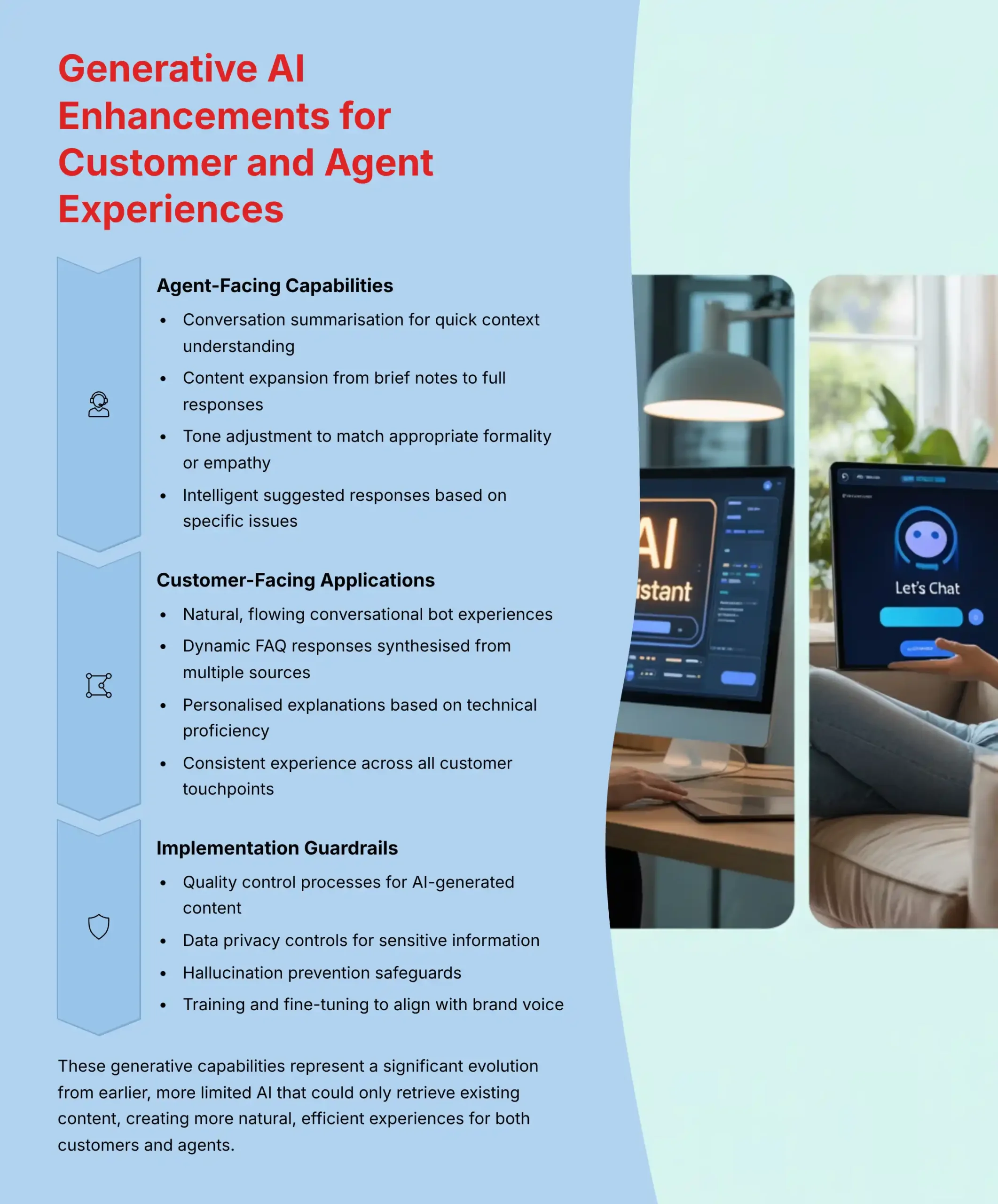
Zendesk has significantly expanded its AI capabilities by integrating generative AI technologies throughout its platform.
These features transform both the agent and customer experience in several key ways:
Agent-Facing Generative AI Capabilities:
- Conversation Summarization: Agents can instantly generate concise summaries of lengthy customer interactions, helping them quickly understand the context of ongoing or historical conversations without reading entire transcripts.
- Content Expansion: The system can transform brief agent notes or bullet points into fully-formed, professional responses. This allows agents to draft responses quickly and have the AI polish them for clarity and completeness.
- Tone Adjustment: Agents can modify the tone of their responses to match the appropriate level of formality, empathy, or technical detail based on the customer and situation.
- Intelligent Suggested Responses: Beyond simple template suggestions, the AI can generate contextually relevant responses based on the specific customer issue, drawing from both knowledge base content and conversation context.
- Draft Improvement: The AI can review agent-written responses and suggest improvements for clarity, completeness, and accuracy before sending.
Customer-Facing Generative AI Applications:
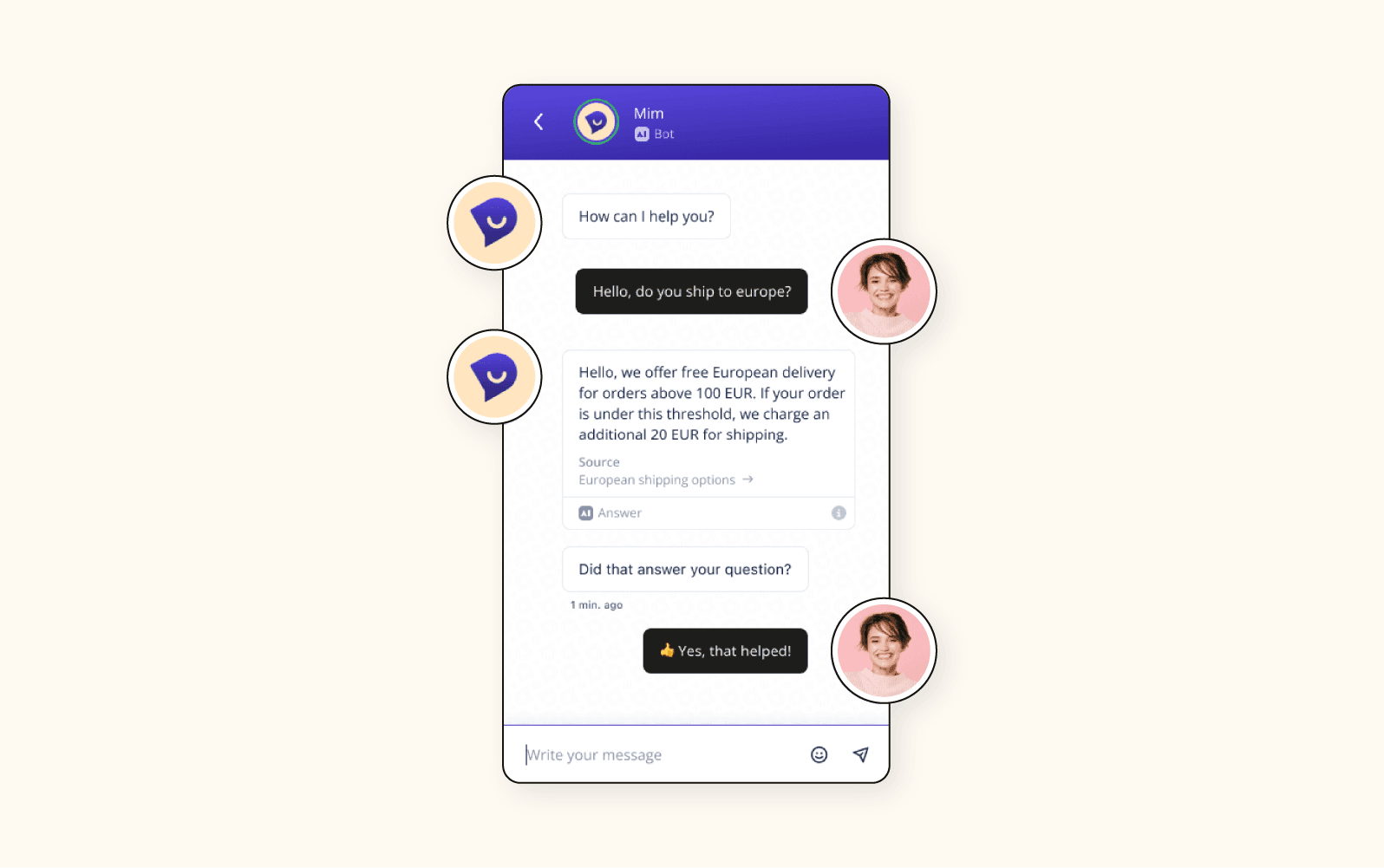
- Conversational Bot Experiences: Rather than rigid, scripted interactions, Zendesk’s bots can engage in more natural, flowing conversations that adapt to customer input variations and maintain context across multiple turns.
- Dynamic FAQ Responses: Instead of simply retrieving static articles, the AI can synthesize information from multiple knowledge sources to create tailored responses that directly address the specific nuances of a customer’s question.
- Personalized Explanations: The AI can adjust its explanation style and detail level based on the customer’s inferred technical proficiency and previous interactions.
Implementation Considerations and Guardrails:
- Quality Control: Organizations should implement review processes for AI-generated content, especially for sensitive or complex issues.
- Data Privacy: Zendesk provides controls to ensure PII and sensitive data isn’t used to train public AI models.
- Hallucination Prevention: The system includes safeguards to reduce the risk of AI “hallucinations” (generating false information), though human oversight remains important.
- Training and Fine-tuning: The AI can be improved over time through feedback loops and custom training to better align with your brand voice and domain-specific knowledge.
These generative capabilities represent a significant evolution from the earlier, more limited AI that could only retrieve existing content, creating more natural, efficient experiences for both customers and agents.
Organizations exploring comprehensive AI-powered customer support solutions should investigate Best 10 AI-Powered Customer Support platforms to understand the competitive landscape and evaluate which solution best fits their specific requirements.

Leave a Reply