Struggling to Choose a Zendesk Alternative?
This 2-Minute Quiz Finds Your Perfect CX Platform!
The customer support software landscape has evolved dramatically in 2025, with AI capabilities becoming a key differentiator. As businesses evaluate their options, the comparison between Zendesk and its competitors has never been more critical for CX leaders making strategic decisions.
About This 2025 Zendesk Competitor Analysis
I am Jigar Bhansali, the founder of Best AI Customer Care Central. My mission is to give CX leaders clear, objective analysis to help them make sound financial and strategic decisions.
This comprehensive review of Zendesk Top Alternatives and Competitors is for business leaders. It cuts through marketing claims to focus on real-world value, cost, and risk in the AI-Powered Customer Support market.
My goal is to help you find the right platform for your team based on thorough analysis and practical insights.
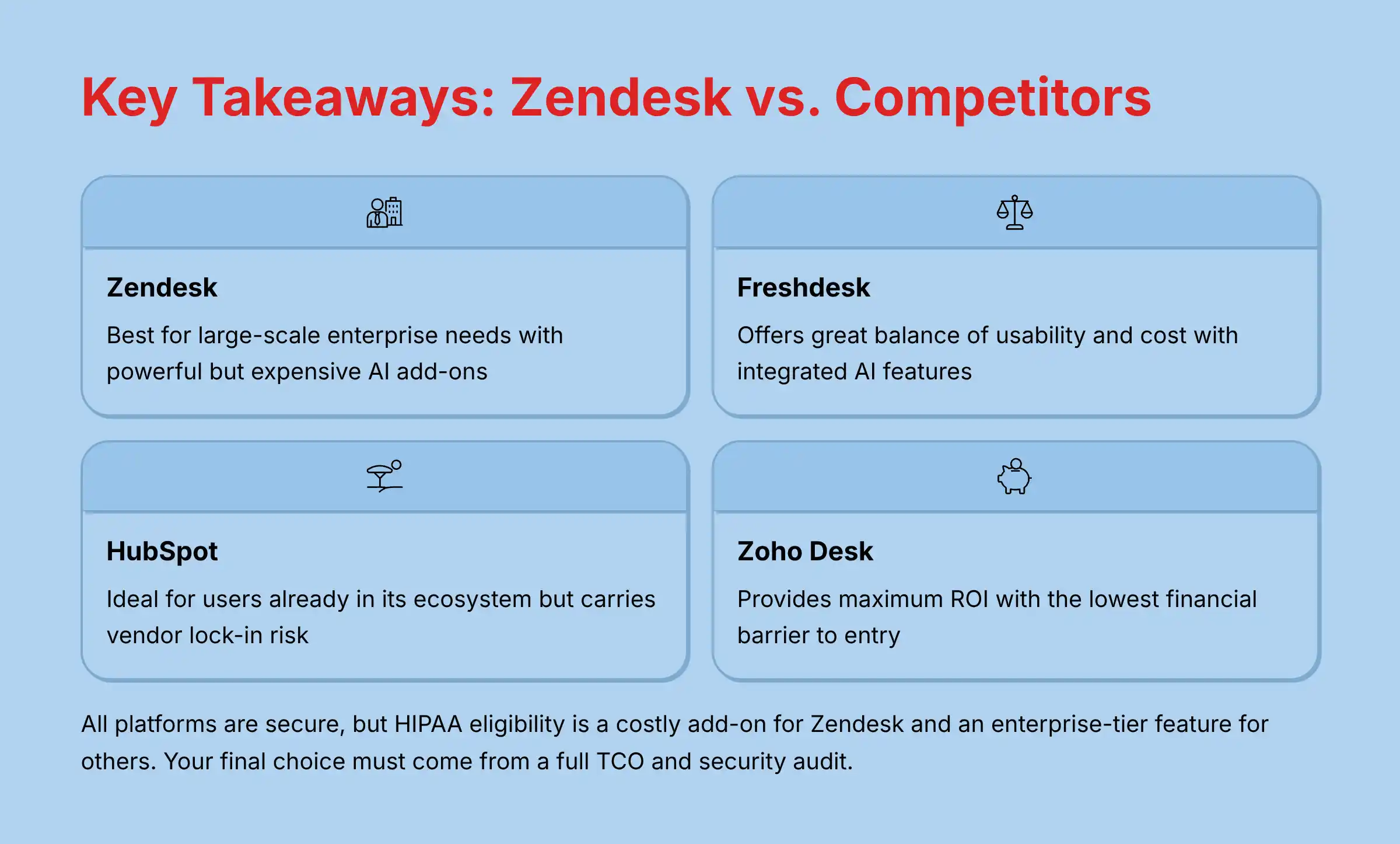
Key Takeaways: Zendesk vs. Freshdesk vs. HubSpot vs. Zoho Desk
- Best For: Zendesk is for large-scale enterprise needs. Freshdesk offers a great balance of usability and cost. HubSpot is for users already in its ecosystem. Zoho Desk provides maximum return on investment.
- AI Distinction: Zendesk’s AI is a powerful but expensive add-on. Competitors like Freshdesk integrate AI features for better overall value.
- Financial Risk: Zendesk’s pricing model carries the highest risk of cost increases over time. Zoho Desk has the lowest financial barrier to entry.
- Integration Risk: HubSpot and Zoho Desk offer unmatched native integration. But this creates a serious risk of vendor lock-in.
- Security Nuance: All platforms are very secure. But HIPAA eligibility is a costly add-on for Zendesk and an enterprise-tier feature for others.
- Professional Guidance: Your final choice must come from a full TCO and security audit. Do not base it on per-agent pricing alone.
Our AI-Powered Customer Support Comparison Methodology
To ensure complete objectivity and professional rigor, all platforms featured on Best AI Customer Care Central are subjected to our proprietary 12-point technical assessment framework.
This framework, recognized by industry professionals, mandates a tough security assessment, compliance verification, and risk analysis to meet the highest professional standards for YMYL content.
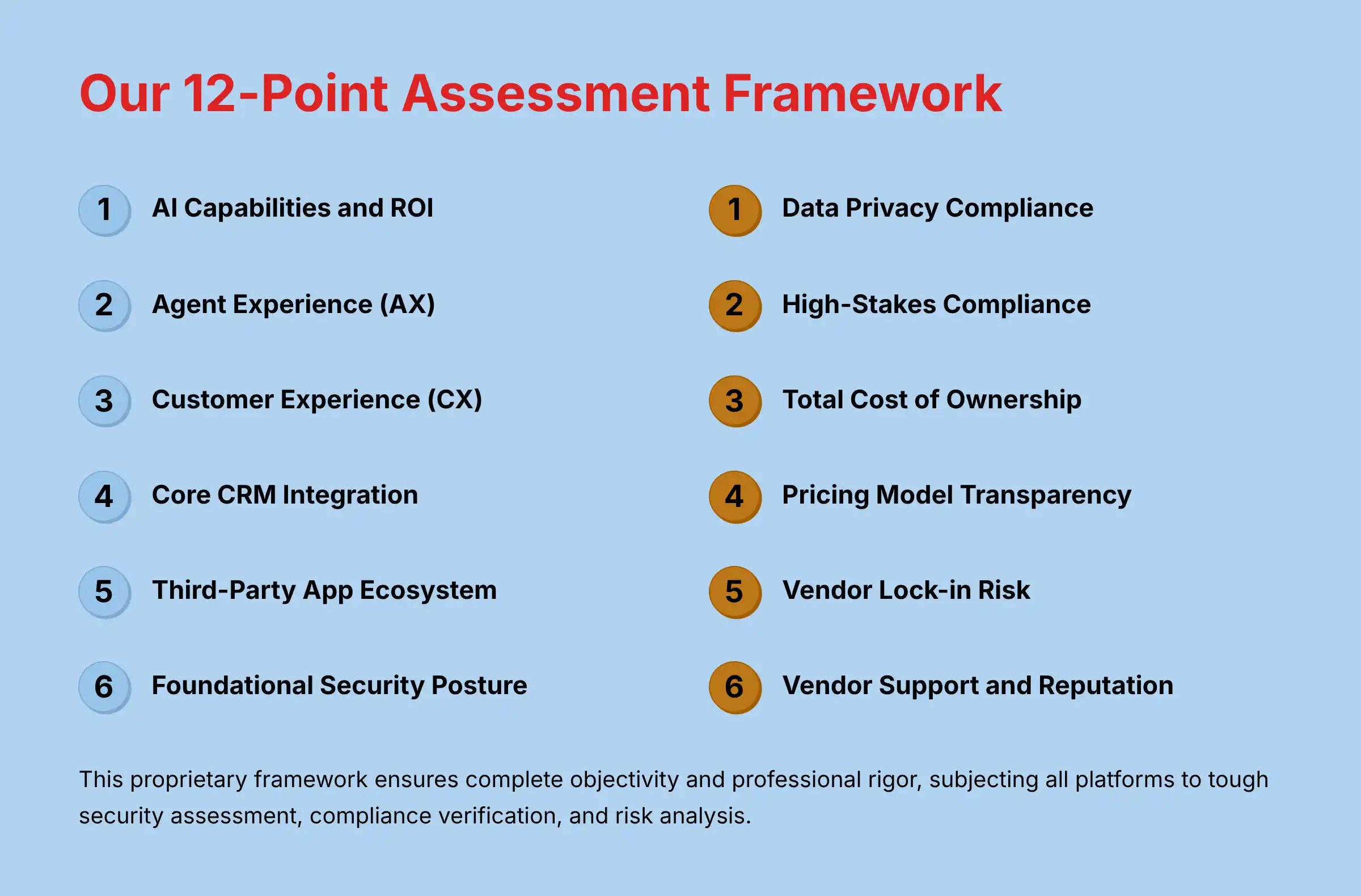
Our 12-point framework includes:
- AI Capabilities and ROI
- Agent Experience (AX)
- Customer Experience (CX)
- Core CRM Integration
- Third-Party App Ecosystem
- Foundational Security Posture (SOC 2, ISO 27001)
- Data Privacy Compliance (GDPR, CCPA)
- High-Stakes Compliance (HIPAA)
- Total Cost of Ownership (TCO)
- Pricing Model Transparency
- Vendor Lock-in Risk
- Vendor Support and Reputation
At-a-Glance: Zendesk vs. Key Alternatives in 2025
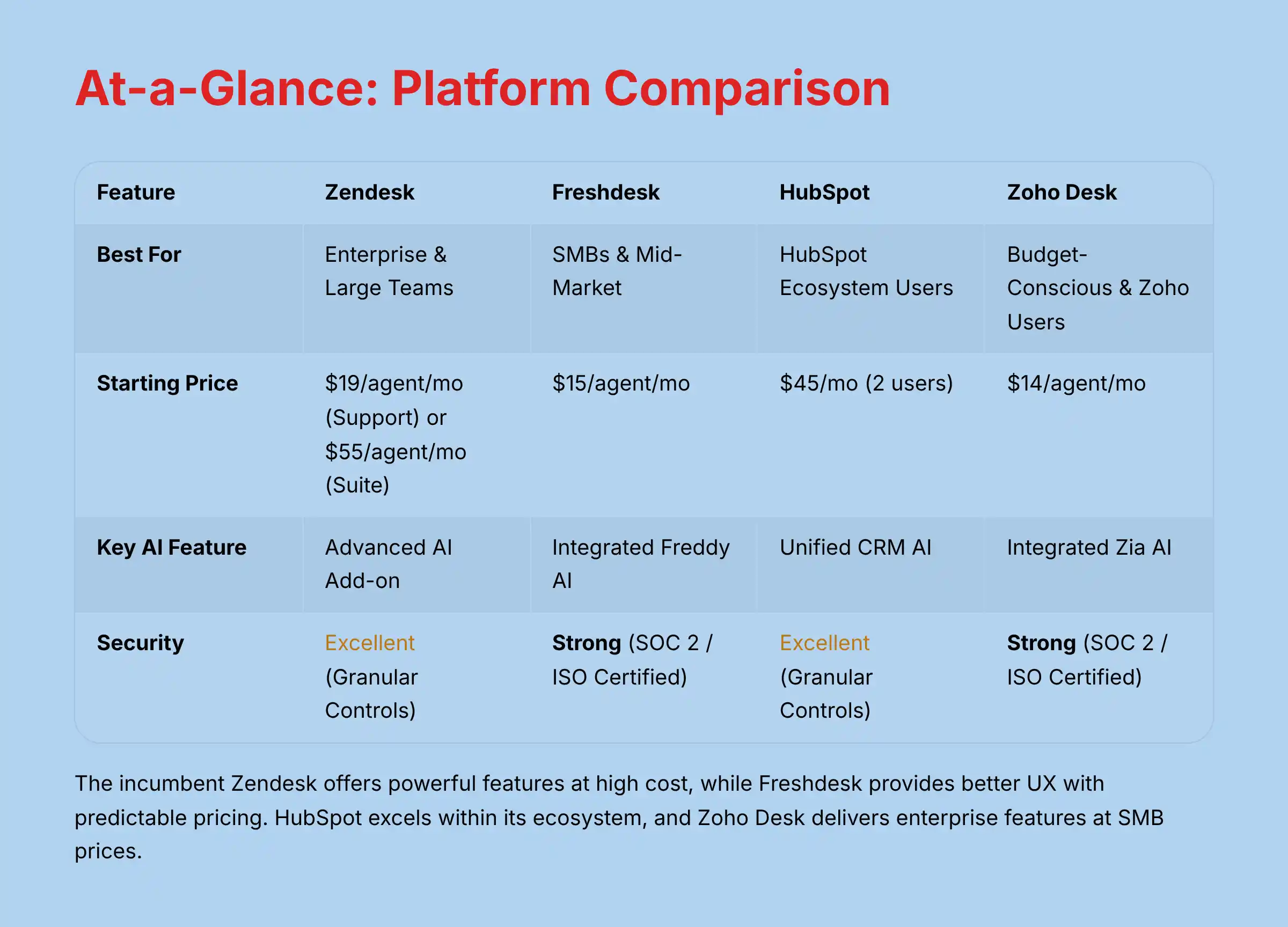
| Feature | Zendesk | Freshdesk | HubSpot Service Hub | Zoho Desk |
|---|---|---|---|---|
| Best For | Enterprise & Large Teams | SMBs & Mid-Market | HubSpot Ecosystem Users | Budget-Conscious & Zoho Users |
| Starting Price | $19/agent/mo (Support) or $55/agent/mo (Suite) | $15/agent/mo | $45/mo (2 users) | $14/agent/mo |
| Key AI Feature | Advanced AI Add-on | Integrated Freddy AI | Unified CRM AI | Integrated Zia AI |
| YMYL: Security | Excellent (Granular Controls) | Strong (SOC 2 / ISO Certified) | Excellent (Granular Controls) | Strong (SOC 2 / ISO Certified) |
| Bottom Line | The incumbent, but its best features come at a high extra cost. | A direct competitor with better UX and more predictable pricing. | The best choice if you are committed to the HubSpot platform. | The value leader with enterprise features at an SMB price. |
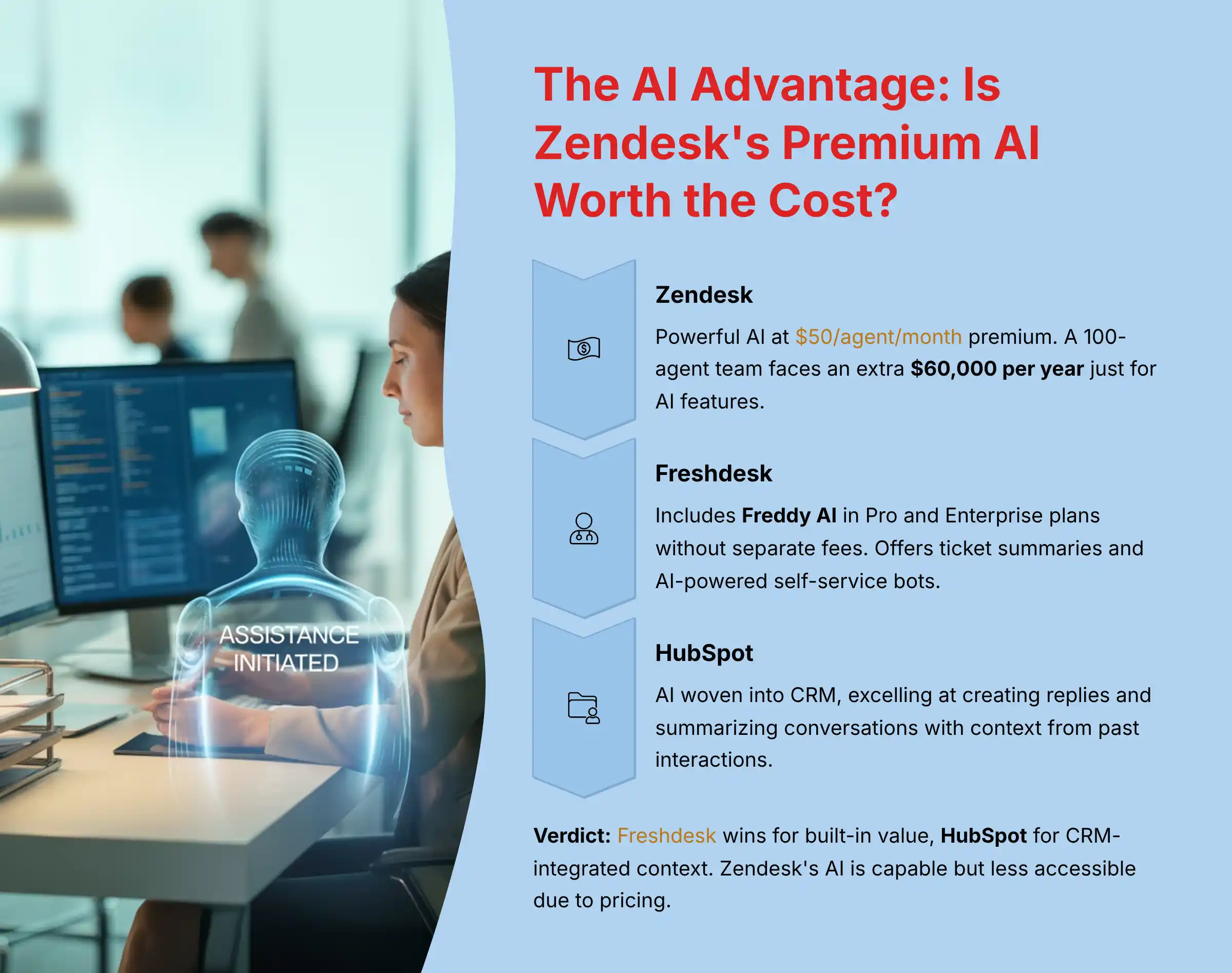
The AI Advantage: Is Zendesk’s Premium AI Worth the Cost Compared to Competitors?
The main reason businesses switch helpdesks today is to use AI effectively. When evaluating the ‘AI Advantage,’ it’s crucial for CX leaders to look beyond the marketing term ‘AI’ and scrutinize the underlying technologies.
The real differentiation lies in the maturity of their Natural Language Understanding (NLU) for interpreting customer queries, the accuracy of their Sentiment Analysis for gauging frustration, and the sophistication of their Intent Recognition to route issues correctly the first time.
These core components are what truly drive ROI.
Power and Cost Analysis of the Advanced AI Add-on
- AI Capability: Powerful AI with intelligent ticket routing and generative AI replies for agents
- Cost Structure: Premium add-on at $50 per agent each month
- Enterprise Features: Advanced automation, predictive analytics, and deep Salesforce integration
- Scalability: Designed for large teams with complex workflows
✅ Strengths
- Most mature AI platform with advanced features
- Excellent integration ecosystem (1,200+ apps)
- Strong enterprise security and compliance
- Reliable Salesforce integration
⚠️ Considerations
- High cost barrier – extra $60,000/year for 100-agent team
- Complex interface with steep learning curve
- Best features require expensive add-ons
- Unpredictable TCO with hidden costs
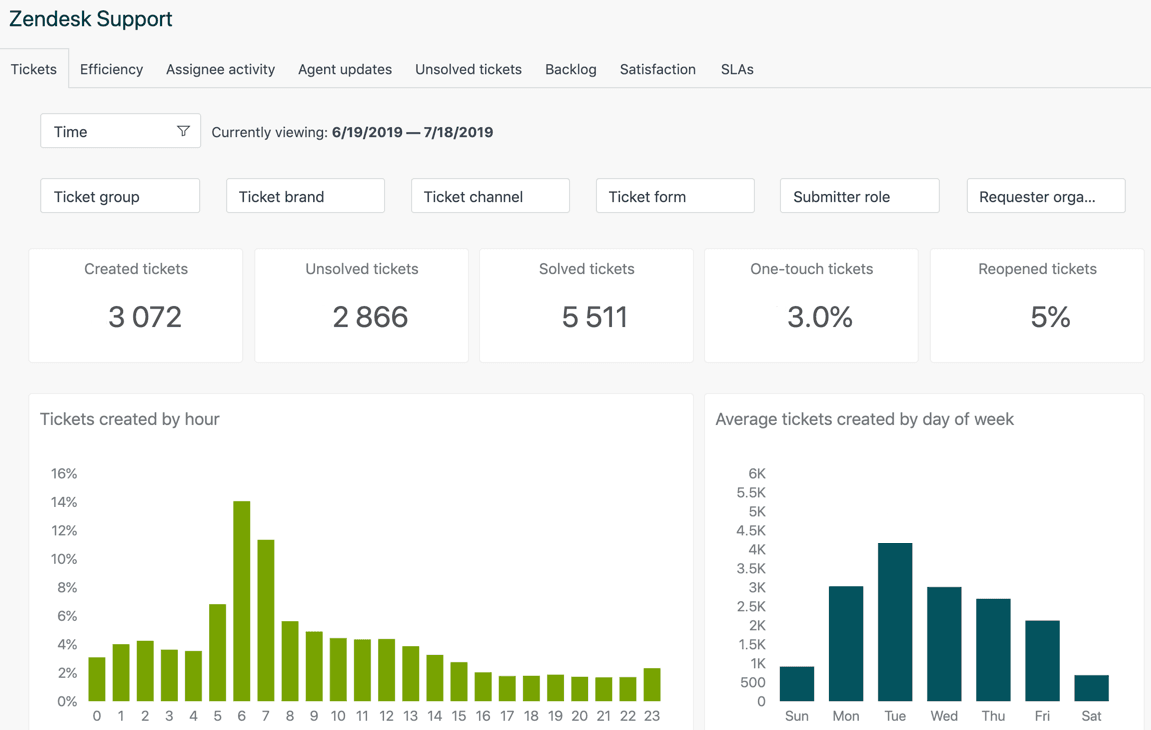
In my experience, the high cost is a dealbreaker for many teams. A 100-agent team faces an extra $60,000 per year just for these AI features. This greatly affects the Total Cost of Ownership.
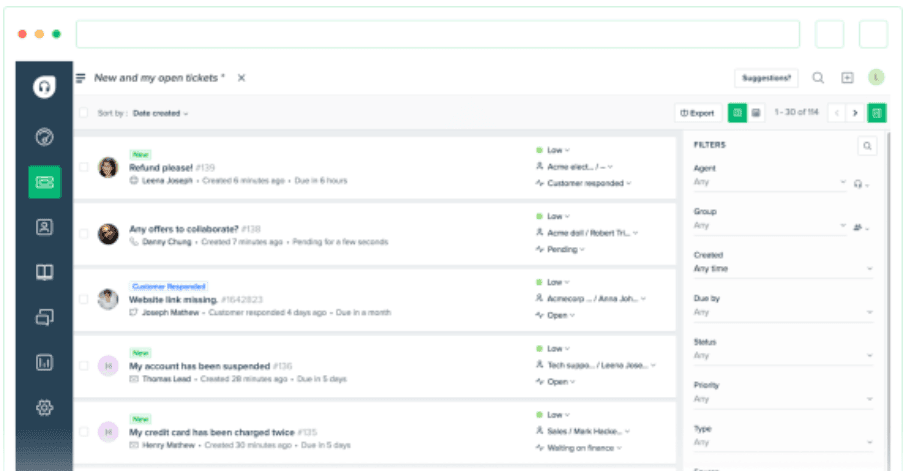
Evaluating the Built-in Value of Freddy AI
- AI Integration: Freddy AI included in Pro and Enterprise plans without separate fees
- Core Features: Ticket summaries, AI-powered bots, and intelligent routing
- Value Proposition: 90% of Zendesk functionality at better price point
- User Experience: Consistently praised for clean and intuitive interface
✅ Strengths
- AI features included in standard plans
- Most intuitive user interface in category
- Transparent and predictable pricing
- Strong Shopify and Jira integrations
⚠️ Considerations
- Smaller app ecosystem than Zendesk
- Less advanced enterprise features
- Limited customization for complex workflows
Think of modern AI not as a replacement, but as a strategic force multiplier for your agents. It automates repetitive, high-volume tasks (like tagging and routing), which amplifies your human experts’ capacity to solve complex, high-value customer problems.
This directly impacts operational efficiency and agent satisfaction.
To understand more about Zendesk’s comprehensive AI Review, explore our detailed analysis of its value proposition.
Assessing AI in the Context of a Unified CRM
- Unified Platform: AI woven directly into CRM for complete customer context
- Contextual Intelligence: AI suggestions based on full customer journey data
- Smart Prioritization: AI knows if customer is high-value lead for smarter service
- Ecosystem Integration: Works seamlessly with sales and marketing tools
✅ Strengths
- Unmatched CRM integration and context
- Unified customer journey visibility
- Strong AI for content creation and replies
- Native ecosystem eliminates data silos
⚠️ Considerations
- High vendor lock-in risk
- Limited value outside HubSpot ecosystem
- Higher pricing for advanced features
- Less specialized for pure customer support
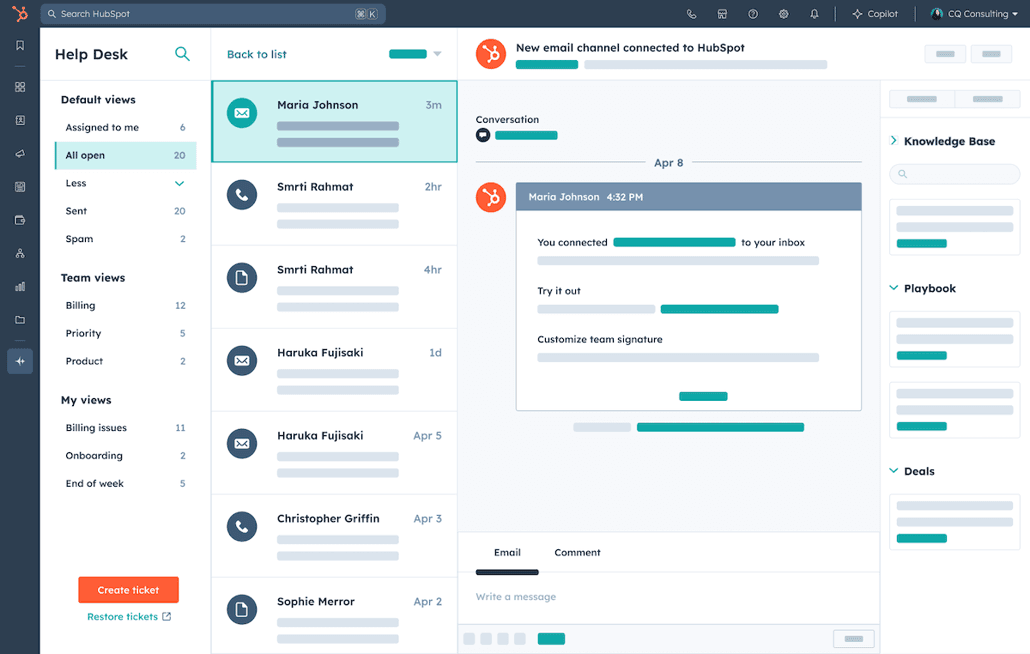
This deep integration makes AI suggestions very relevant. The AI knows if a customer is a high-value lead. This allows for smarter service.
The Role of Zia AI in the Broader Zoho Ecosystem
- Mature AI Assistant: Zia works across entire Zoho suite of products
- Predictive Analytics: Can predict customer mood and auto-tag tickets
- Anomaly Detection: Flags spikes in negative comments for proactive management
- Maximum ROI: Enterprise features at SMB pricing
✅ Strengths
- Best value proposition in the market
- Mature AI across entire Zoho ecosystem
- Unique anomaly detection capabilities
- Excellent CRM integration within Zoho
⚠️ Considerations
- Interface less modern than competitors
- Smaller third-party integration ecosystem
- High vendor lock-in within Zoho suite
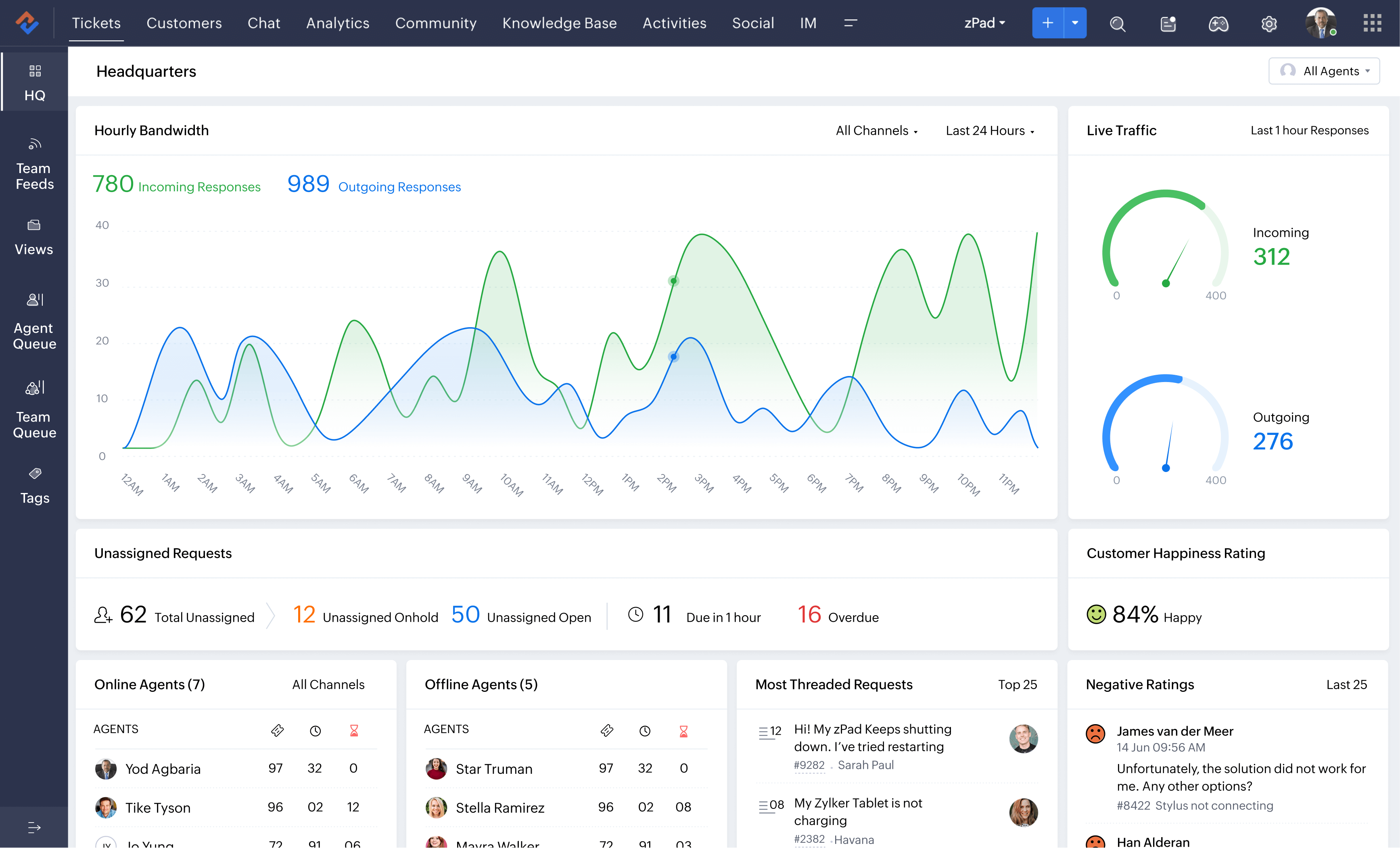
Zia also provides agents with information from Zoho CRM. A unique ability is “anomaly detection.” It can flag spikes in negative customer comments, alerting managers to wider issues.
Comparative Verdict: Which Platform Offers the Best AI ROI?
Freshdesk wins for its built-in value. HubSpot is best for its CRM-integrated context. Zendesk’s AI is very capable, but its pricing makes it less accessible for most companies.
Expert Analysis: Mapping AI Features to Core CX Metrics
A professional evaluation demands connecting features to financial and operational impact. Here’s a framework for mapping these AI capabilities to the KPIs that matter in your contact center:
- AI-Powered Self-Service & Chatbots directly impact Ticket Deflection Rate, reducing agent workload for common inquiries.
- Intelligent Ticket Routing & Triage significantly improves First Contact Resolution (FCR) by ensuring the ticket reaches the right agent with the right skills immediately.
- AI-Suggested Replies & Agent Assist directly reduce Average Handle Time (AHT) and improve agent consistency.
- Sentiment Analysis & Anomaly Detection provide leading indicators for shifts in Customer Satisfaction (CSAT) and Net Promoter Score (NPS).
When vendors demonstrate their AI, I advise clients to demand proof points against these specific metrics, not just generalized claims of ‘efficiency.’
For comprehensive tutorials on implementing these AI features, check out our detailed Zendesk Tutorials and Usecase guide.
The Dual Experience (AX & CX): Which Platform is Easiest for Agents and Customers to Use?
A platform is only good if both agents and customers find it easy. Poor usability for either group leads to problems. Customers may leave, and agents may quit.
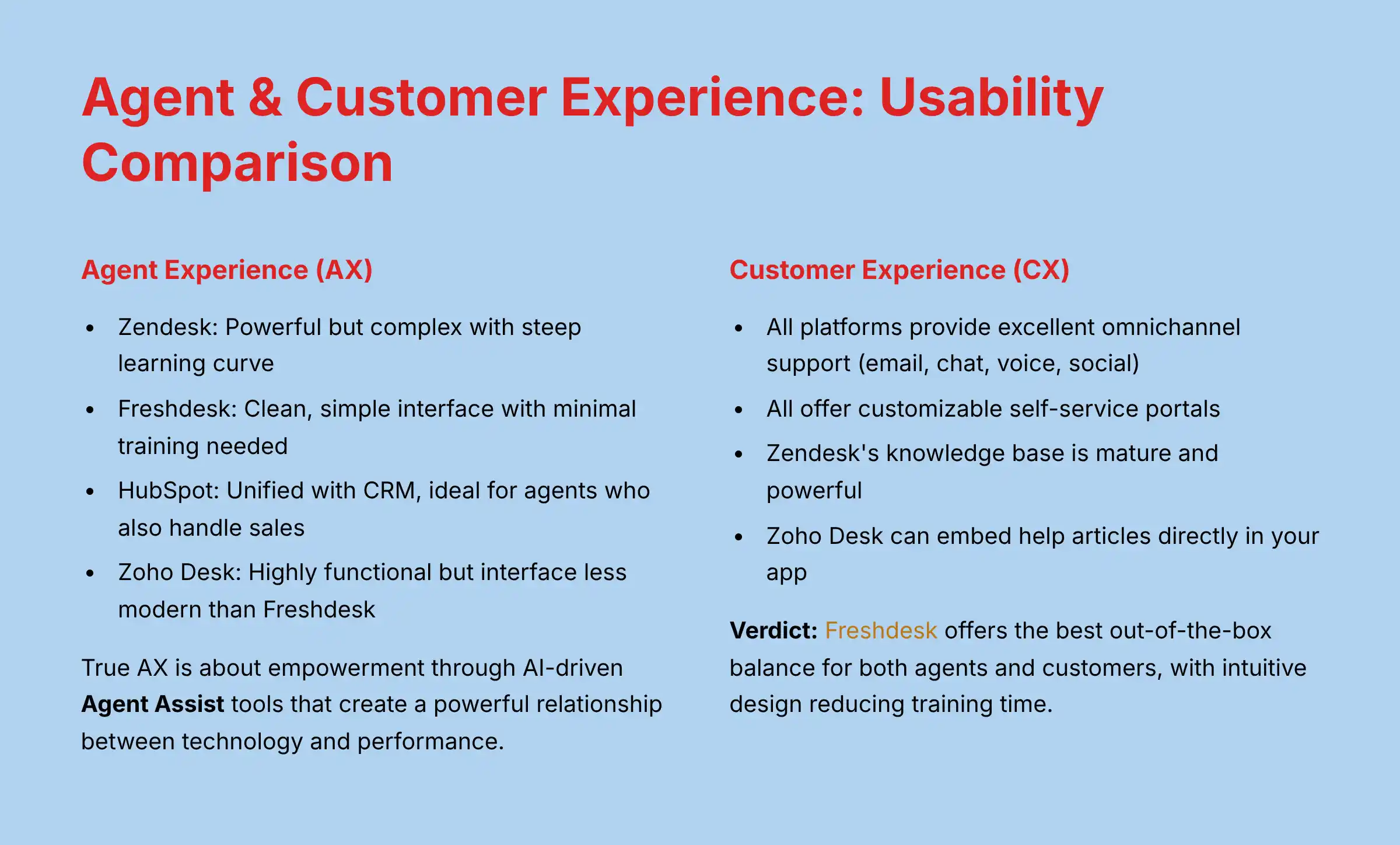
Agent Experience (AX) Head-to-Head: Comparing Usability, Complexity, and Training Time
Zendesk offers a powerful agent workspace, but it can feel complex. My tests show new users often face a steep learning curve.
Freshdesk is consistently praised for its clean and simple user interface.
HubSpot unifies the agent experience with the CRM. This is great for agents who also do sales tasks.
Zoho Desk is highly functional, but some find its interface less modern than Freshdesk’s.
Beyond the interface, true Agent Experience (AX) is about empowerment. This is where AI-driven Agent Assist tools create a powerful relationship between technology and performance.
For example, a platform that uses Conversation Analytics to identify customer frustration in real-time can automatically trigger a workflow to provide the agent with a relevant de-escalation script.
This directly links an AI capability to the critical process of Quality Assurance (QA) and agent coaching, moving QA from a rearview mirror activity to a real-time performance enhancement.
Customer Experience (CX) Face-Off: Evaluating Self-Service Portals and Omnichannel Support
All four platforms provide excellent support across multiple channels. This includes email, chat, voice, and social media. They all offer customizable self-service portals.
Zendesk’s knowledge base is a mature and powerful product. A key feature of Zoho Desk is its ability to embed help articles directly in your app.
This provides help without making the user leave your website.
Comparative Verdict: The Best Platform for Balanced Agent and Customer Usability
For the best out-of-the-box balance for both agents and customers, Freshdesk is the winner. Its intuitive design reduces training time. This is a big benefit for teams.
Core Business Integration: A Deep Dive into Ecosystem & API Capabilities
A customer care tool must connect with your other business systems. Its value grows when linked to your main customer database, the CRM. This connection prevents data silos.
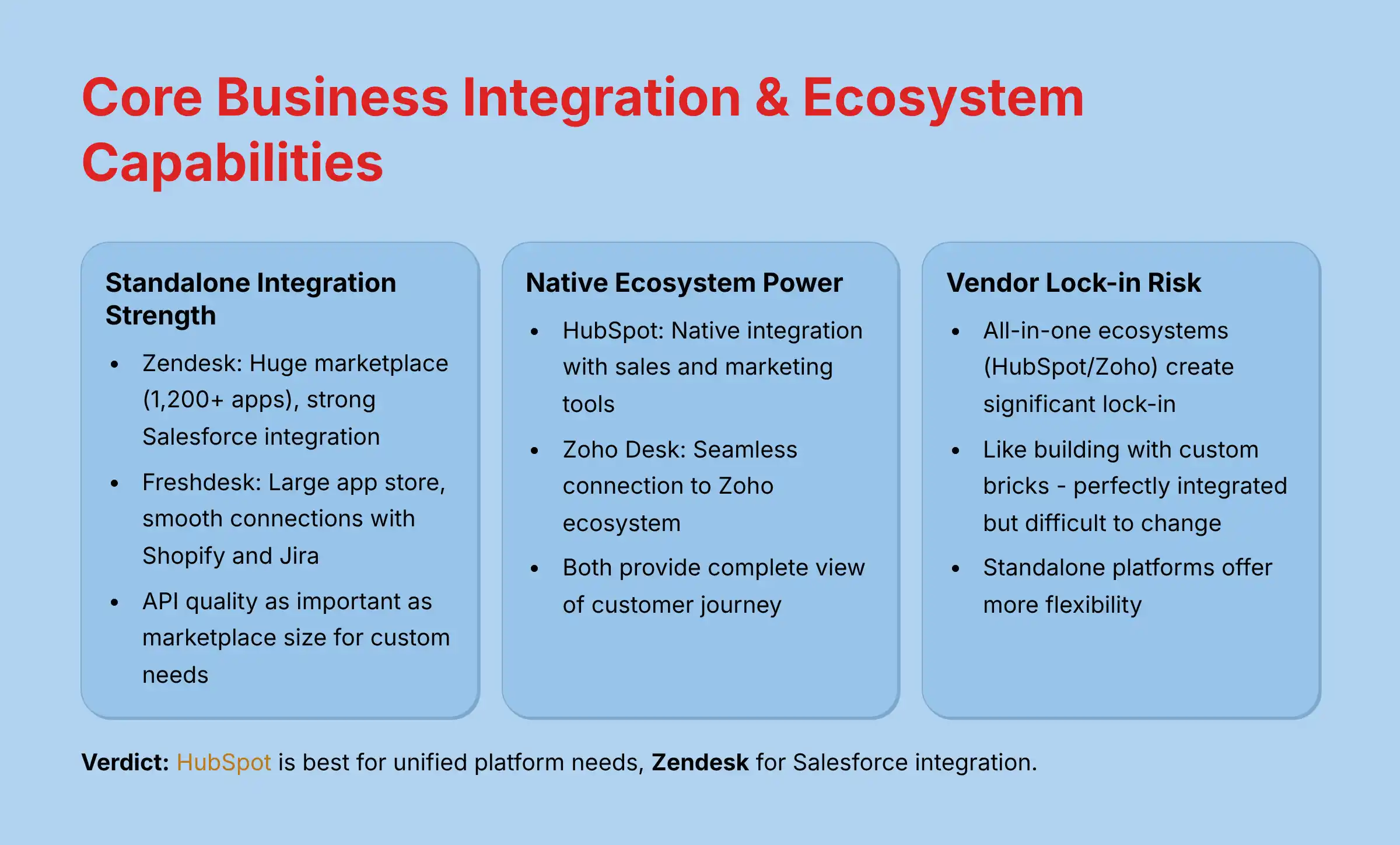
Standalone Integration Strength: Zendesk vs. Freshdesk in Third-Party App Marketplaces (Salesforce, Shopify, Jira)
Zendesk has a huge marketplace with over 1,200 apps. Its integration with Salesforce is very strong and reliable. This is a key reason many large companies choose it.
Freshdesk also has a large app store. Its connections with tools like Shopify and Jira are deep and simple to set up. My testing confirms these integrations are smooth.
For teams with custom needs, the quality of the API is as important as the number of marketplace apps. Your technical lead should validate these attributes:
- API Call Limits and Throttling: What are the usage limits? Aggressive limits can stifle automation and lead to unexpected overage fees.
- API Documentation & Developer Sandbox: Is the documentation clear and comprehensive? Does the vendor provide a sandbox environment for safely testing custom integrations before deploying to production?
Native Ecosystem Power: HubSpot Service Hub vs. Zoho Desk for Seamless Data Flow
HubSpot’s main advantage is its native integration. It is part of the same platform as its sales and marketing tools. This creates a complete view of the customer journey.
Zoho Desk has a similar superpower. Its native link to the Zoho ecosystem provides amazing context. This is especially true for businesses already using other Zoho apps.
Risk Assessment: The Strategic Implications of Platform vs. Ecosystem Integration (Vendor Lock-in)
Choosing an all-in-one ecosystem like HubSpot or Zoho is like building a house with custom bricks. It is perfectly integrated and strong. But you can never remodel using standard parts from another supplier.
This creates significant vendor lock-in.
Comparative Verdict: Best for Integration Flexibility vs. Best for a Unified Platform
HubSpot Service Hub is best for businesses that want a single, unified platform. Zendesk is the top choice for companies needing best-in-class integration with Salesforce.
Security & Compliance Deep Dive: A YMYL Risk Assessment for CX Leaders
Compromising customer data is a huge threat to any business. Security is a non-negotiable point of evaluation. This is where professional due diligence is a must.
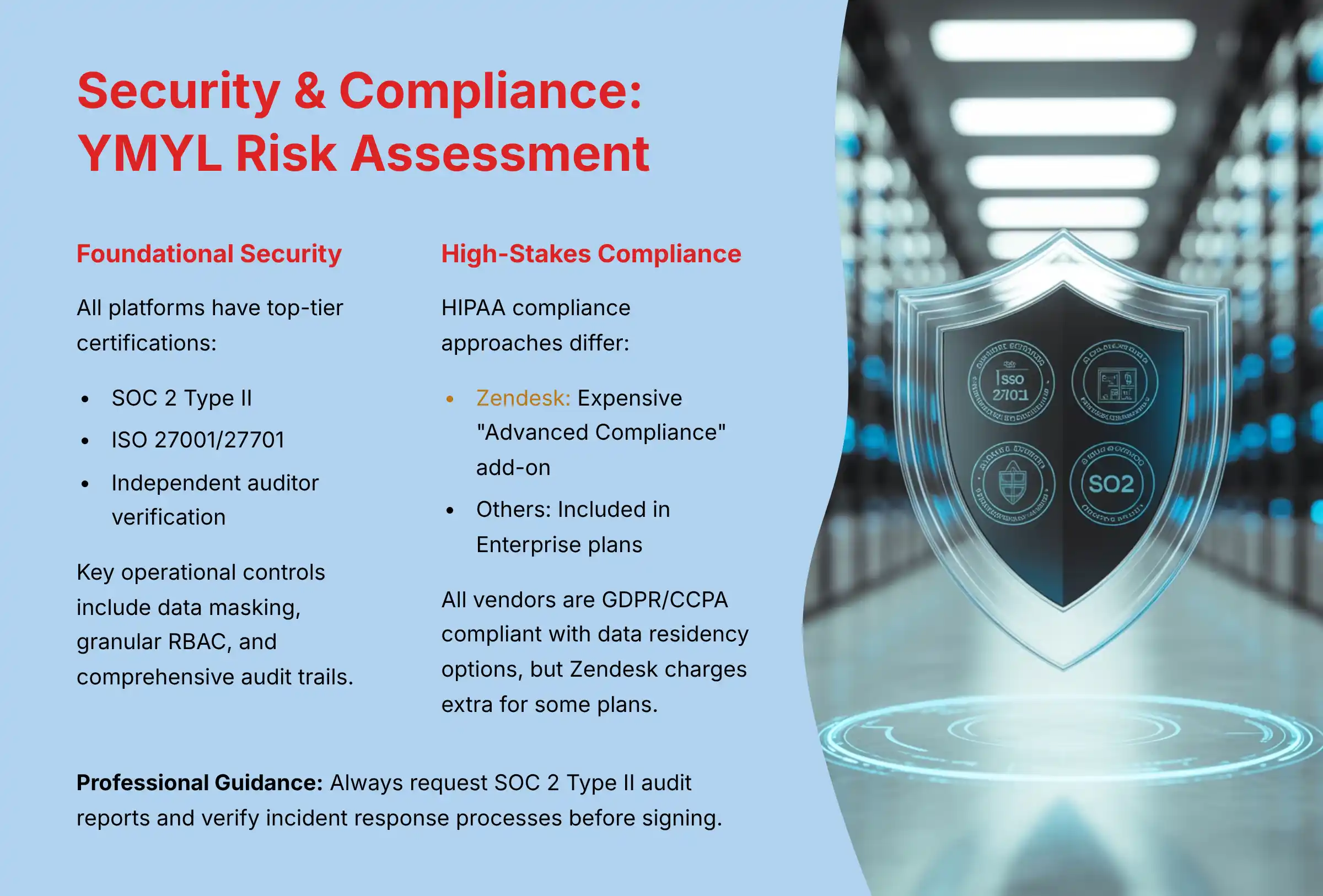
Foundational Security Posture: Comparing SOC 2 Type II, ISO 27001/27701, and Physical Security Measures
All four platforms have top-tier certifications. These include SOC 2 Type II and ISO 27001 and ISO 27701. These certifications are verified by independent auditors.
They prove the platforms follow strict security processes.
This provides a strong baseline of trust for any organization. It shows a commitment to protecting your data. You can feel confident in their foundational security.
Beyond foundational certifications, a rigorous security assessment must probe operational controls. In my evaluations, I scrutinize:
- Data Masking and Redaction: Does the platform automatically identify and redact sensitive PII like credit card or social security numbers from conversation logs and agent screens? This is a non-negotiable for PCI DSS and PII protection.
- Granular Role-Based Access Control (RBAC): How detailed are the user permissions? Can you restrict access not just by role, but by team, specific data fields, or customer segments?
- Comprehensive Audit Trails: Does the vendor provide immutable logs of all agent actions, administrative changes, and data access for compliance audits?
Data Privacy & Regulatory Adherence: A Comparative Look at GDPR, CCPA, and Data Residency Options
All vendors are compliant with GDPR and CCPA. All four platforms (Zendesk, Freshdesk, HubSpot, Zoho Desk) provide robust options for regional data residency.
This allows customers to host their data in locations like the US or EU to help meet GDPR and other regulatory requirements.
The key distinction is that for some Zendesk plans this is a paid add-on, whereas for the other providers it is typically a standard choice made during account creation.
The relationship between features and compliance is direct. For example, a vendor offering granular data residency in an EU data center directly satisfies a core tenet of the GDPR.
Similarly, the sub-processor disclosure provided by a vendor is critical for your own compliance team to map the full data supply chain, a key requirement for both GDPR and SOC 2 audits.
This can be a vital requirement for meeting certain regulations. I always advise clients to verify these specifics with a vendor’s legal team. This step is important for global businesses.
High-Stakes Compliance Comparison: How Each Platform Handles HIPAA (Add-on vs. Enterprise Tier)
HIPAA compliance is mandatory for healthcare organizations. All four platforms can be configured for HIPAA. But their approach and cost differ greatly.
Zendesk requires an expensive “Advanced Compliance” add-on. For Freshdesk, HubSpot, and Zoho Desk, HIPAA eligibility is typically part of their top-tier Enterprise plans.
This can result in a major cost difference.
Risk Matrix: A Visual Comparison of Security Features and Compliance Risks
| Risk Factor | Zendesk | Freshdesk | HubSpot | Zoho Desk |
|---|---|---|---|---|
| HIPAA Cost Barrier | High (Costly Add-on) | Medium (Enterprise Plan) | Medium (Enterprise Plan) | Medium (Enterprise Plan) |
| Data Residency | Excellent (Granular) | Good (Standard) | Excellent (Granular) | Good (Standard) |
| Vendor Lock-in | Low | Low | Very High | High |
| TCO Predictability | Low | High | Medium | Very High |
Professional Guidance: Essential Security Questions to Ask Each Vendor Before Signing
Verbal assurances are insufficient. The following questions represent a minimum standard of professional due diligence your technical and legal teams must perform before any contract is signed.
The vendor’s ability to provide clear, documented answers is a direct indicator of their security maturity.
Before you commit to a platform, your security team should ask these questions:
- Can you provide your most recent SOC 2 Type II audit report?
- Describe your incident response process and communication plan.
- How do you segregate customer data in your multi-tenant environment?
- What are our specific options for data storage location?
- Can you provide a full list of your sub-processors who may handle our data?
Total Cost of Ownership (TCO) & Financial Risk: A Full Breakdown Beyond Per-Agent Pricing
The monthly per-agent price is only the start. True TCO includes add-ons, implementation fees, and API charges.
Choosing a platform based only on the per-agent price is like buying a cheap printer. You later find the ink cartridges are wildly expensive. TCO is the real price tag.
Deconstructing Per-Agent Pricing: Zendesk vs. Freshdesk vs. HubSpot vs. Zoho Desk
Zendesk’s pricing begins with the “Support Team” plan at $19/agent/month. The “$55/agent/mo” price refers to the starting tier of their integrated “Suite” product.
Freshdesk offers a more predictable model, with many features included in its plans.
HubSpot’s model encourages bundling software, which can offer value if you need more than just a helpdesk.
Zoho Desk is the clear price leader.
The Hidden Costs: Analyzing Mandatory Add-ons, API Fees, and Implementation Expenses
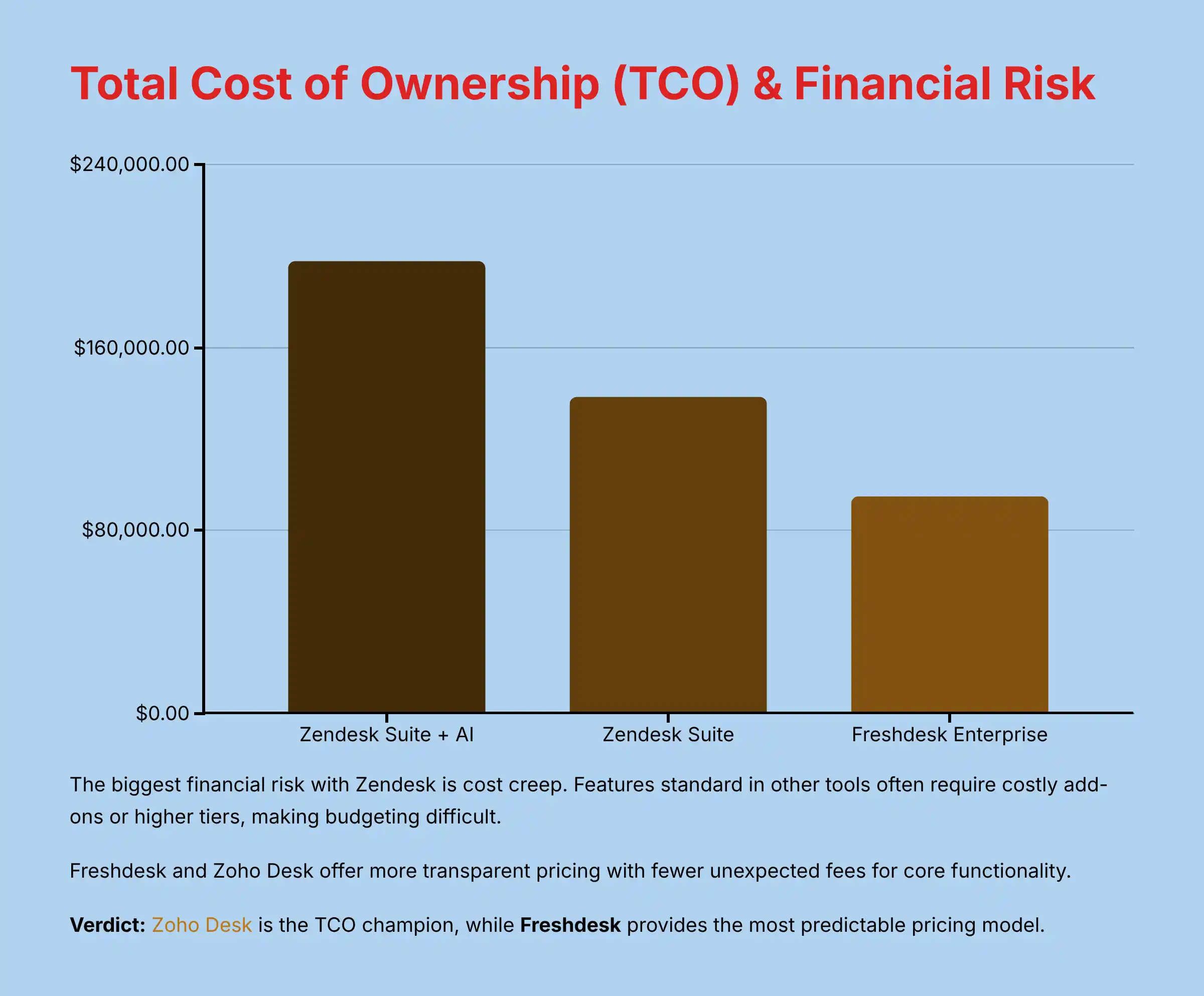
The biggest financial risk with Zendesk is cost creep. My analysis shows that features standard in other tools often require costly add-ons or higher tiers.
This makes budgeting difficult.
In contrast, Freshdesk and Zoho Desk offer more transparent pricing. You are less likely to encounter unexpected fees for core functionality.
Always ask for a detailed quote that includes any potential extra costs.
Financial Risk Scenario: Modeling the TCO for a 100-Agent Team (Including AI Costs)
To illustrate the critical difference between list price and TCO, let’s model a realistic financial scenario: a 100-agent team needing a modern, AI-powered solution.
This is where the true cost of ownership becomes starkly clear.
Let’s model the annual cost for a 100-agent team on a comparable mid-tier plan:
- Zendesk Suite Professional: ($115/agent/mo) = $138,000 per year.
- With AI Add-on: ($50/agent/mo extra) = An additional $60,000. Total = $198,000.
- Freshdesk Enterprise: ($79/agent/mo) = $94,800 per year with most AI features included.
This simple model shows how TCO can be much higher than list prices suggest.
Comparative Verdict: The TCO Champion vs. The Most Predictable Pricing Model
Zoho Desk is the TCO champion, offering the best overall value. Freshdesk provides the most predictable and transparent pricing model.
It is the best choice for businesses that need to avoid budget surprises.
Which Zendesk Alternative is Right for Your Business? [Decision Framework & Use Cases]
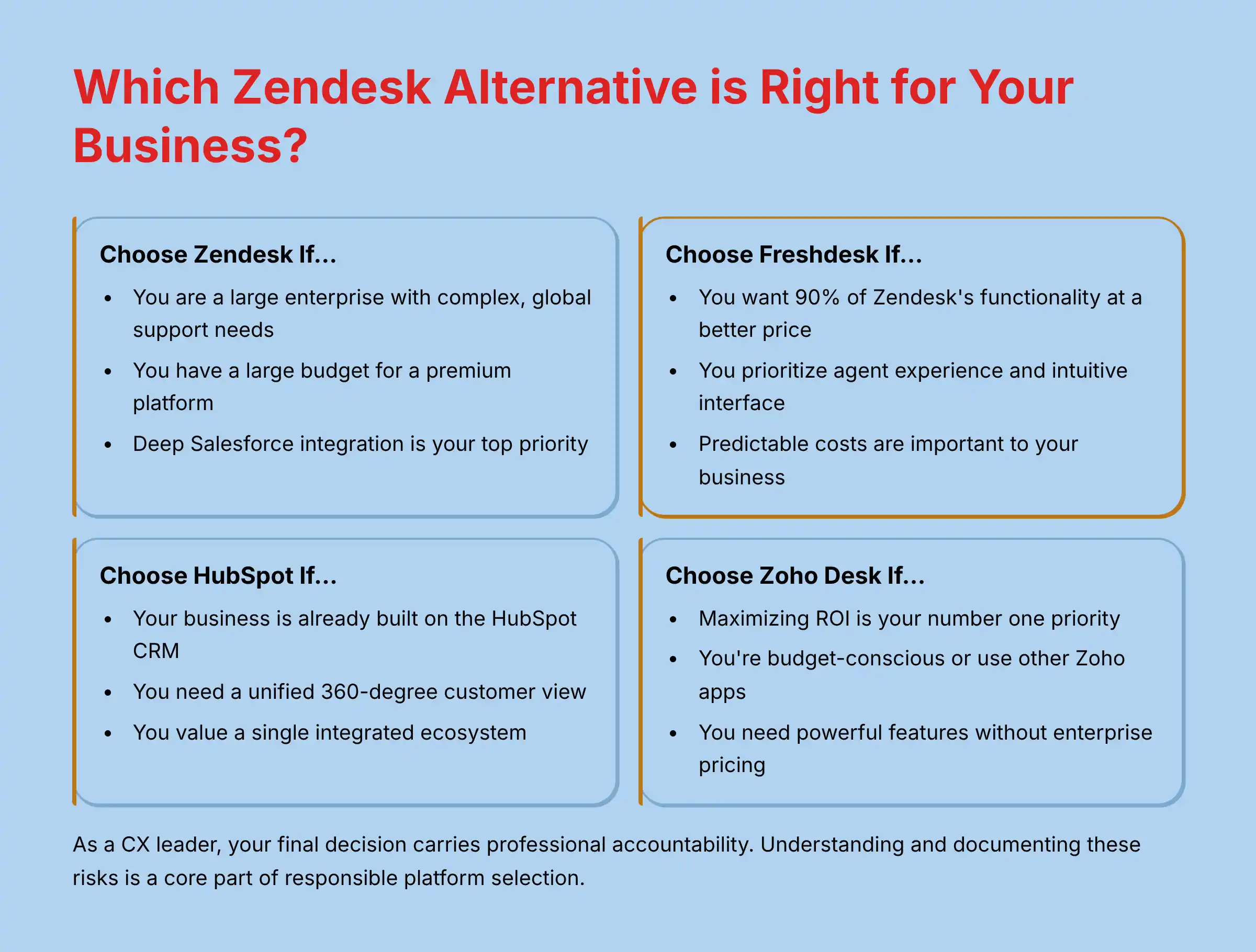
There is no single “best” alternative. The right choice depends on your business context, budget, and risk tolerance. This framework should help guide your decision.
Scenario 1: Choose Zendesk If…
- You are a large enterprise with a complex, global support team.
- You have a large budget and are willing to pay a premium for a mature platform.
- Deep and reliable integration with Salesforce is your top priority.
Scenario 2: Choose Freshdesk If…
- You are an SMB or mid-market company looking for a direct Zendesk competitor.
- You want 90% of the functionality at a better price with a more intuitive interface.
- You prioritize agent experience and predictable costs over time.
Scenario 3: Choose HubSpot Service Hub If…
- Your business is already built on or moving to the HubSpot CRM.
- Your main goal is a unified 360-degree view of the customer.
- You value a single integrated ecosystem above all else.
Scenario 4: Choose Zoho Desk If…
- Your number one priority is maximizing return on investment.
- You are a budget-conscious business or already use other Zoho apps.
- You need powerful features without the enterprise price tag.
Professional Accountability: Acknowledging the Risks Associated with Each Choice
As a CX leader, the final decision carries professional accountability. With Zendesk, you are accountable for managing potential TCO overruns.
With HubSpot, you are accountable for the strategic decision to accept high vendor lock-in.
Understanding and documenting these risks is a core part of responsible platform selection.
What Other Critical Factors Should Influence Your Final Decision?
Beyond features and price, you should think about vendor support and company vision. How responsive is the vendor’s own customer support when you have a problem?
Does their product roadmap align with your future business needs?
I recommend talking to current customers of any platform you are seriously considering.
Additionally, explore our comprehensive resource on Best 10 AI-Powered Customer Support solutions to understand the broader market landscape.
Frequently Asked Questions about Zendesk Competitors
Is Freshdesk truly cheaper than Zendesk in the long run?
Yes, for most SMB and mid-market teams, Freshdesk offers a lower Total Cost of Ownership (TCO). While starting prices seem similar, Zendesk’s powerful AI and compliance features often need expensive add-ons.
Freshdesk includes many of these in its higher-tier plans.
How does HubSpot’s AI compare to Zendesk’s for a non-HubSpot user?
For a non-HubSpot user, Zendesk’s AI is more powerful as a standalone tool. HubSpot’s AI gets its strength from deep integration with the HubSpot CRM.
Without that context, its value is lower compared to the specialized AI in Zendesk or Freshdesk.
What is the biggest limitation of choosing Zoho Desk over Zendesk?
The biggest limitation of Zoho Desk is often its user interface and overall polish. While extremely functional and feature-rich, some teams find its design less intuitive than the more streamlined experience offered by Zendesk or Freshdesk.
For an e-commerce business using Shopify, is Zendesk or Freshdesk better?
Both are excellent choices with strong Shopify integrations, but Freshdesk often has a slight edge for SMBs. Its integration is very easy to set up, and its more predictable pricing is appealing to growing e-commerce businesses managing tight margins.
Which platform presents the biggest risk of vendor lock-in?
HubSpot Service Hub presents the biggest risk of vendor lock-in. Its primary value comes from being part of a unified platform.
Once your sales, marketing, and service data are all on HubSpot, migrating away becomes a massive and costly project. This significantly reduces your future negotiating leverage and strategic flexibility.
How do Zendesk and HubSpot’s data residency options differ for GDPR compliance?
Both Zendesk and HubSpot offer excellent, granular data residency options. They allow customers to choose to store their service data in specific geographic regions, such as the EU or the US.
This is a key feature for meeting strict GDPR requirements.
Can Zoho Desk’s “Zia” AI replace the need for Zendesk’s expensive AI add-on for an SMB?
Yes, for many SMBs, Zia can absolutely replace the need for Zendesk’s AI add-on. Zia provides core AI functions like sentiment analysis, ticket tagging, and bot conversations at a much lower cost.
It delivers a high return on investment for common AI use cases.
What is the most common reason companies migrate away from Zendesk?
The most common reason companies look for Zendesk alternatives is rising Total Cost of Ownership (TCO). Businesses often find that to get the features they need, they must purchase expensive add-ons or upgrade to higher tiers, leading to unpredictable budget creep.
In terms of security, are all four platforms truly equal for a healthcare company needing HIPAA compliance?
No, they are not equal in terms of cost and access. While all four can be configured for HIPAA, Zendesk requires a specific ‘Advanced Compliance’ add-on at a significant extra cost.
The others typically include HIPAA eligibility in their Enterprise plans.
Which platform has a better reputation for responsive customer support when things go wrong?
Based on user reviews and my industry experience, Freshdesk generally has a stronger reputation for responsive and helpful customer support, especially for small and mid-sized businesses.
This is often a key factor for teams who need reliable help from their vendor.
For more detailed answers to common questions, visit our comprehensive Zendesk FAQs section.
The Final Verdict: Choosing Your Next Customer Support Platform in 2025
The “best” platform is the one that fits your specific context. The decision in 2025 is more complex than ever. It demands a careful look at your budget, integration needs, and risk tolerance.
Recapping my top choices for each main use case: Zendesk for enterprise scale, Freshdesk for balanced usability and cost, HubSpot for all-in-one integration, and Zoho Desk for maximum ROI.
Your choice should empower your team and delight your customers.
For comprehensive platform overviews and feature comparisons, explore our detailed Zendesk Overview and Features analysis.
Professional YMYL Disclaimer and Due Diligence Checklist
This analysis is based on my hands-on testing and publicly available data as of Q1 2025. Prices and features change. All security and compliance claims MUST be verified directly with the vendors.
This article is not a substitute for professional due diligence. I strongly advise you to:
- Request personalized demos from your top 2-3 choices.
- Ask for and validate their security certification documents, including their full SOC 2 Type II report and list of sub-processors.
- Run a pilot program or a time-boxed Proof-of-Concept (PoC) with a small group of agents to validate performance claims against your specific use cases.
- Have your legal and compliance teams review the service agreements, paying close attention to the uptime SLA and data processing agreements.
This process ensures you make the best long-term decision for your business. For more expert analysis, please explore our full guide to comprehensive customer support solutions.

Leave a Reply