Is Salesforce Einstein the Right AI for Your Support Team?
Take This Quiz to Find Out!
Key Takeaways
- Einstein Overview: Comprehensive AI umbrella brand encompassing Einstein 1 Platform, Einstein Copilot, and Service Cloud integration
- Enterprise Security: Trust Layer provides data masking, zero-retention policies, and comprehensive compliance frameworks
- ROI Measurement: Track operational efficiency, customer experience impact, and strategic business value indicators
- Implementation Strategy: Partner needs depend on complexity, integration requirements, and organizational scale
Navigating the complex world of AI in customer service can be challenging, but this comprehensive guide tackles your most pressing Salesforce Einstein FAQs to empower your team. As customer service managers and CX leaders, you understand the critical need for solutions that drive efficiency and enhance customer satisfaction. Salesforce Einstein stands out as a pivotal AI solution for customer support, promising to transform reactive operations into proactive growth engines.
At Best AI Customer Care Central, founder Jigar Bhansali’s mission is to cut through the marketing hype, providing objective, hands-on analysis. We delve into how Einstein differs from its platform and Copilot, explore real-world use cases, compare it with other leading tools, and unpack its robust data privacy and security measures, including HIPAA, GDPR, and CCPA compliance.
You’ll gain insights into its pricing, learn to measure its ROI, and determine if an implementation partner is essential for your AI-powered customer support strategy (comprehensive AI-Powered Customer Support analysis). Prepare to make informed decisions that will strategically transform your customer care.
What is Salesforce Einstein, and how does it differ from the Einstein 1 Platform and Einstein Copilot?
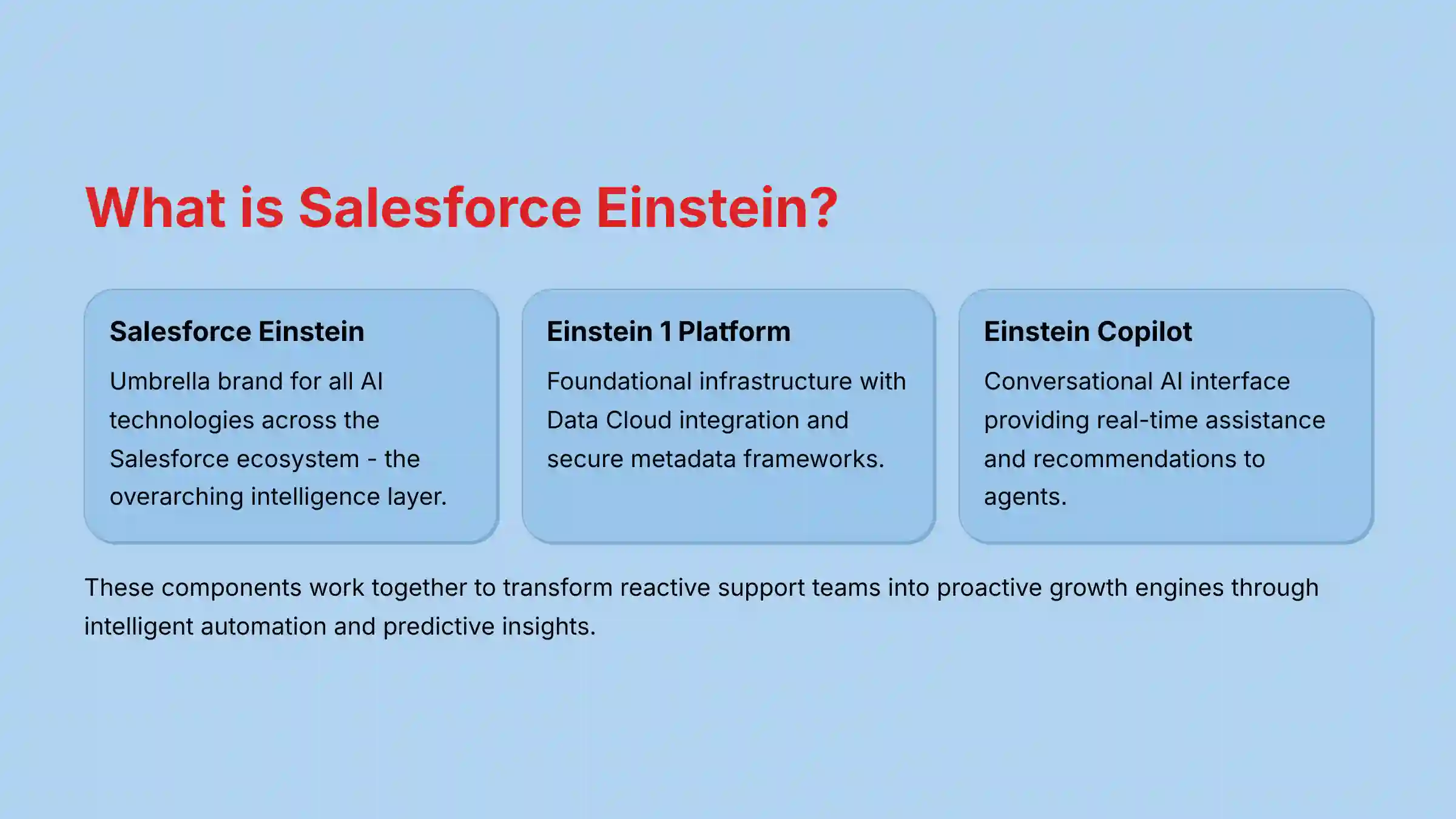
Salesforce Einstein is the umbrella brand for all of Salesforce’s artificial intelligence technologies embedded across the entire Salesforce ecosystem, including Service Cloud, Sales Cloud, and Marketing Cloud. Rather than a single product, Einstein represents a comprehensive AI layer designed to transform customer support teams from reactive cost centers into proactive, efficient growth engines through intelligent automation, predictive insights, and personalized customer interactions at scale.
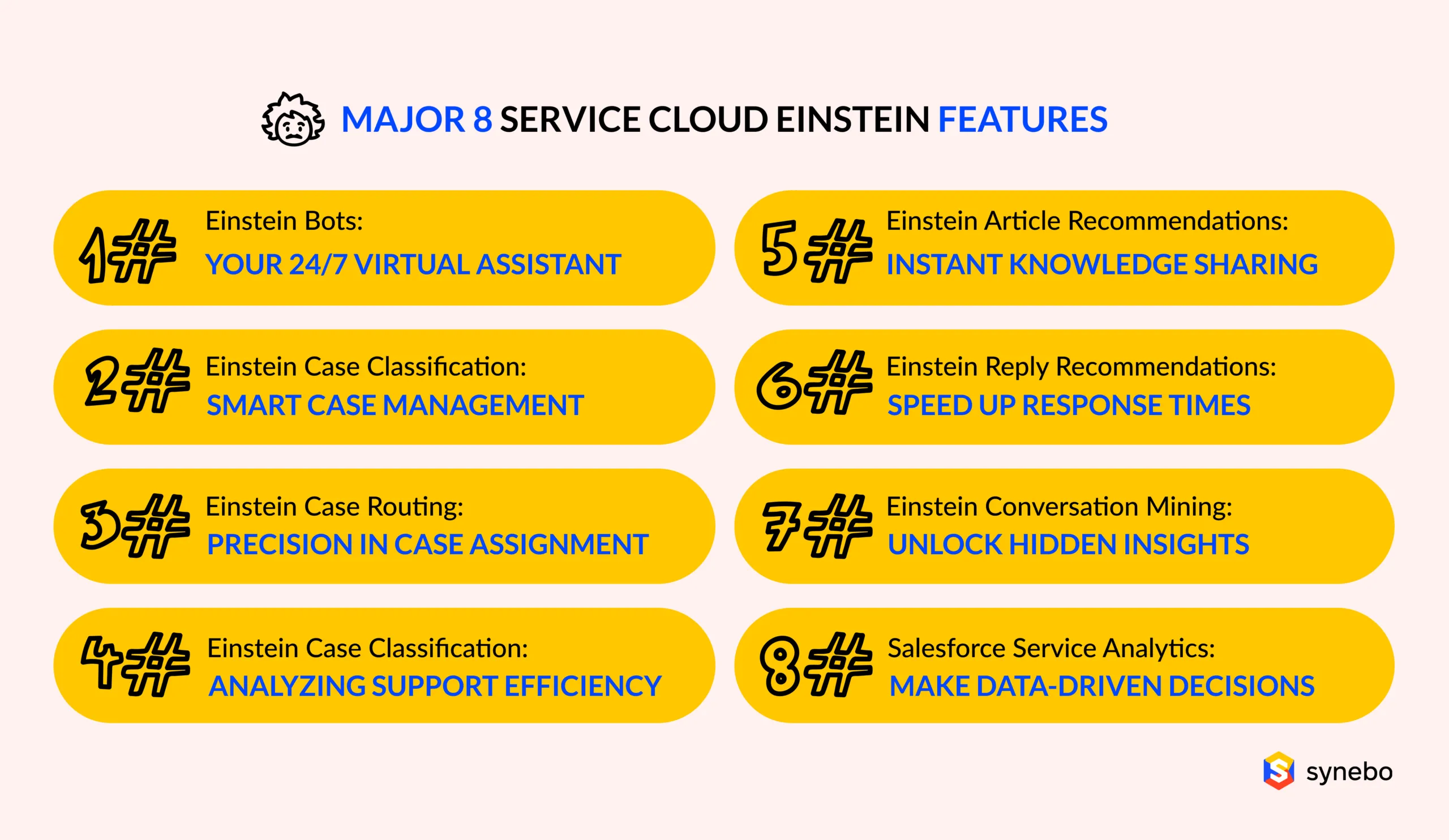
The Einstein ecosystem consists of three interconnected components that work together:
Salesforce Einstein encompasses all AI capabilities and features, including predictive analytics for case routing, article recommendations, and generative AI functionalities. This is the overarching intelligence that powers automated workflows, intelligent decision-making, and data-driven insights across customer touchpoints.
Einstein 1 Platform serves as the foundational technology infrastructure, including Data Cloud integration and metadata frameworks that enable AI to securely understand and act upon your business context. This platform acts as the secure engine that connects Einstein’s AI capabilities to your organization’s data while maintaining strict privacy and compliance standards.
Einstein Copilot functions as the primary conversational AI interface for both customers and employees. For support agents, Einstein Copilot appears within their Service Cloud console, providing AI-generated case summaries, drafted customer responses, next-best-action recommendations, and real-time assistance during customer interactions.
This integrated approach ensures that AI capabilities are deeply woven into daily support operations rather than existing as standalone tools. The synergy between these components enables support teams to leverage unified customer data for more contextual, personalized service while maintaining enterprise-grade security and compliance standards essential for customer care operations.
What are some concrete examples of Salesforce Einstein in action for a customer support team?
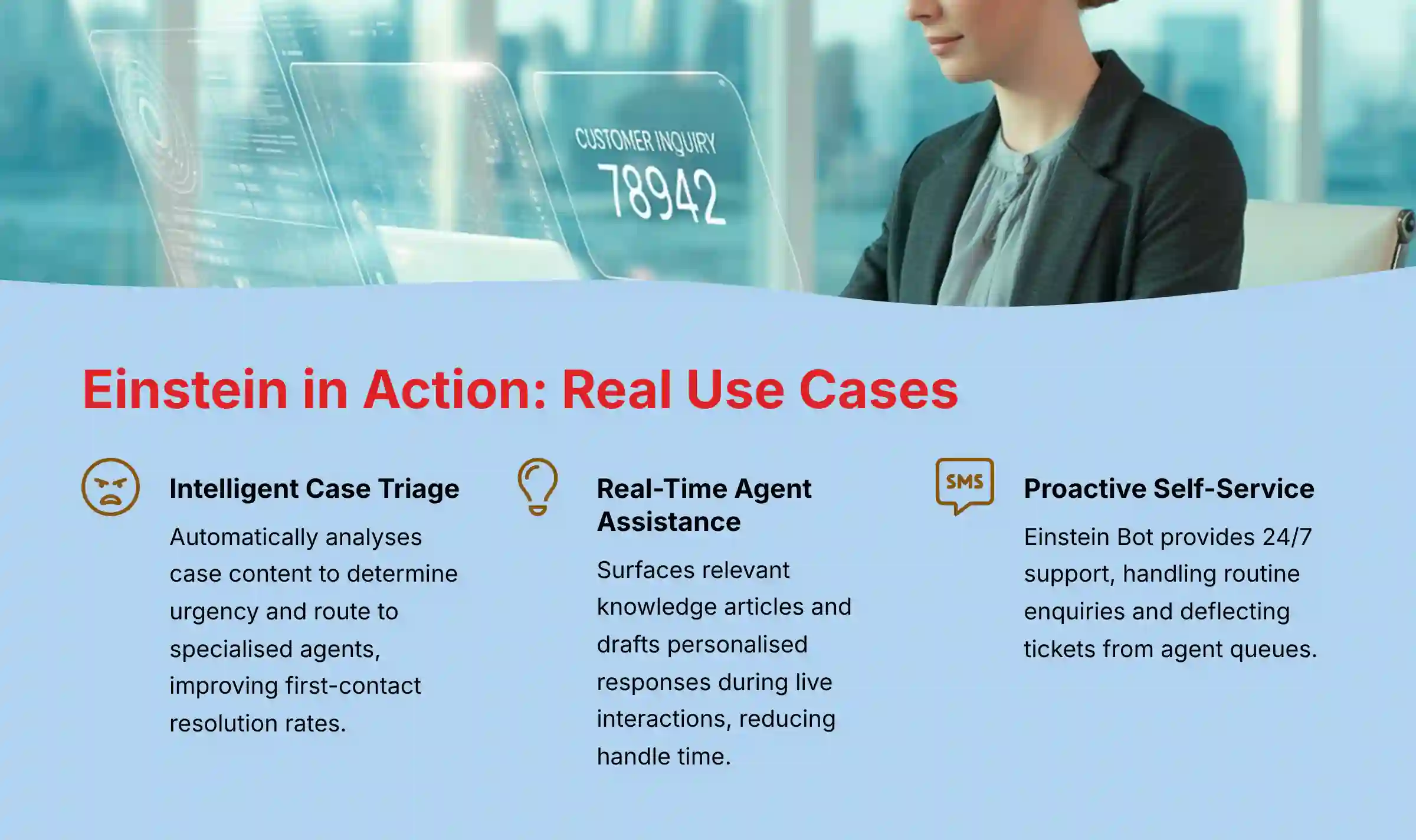
Salesforce Einstein delivers measurable operational improvements through three primary use cases that directly impact daily support team workflows and customer satisfaction metrics.
Intelligent Case Triage and Automated Routing streamlines ticket management by analyzing incoming case content to determine intent, urgency, and optimal routing. When a customer submits “My monthly invoice shows incorrect charges for services I cancelled,” Einstein’s Case Classification instantly identifies this as a “Billing Dispute,” assesses urgency based on keywords and customer tier, then automatically routes it to agents specialized in billing resolution. This eliminates manual sorting delays, reduces human error in assignment, and ensures customers reach the right expertise immediately, significantly improving first-contact resolution rates.
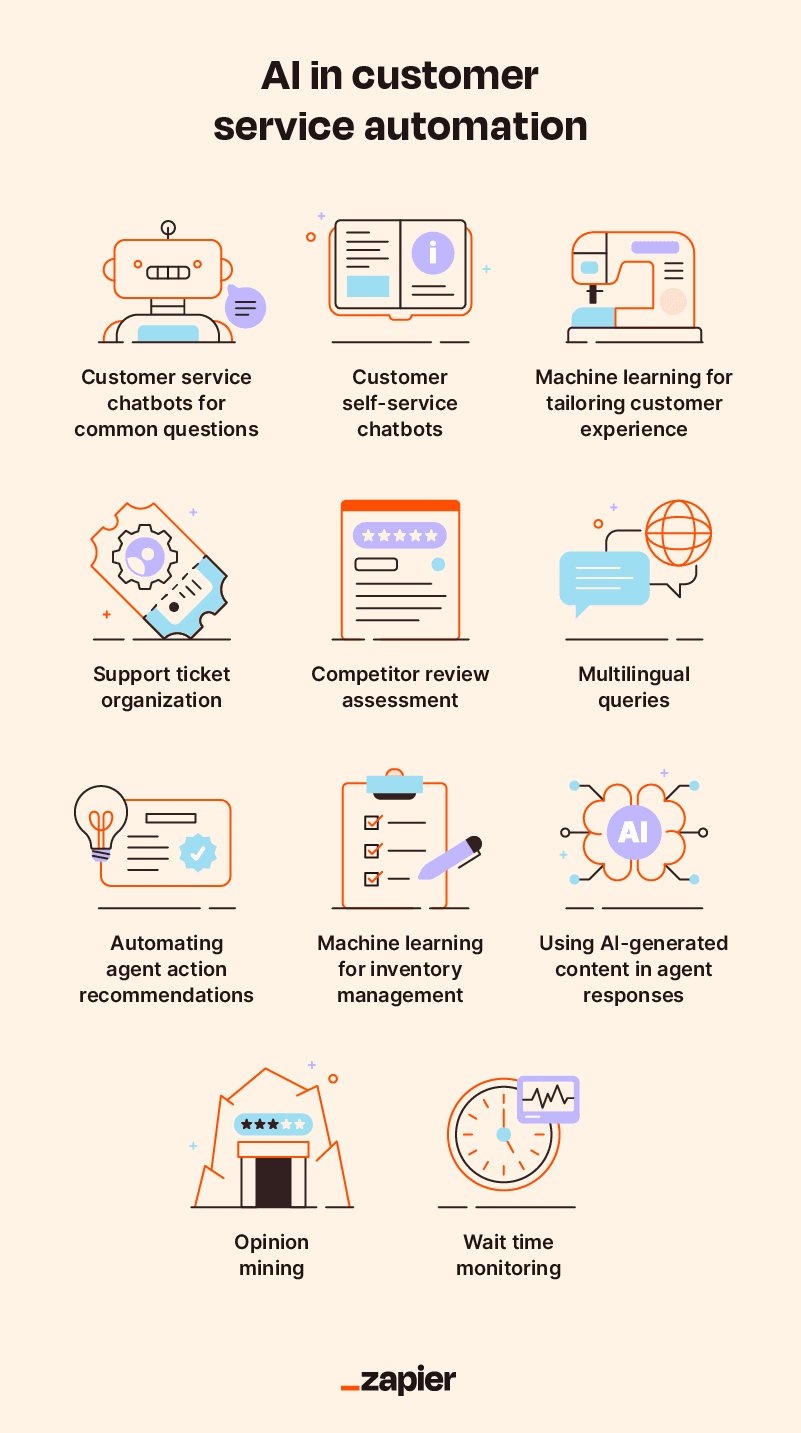
Real-Time Agent Assistance and Knowledge Discovery enhances agent productivity during live customer interactions. As an agent engages with a customer experiencing device connectivity issues, Einstein Copilot continuously analyzes the conversation context, automatically surfacing relevant knowledge base articles, suggesting proven resolution steps, and drafting personalized responses for agent review. This reduces the time agents spend searching for information, ensures consistent solution quality, and dramatically decreases average handle time while maintaining empathetic, accurate customer communication.
Proactive Self-Service Through Intelligent Bots provides 24/7 customer support without human intervention. When customers visit the support portal seeking order status updates, Einstein Bot initiates contextual conversations, securely retrieves real-time order information from integrated systems, and provides comprehensive tracking details with proactive shipping notifications. This deflects routine inquiries from agent queues, delivers instant customer satisfaction during off-hours, and allows human agents to focus on complex, high-value problem-solving that requires emotional intelligence and creative thinking.
How does Salesforce Einstein compare to other AI tools like Zendesk AI or Microsoft Copilot for Service?
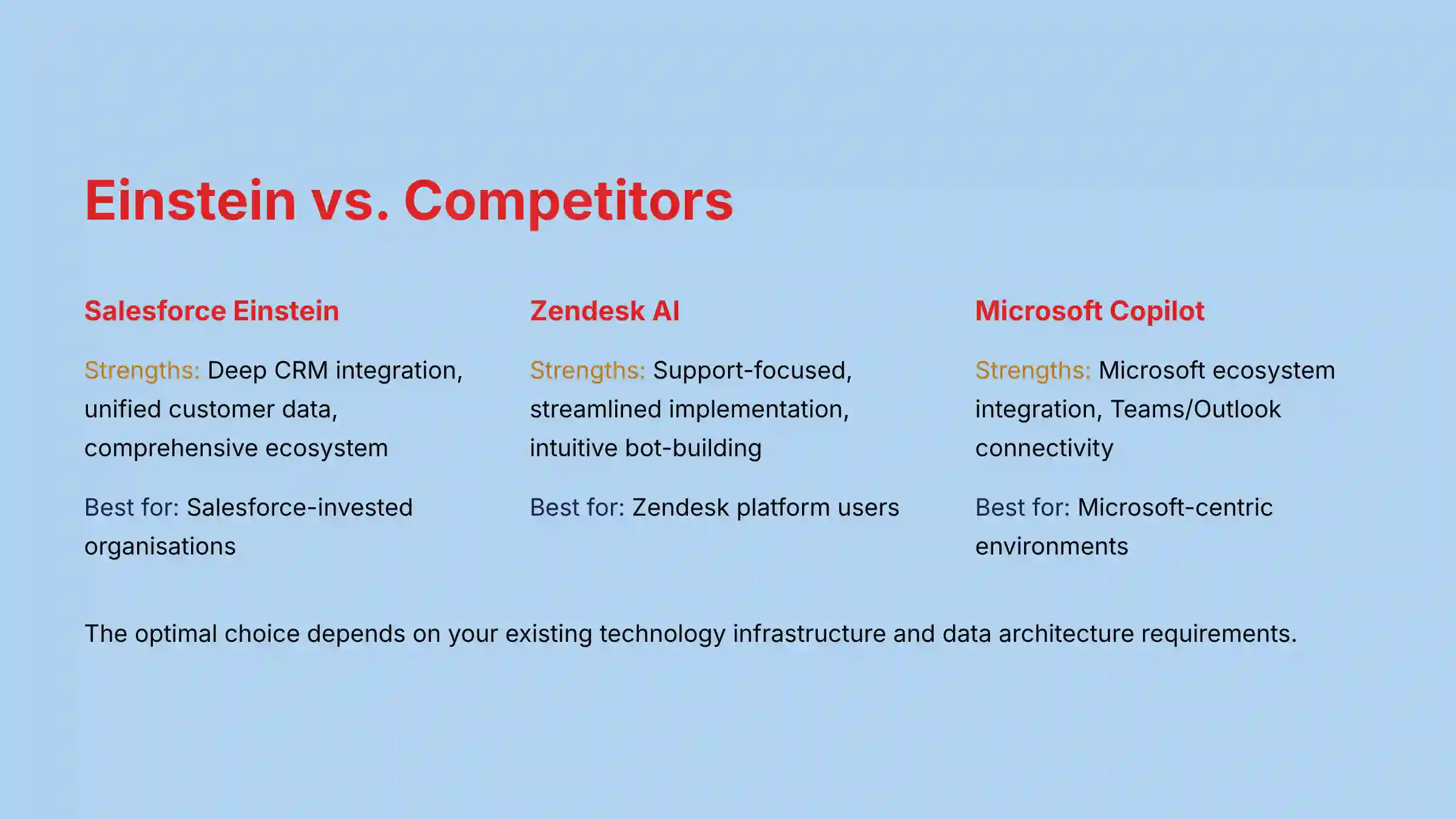
Salesforce Einstein’s competitive advantage lies in its deep integration with the Salesforce Data Cloud ecosystem and comprehensive customer data unification, enabling more sophisticated AI predictions and personalized service experiences compared to standalone solutions.
Salesforce Einstein excels through its “data-first” architecture built on the Einstein 1 Platform, which unifies customer information across sales, service, and marketing touchpoints. This comprehensive data foundation enables advanced capabilities like identifying support issues that could impact pending sales opportunities, predicting customer churn based on service interaction patterns, and personalizing support experiences using complete customer journey insights. The Einstein Trust Layer provides enterprise-grade security with data masking, zero-retention policies, and comprehensive audit trails. Einstein’s full potential is realized when organizations are deeply invested in the Salesforce ecosystem, as it leverages existing CRM data investments for more contextual AI insights.
Zendesk AI provides exceptional support-focused AI capabilities with streamlined implementation for organizations committed to the Zendesk platform. Its strengths include intelligent ticket triage, macro suggestions, and intuitive bot-building tools specifically designed for helpdesk operations. Zendesk AI integrates seamlessly within its ticketing ecosystem and offers faster time-to-value for support-only implementations. Organizations using Zendesk as their primary support platform often find this solution more straightforward to deploy and maintain, particularly when CRM integration complexity is not a priority.
Microsoft Copilot for Service delivers powerful AI capabilities for organizations invested in the Microsoft ecosystem, including Dynamics 365, Teams, and Outlook integrations. Its ability to connect data across Microsoft applications provides contextual insights and workflow automation. While Copilot can integrate with Salesforce, it performs optimally within native Microsoft environments where Dynamics 365 serves as the customer data foundation.
The optimal choice depends on your existing technology infrastructure, data architecture, and integration requirements. Organizations with Salesforce as their central customer data platform will find Einstein provides the most comprehensive and contextually rich AI capabilities.
How does Salesforce Einstein ensure customer data privacy and security with its generative AI features?
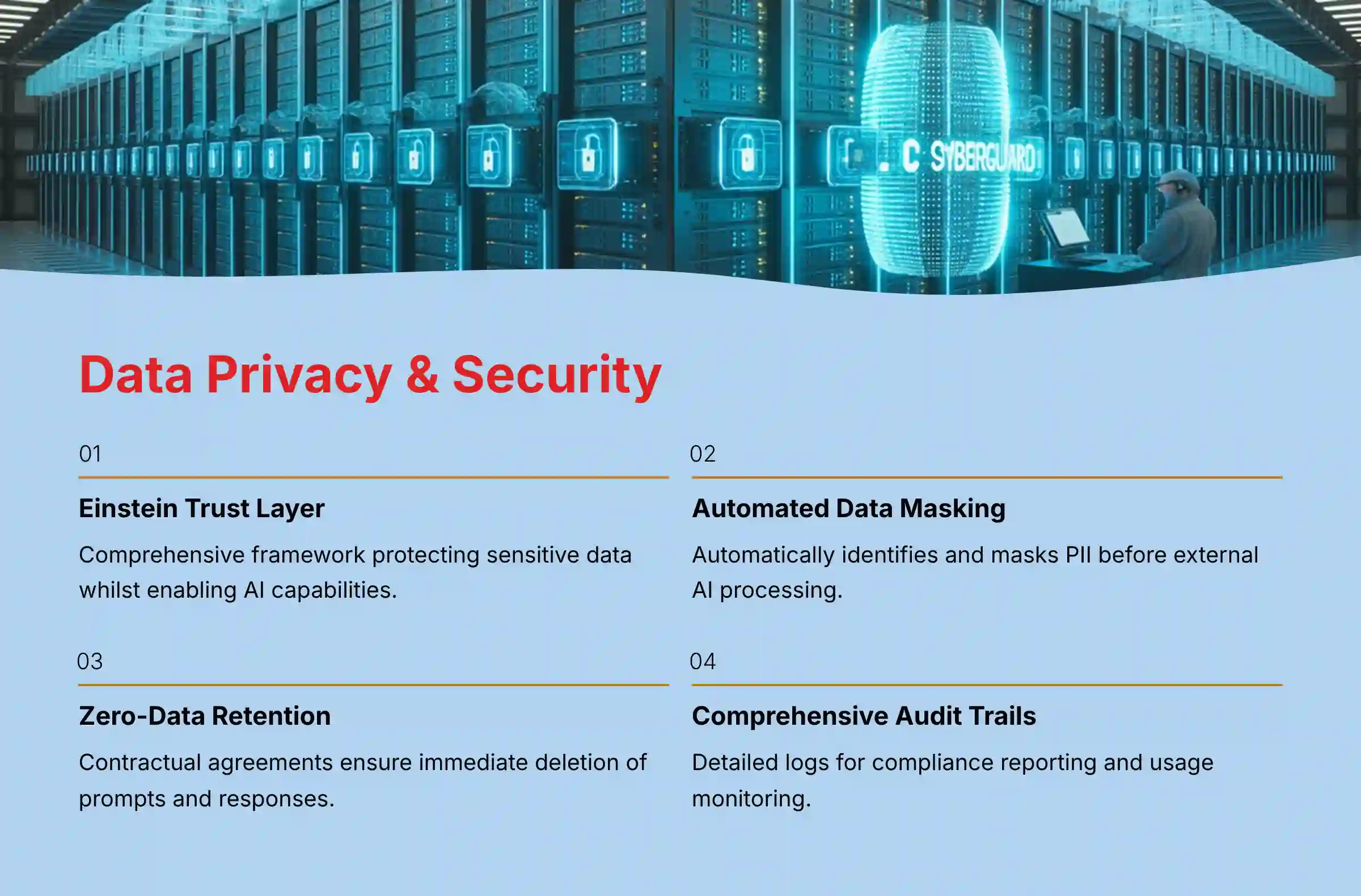
Salesforce addresses critical generative AI security concerns through the Einstein Trust Layer, a comprehensive framework that enables organizations to leverage large language model capabilities without exposing sensitive customer data to external providers or compromising compliance standards.
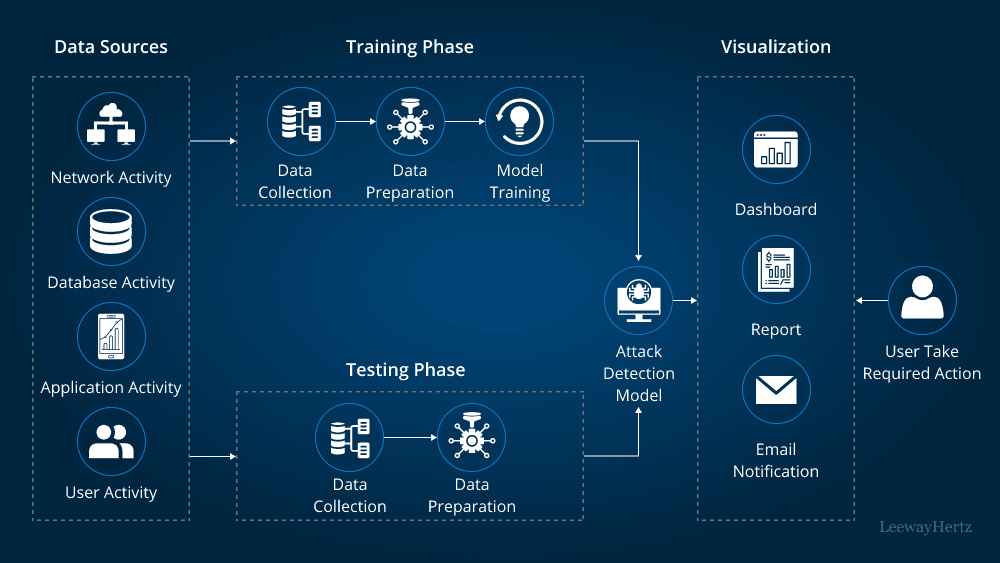
The Trust Layer implements multiple security mechanisms working in concert:
Secure Data Retrieval and Dynamic Grounding ensures that when agents prompt Einstein Copilot for case summaries or response suggestions, the AI first retrieves relevant context from your secure Salesforce Data Cloud instance. This grounding process occurs entirely within your Salesforce environment before any external AI model interaction, maintaining complete data control and visibility.
Automated Data Masking and PII Protection scans all prompts before external processing, automatically identifying and masking personally identifiable information including names, email addresses, phone numbers, and custom data patterns. This ensures that external language models receive anonymized versions of prompts while maintaining context necessary for accurate AI responses. Organizations can configure custom masking patterns for industry-specific identifiers like patient IDs or account numbers.
Zero-Data Retention and Audit Compliance establishes contractual agreements with AI model providers ensuring that anonymized prompts and responses are immediately deleted after processing, with no data retention or model training usage. Every AI interaction generates detailed audit logs capturing prompts, responses, and agent modifications, enabling comprehensive compliance reporting and usage monitoring.
Toxicity Screening and Content Governance includes automated content filtering for both input prompts and AI-generated responses, preventing inappropriate or harmful content from entering customer communications while maintaining professional service standards.
Organizations must proactively configure Trust Layer settings before deploying generative AI features. The critical first step involves reviewing data masking patterns in the “Einstein Generative AI” setup to ensure industry-specific sensitive data formats are properly protected, establishing the foundation for secure AI adoption.
Is Salesforce Einstein HIPAA compliant for healthcare organizations? What about GDPR and CCPA?
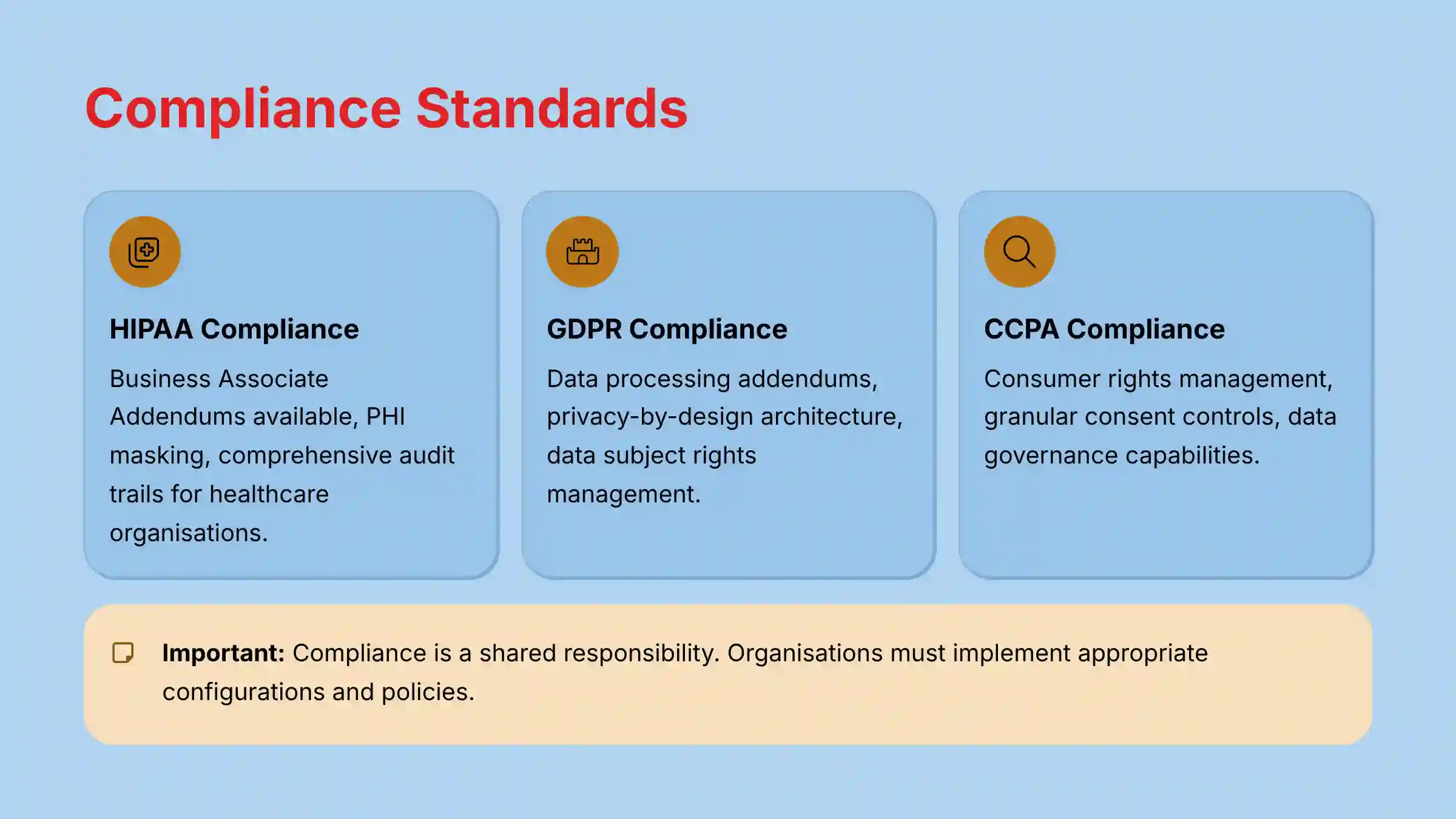
Salesforce Einstein can achieve compliance with HIPAA, GDPR, and CCPA requirements through proper configuration and adherence to Salesforce’s compliance frameworks, though organizations maintain ultimate responsibility for correct implementation and ongoing governance.
HIPAA Compliance for Healthcare Organizations is supported through Salesforce’s HIPAA-ready environment, which includes willingness to execute Business Associate Addendums (BAA) required for protected health information (PHI) handling. Within this environment, the Einstein Trust Layer becomes critical, automatically masking PHI before any generative AI processing and maintaining comprehensive audit trails for all AI interactions. Healthcare organizations must configure access controls, data governance policies, and encryption settings appropriately while ensuring staff training on compliant AI usage. The zero-retention policy for external AI model interactions provides additional PHI protection assurance.
GDPR Compliance is facilitated through Salesforce’s data processing addendums and privacy-by-design architecture. Einstein respects data subject rights including access, portability, and erasure through integrated Salesforce privacy tools. For AI features, the Trust Layer’s data masking capabilities help minimize personal data exposure while the zero-retention policy aligns with data minimization principles. Organizations can control which historical data is used for predictive AI model training and maintain granular consent management for AI-powered customer interactions.
CCPA Compliance leverages similar privacy controls as GDPR, including consumer rights management for access, deletion, and opt-out requests. Salesforce provides tools to honor these rights across all Einstein features while maintaining operational efficiency. The platform’s data governance capabilities enable organizations to track and manage personal information usage across AI workflows.
Risk Disclaimer: Compliance is a shared responsibility model. While Salesforce provides compliant tools and infrastructure, organizations must implement appropriate configurations, policies, and training. All healthcare and regulated industry deployments should include legal and compliance team validation of specific Einstein implementations against applicable regulatory requirements.
What are the known limitations or potential risks of implementing Salesforce Einstein for customer support?
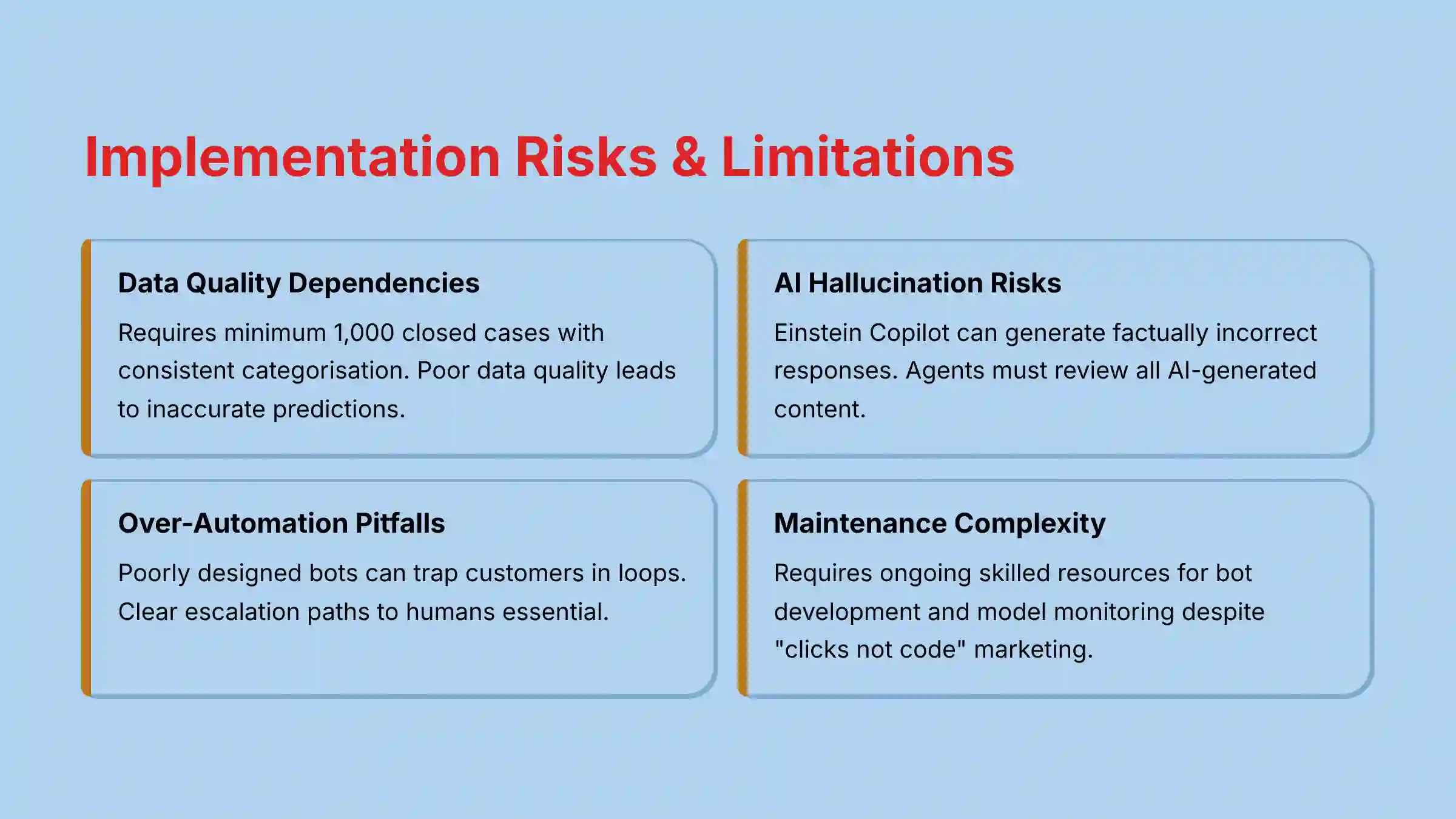
Implementing Salesforce Einstein requires understanding specific limitations and risk factors that can impact deployment success and ongoing performance, particularly around data quality dependencies, AI accuracy challenges, and implementation complexity.
Data Quality and Volume Dependencies represent the most significant implementation risk. Einstein’s predictive capabilities like Case Classification and Article Recommendations require high-quality historical data for effective training. Organizations need at least 1,000 closed cases with consistent categorization and resolution patterns. Poor data quality, inconsistent case categorization, or insufficient historical volume will result in inaccurate AI predictions and recommendations. The most critical pre-implementation task involves comprehensive data cleansing and standardization, which can require significant time and resources before Einstein activation.
Generative AI Accuracy and Hallucination Risks pose ongoing operational challenges. Einstein Copilot can generate responses containing factually incorrect information not present in source knowledge bases, despite Trust Layer grounding mechanisms. This creates risk if agents send AI-generated responses without proper review and validation. Organizations must establish clear agent guidelines for AI-generated content review and implement quality assurance processes to catch potential inaccuracies before customer communication.
Over-Automation and Customer Experience Degradation occurs when Einstein Bots are poorly designed without clear escalation paths to human agents. Bots that trap customers in repetitive loops or fail to recognize complex issues can severely damage customer satisfaction. The focus should remain on automating routine, straightforward inquiries while ensuring frustrated customers can easily reach human support when needed.
Implementation and Maintenance Complexity requires ongoing skilled resources despite “clicks not code” marketing. Effective bot development, prediction model monitoring, and generative AI prompt optimization demand dedicated Salesforce administration expertise. Organizations need sustained internal capability or external partner support to maintain AI performance and realize ongoing value.
Risk Mitigation Strategy: Invest heavily in knowledge base quality before deploying generative AI features. Well-maintained, accurate knowledge articles serve as guardrails for AI responses, significantly reducing hallucination risks while building agent confidence in AI-generated suggestions.
What is the pricing model for Salesforce Einstein? Is it included in Service Cloud or a separate add-on?
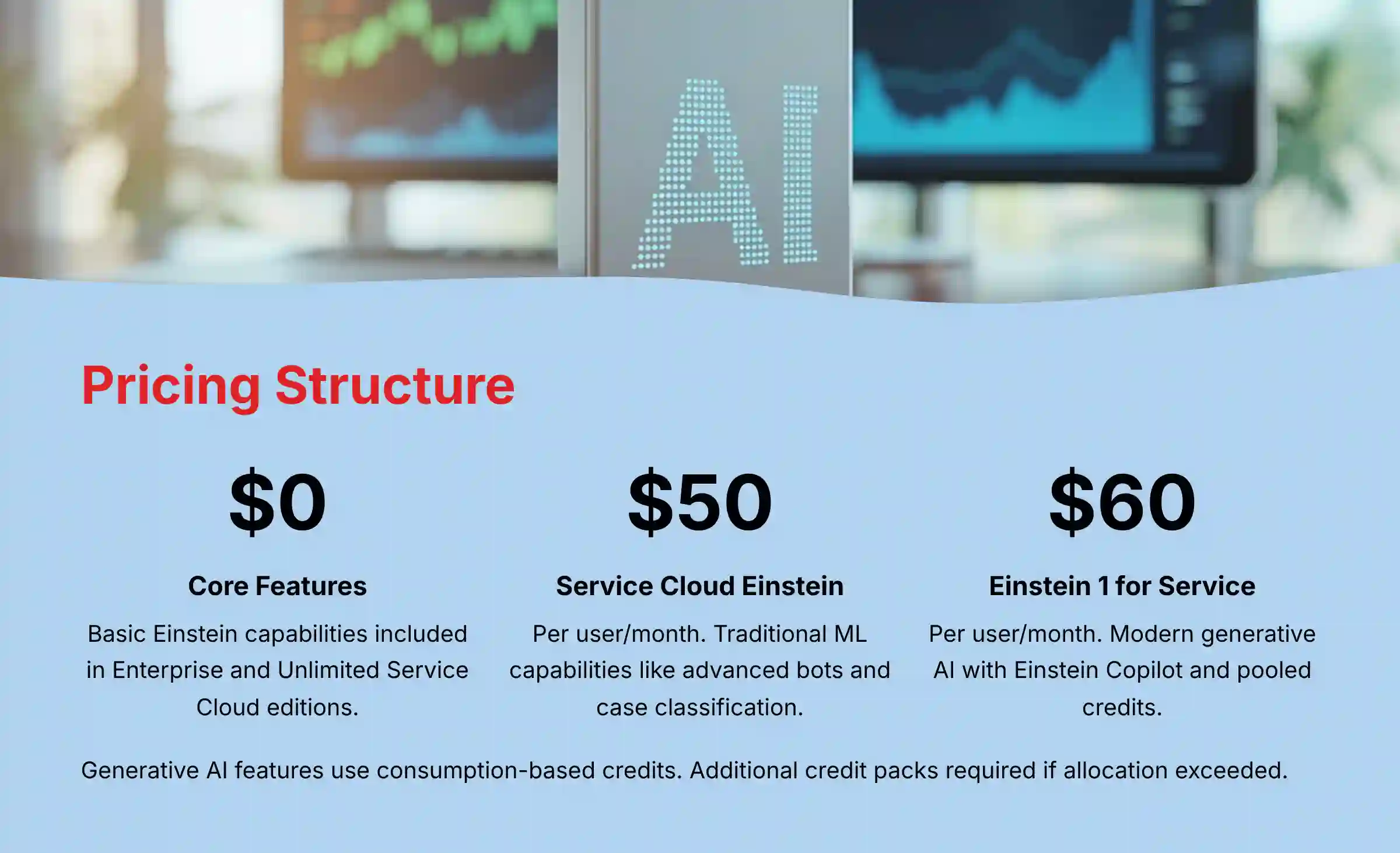
Salesforce Einstein pricing follows a multi-tier model combining included features in core licenses with premium add-ons and consumption-based pricing for advanced generative AI capabilities, requiring careful evaluation of specific organizational needs and usage patterns.
Core Service Cloud Inclusions provide foundational Einstein capabilities within Enterprise and Unlimited Service Cloud editions. These typically include basic predictive features like Case Classification, Article Recommendations, and limited Einstein Bot functionality. The goal is delivering immediate AI value within existing subscriptions, though advanced capabilities require additional licensing.
Einstein Add-on Licensing encompasses two distinct product categories with different feature sets and pricing structures:
- Service Cloud Einstein ($50/user/month as of 2024) includes predictive AI tools like advanced Einstein Bots, Case Classification, and Einstein Article Recommendations. This add-on focuses on traditional machine learning capabilities without generative AI features.
- Einstein 1 for Service ($60/user/month) provides access to modern generative AI capabilities including Einstein Copilot, AI-generated case summaries, response drafting, and next-best-action recommendations. This license includes pooled generative AI credits for organizational usage.
Consumption-Based Credit System applies specifically to generative AI features within Einstein Copilot. Actions like generating case summaries, drafting customer responses, or creating content consume credits from your annual allocation. Organizations exceeding their credit pool must purchase additional credit packs, similar to cloud computing usage models. Credit consumption rates vary by feature complexity and content length.
Critical Distinction: The older “Service Cloud Einstein” add-on does not include generative AI credits or Einstein Copilot access. Organizations seeking modern AI capabilities like automated response drafting must purchase “Einstein 1 for Service” or equivalent Einstein 1 editions.
Risk Disclaimer: Salesforce pricing and packaging evolve frequently. All pricing details, feature inclusions, and credit allocations must be verified directly with your Salesforce Account Executive before purchasing decisions. They provide accurate quotes based on existing contracts, regional pricing, and specific feature requirements.
How can we measure the ROI of implementing Salesforce Einstein for our customer service team?
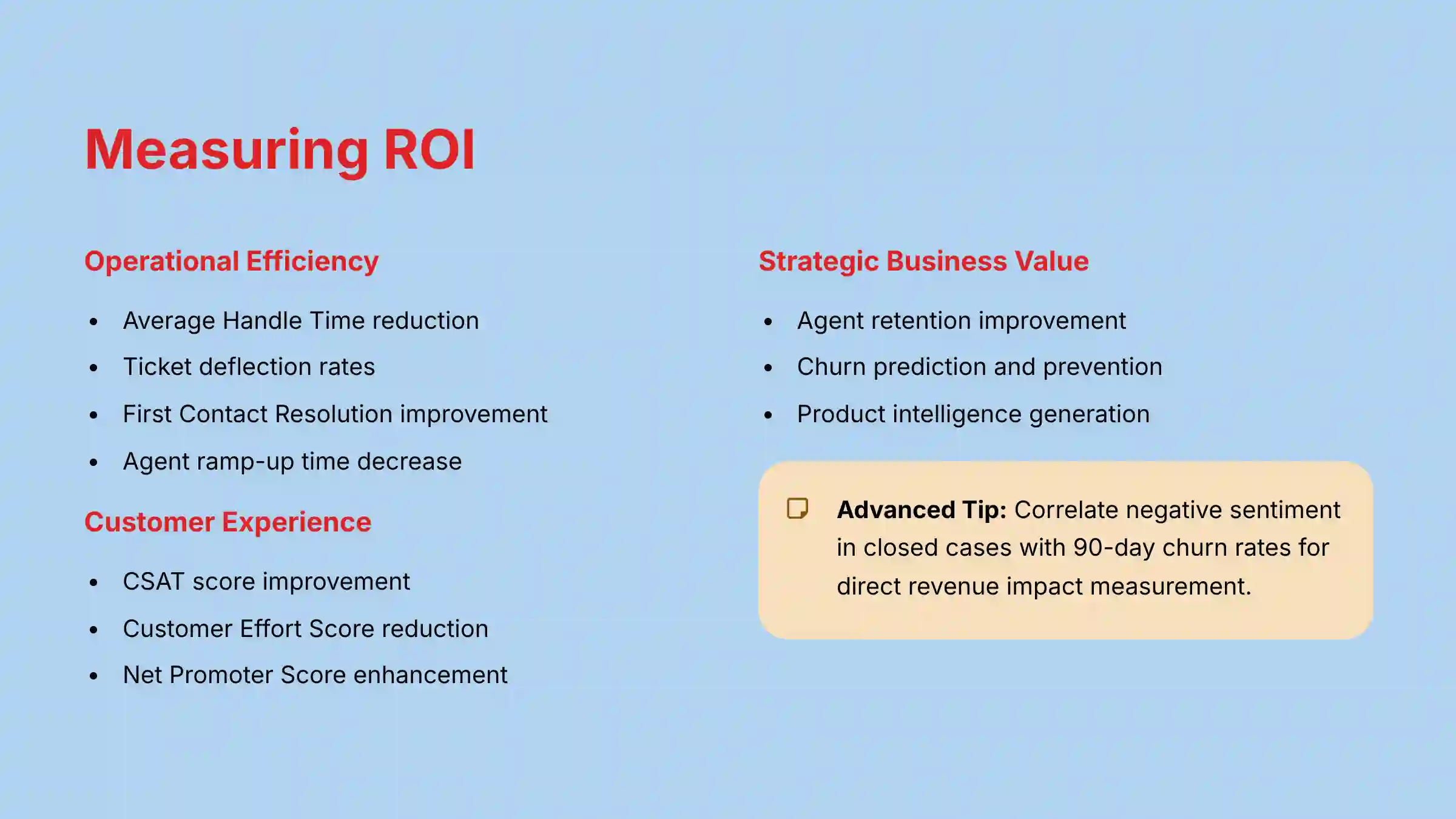
Measuring Salesforce Einstein ROI requires comprehensive analysis across operational efficiency, customer experience, and strategic business value metrics to demonstrate both immediate cost savings and long-term revenue impact for customer support investments.
Operational Efficiency Metrics provide the most direct ROI calculations through measurable cost reductions:
- Average Handle Time (AHT) Reduction tracks how AI-generated responses and case summaries decrease resolution time per interaction. Even 30-second reductions per case multiply significantly across thousands of monthly interactions.
- Ticket Deflection Rate measures Einstein Bot effectiveness in resolving customer inquiries without agent involvement, directly reducing labor costs and increasing capacity for complex issues.
- First Contact Resolution (FCR) Improvement demonstrates how intelligent case routing and AI-powered agent assistance increase single-interaction resolution rates, reducing repeat contacts and associated costs.
- Agent Ramp-Up Time quantifies how AI assistance accelerates new hire productivity, reducing training costs and time-to-contribution for support team expansion.
Customer Experience Impact Metrics connect AI implementation to customer loyalty and retention:
- Customer Satisfaction (CSAT) Score Improvement demonstrates how faster, more accurate AI-assisted resolutions enhance customer perceptions and satisfaction ratings.
- Customer Effort Score (CES) Reduction measures how AI-powered self-service and improved agent efficiency reduce customer effort required for issue resolution.
- Net Promoter Score (NPS) Enhancement tracks overall customer advocacy improvements resulting from superior support experiences enabled by AI capabilities.
Strategic Business Value Indicators demonstrate Einstein’s contribution to broader organizational success:
- Agent Retention Improvement measures how AI empowerment reduces support team turnover, saving recruitment and training costs while maintaining institutional knowledge.
- Churn Prediction and Prevention uses Einstein analytics to identify at-risk customers based on support interaction patterns, enabling proactive retention efforts.
- Product Intelligence Generation leverages case sentiment and topic analysis to identify recurring issues and feature requests, providing valuable product development insights.
Advanced ROI Calculation: Create predictive models correlating negative sentiment in closed cases with 90-day customer churn rates, transforming support teams into proactive retention engines that demonstrate direct revenue impact and customer lifetime value protection.
Do we need a Salesforce implementation partner to successfully deploy Einstein for customer care?
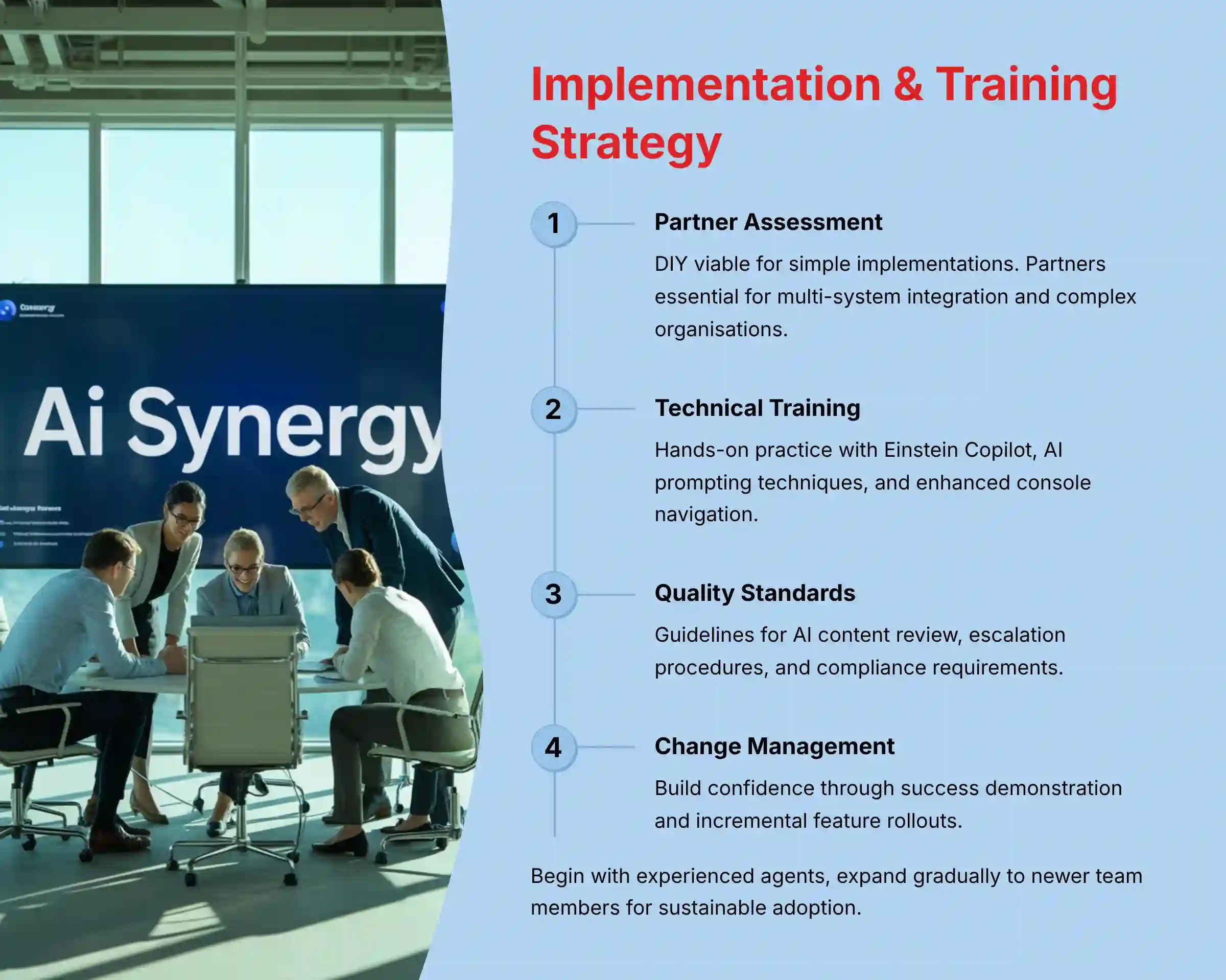
The need for a Salesforce implementation partner depends on organizational complexity, internal expertise, and project scope, with clear indicators helping determine the most cost-effective approach for successful Einstein deployment and ongoing optimization.
DIY Implementation is Viable When organizations have certified Salesforce administrators with Service Cloud experience and limited, well-defined objectives. Small teams with straightforward organizational structures can successfully implement basic features like Case Classification for single queues or simple FAQ bots with decision trees. Salesforce’s Trailhead documentation provides comprehensive guidance for standard configurations, and setup wizards streamline common implementations. This approach works best for organizations seeking quick wins with foundational Einstein capabilities before expanding to more complex use cases.
Implementation Partners Are Recommended For organizations with moderate complexity or ambitious integration requirements:
- Multi-System Integration Projects involving external ERPs, telephony providers, or third-party applications require specialized expertise in API development and data synchronization.
- Advanced Bot Development including Apex code integration, complex workflow automation, or sophisticated conversation flows benefits from partner experience and best practices.
- Large, Complex Organizations with multiple business units, varied support processes, or extensive customization needs require strategic guidance to ensure consistent implementation across departments.
- Custom AI Model Development using Einstein Prediction Builder for specialized use cases demands machine learning expertise and statistical modeling knowledge.
- Compliance-Heavy Industries requiring HIPAA, GDPR, or other regulatory adherence benefit from partners experienced in compliant AI implementations.
Partners Are Essential For comprehensive business transformations including CRM migrations, simultaneous Service Cloud and Einstein implementations, or global deployments with complex governance requirements. These high-stakes scenarios require strategic change management, technical expertise, and risk mitigation that experienced partners provide. Partners offer not just technical skills but strategic guidance on process re-engineering to maximize AI value realization.
Cost-Benefit Analysis: While DIY implementation saves upfront costs, partners often accelerate time-to-value and prevent costly mistakes that can exceed partner fees. For projects beyond basic feature activation, partner investment typically pays for itself through faster deployment, better adoption rates, and more impactful long-term results.
What specific training and onboarding do agents need for Salesforce Einstein features?
Successful Einstein adoption requires structured agent training that addresses both technical functionality and behavioral changes necessary for effective AI-assisted customer support, with emphasis on building confidence and establishing quality standards for AI-powered interactions.
Technical Skills Training covers core Einstein feature operation and daily workflow integration. Agents need hands-on practice with Einstein Copilot prompting techniques, understanding how to request case summaries, generate response drafts, and interpret AI-suggested knowledge articles. Training should include practical exercises in reviewing and editing AI-generated content, understanding when AI suggestions are appropriate versus when human expertise is essential. Agents must learn to navigate the enhanced Service Cloud console interface, manage AI-powered case routing notifications, and utilize real-time knowledge recommendations effectively during customer interactions.
AI Collaboration Best Practices focus on developing judgment for AI-assisted workflows. Agents require training on reviewing AI-generated responses for accuracy, tone, and completeness before sending to customers. This includes understanding AI limitations, recognizing potential hallucinations or inaccuracies, and knowing when to override AI suggestions with human expertise. Training should emphasize AI as an enhancement tool rather than replacement, maintaining the human connection and empathy essential for customer relationship building while leveraging AI for efficiency gains.
Quality Assurance and Compliance Training ensures agents understand organizational standards for AI usage. This includes guidelines for when AI-generated content requires additional review, escalation procedures for complex AI recommendations, and compliance requirements for industries like healthcare or finance. Agents need clear protocols for handling sensitive customer information when using AI features, understanding how the Trust Layer protects data while maintaining service quality standards.
Change Management and Confidence Building addresses natural resistance to AI adoption through structured support and success demonstration. Training should include real scenarios showing how Einstein improves job satisfaction by reducing repetitive tasks and enabling focus on complex, rewarding customer problems. Ongoing reinforcement through manager coaching, peer success sharing, and incremental feature rollouts helps build agent confidence and enthusiasm for AI-powered capabilities.
Recommended Implementation Timeline: Begin with Einstein basics for experienced agents, gradually expanding to newer team members as internal expertise develops, ensuring sustainable adoption and peer mentoring capabilities.

Leave a Reply