Struggling with Ada Alternatives?
This 2-Minute Quiz Finds Your Perfect AI Customer Care Tool!
As the founder of Best AI Customer Care Central, I’ve spent years analyzing AI Customer Care Tools. In 2025, CX leaders face a critical decision when looking for Ada Top Alternatives and Competitors. This isn’t just about features; it’s a strategic choice between different philosophies. You can choose a specialized automation engine like Ada, an integrated platform like Zendesk AI, a conversational leader like Intercom, or an enterprise orchestrator like LivePerson.
This deep-dive comparison moves past marketing claims. We will analyze core trade-offs in automation efficiency, platform integration, and customer experience. Choosing the right tool has major financial and security implications. This guide provides a framework for that choice, but professional consultation with your security and legal teams is a mandatory step before procurement. My focus is on providing a clear path through the complex world of AI-Powered Customer Support.
Key Takeaways
- Core Trade-Off: Ada offers the highest automation potential but comes with a big financial risk. Zendesk AI is the safest, most integrated platform play for its existing customers. Intercom delivers a superior customer experience but at a premium price.
- Security Winner: Ada and LivePerson are top choices for regulated industries. Ada offers HIPAA compliance and isolated deployments. Zendesk AI is the “safe,” pre-vetted choice for most enterprise IT teams but has important HIPAA limitations.
- Financial Risk Alert: Ada’s usage-based pricing model can lead to unpredictable, very high bills. This requires strict cost management. Zendesk AI offers the most predictable Total Cost of Ownership (TCO).
- Agent Experience (AX): Zendesk AI gives the most unified agent workflow. In my testing, Ada suffers from a frequently reported disconnected agent handoff experience, which can frustrate both agents and customers.
- Customer Experience (CX): Intercom’s “Fin” AI provides an almost human-like conversational experience. It is best-in-class for customer engagement.
- Expert Guidance: Your choice depends on your main goal. For maximum ticket deflection, look at Ada. For agent efficiency, Zendesk AI is the fit. For proactive customer engagement, Intercom leads.
Our AI Customer Care Comparison Methodology
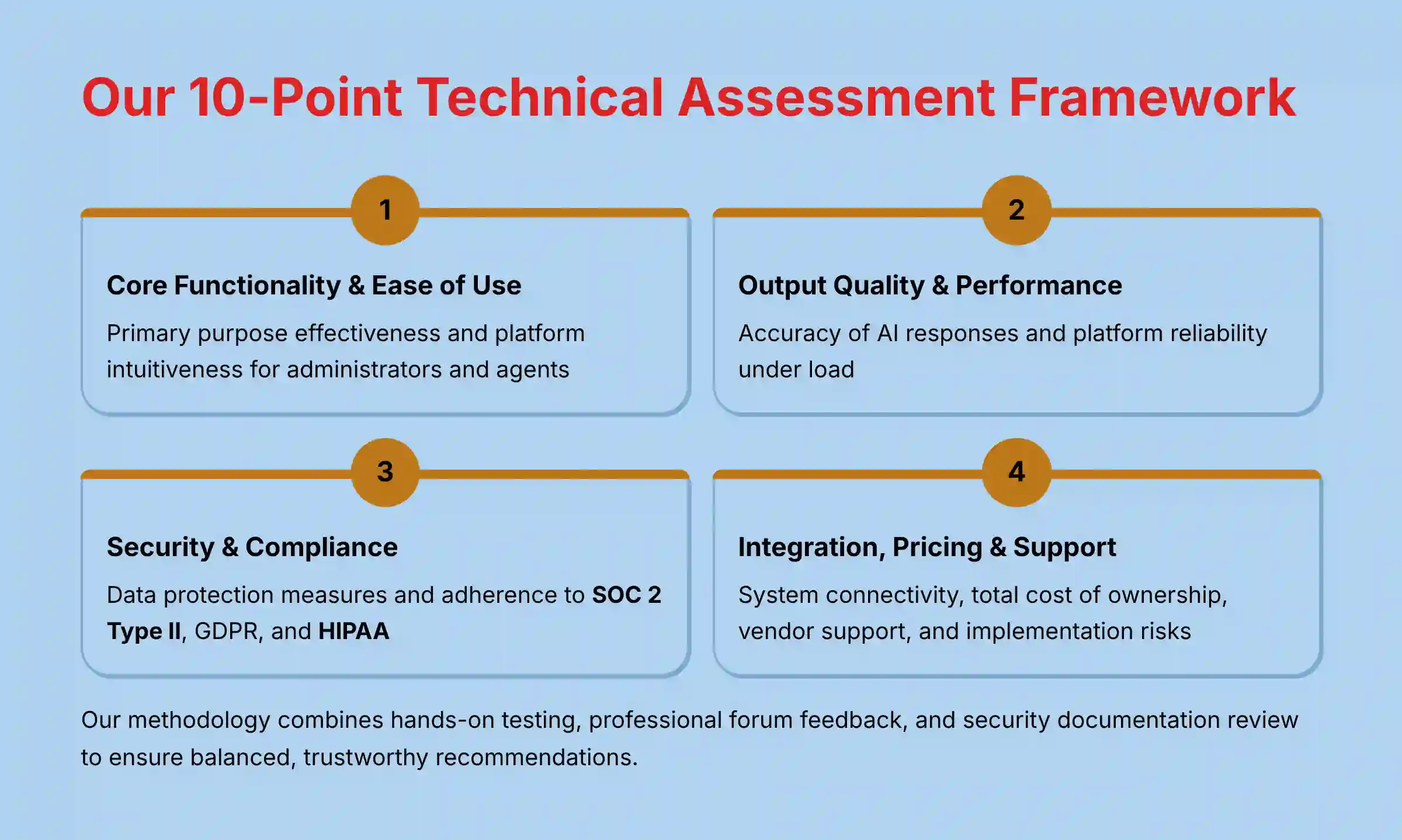
After analyzing over hundreds of tools on the market in AI Customer Care Tools and testing Ada Top Alternatives and Competitors across numerous real-world implementation projects in 2025, our team at Best AI Customer Care Central now provides a comprehensive 10-point technical assessment framework. My analysis combines hands-on testing, feedback from professional forums, and a careful review of security documentation. This ensures our recommendations are balanced and trustworthy.
Our evaluation framework is built on these ten points:
- Core Functionality: What is the tool’s primary purpose and how well does it achieve it?
- Ease of Use: How intuitive is the platform for both administrators and agents?
- Output Quality: How accurate and helpful are the AI’s responses and actions?
- Performance: How fast and reliable is the platform under load?
- Security Protocols: What measures are in place to protect sensitive customer data?
- Compliance: Does the tool meet key industry regulations like SOC 2 Type II, GDPR, and HIPAA?
- Integration: How well does it connect with core business systems like your CRM?
- Pricing: What is the total cost of ownership, including hidden fees?
- Support: What level of customer support does the vendor provide?
- Risk Assessment: What are the financial, operational, and security risks of implementation?
The 2025 Decision Framework: Choosing Your AI Customer Care Strategy
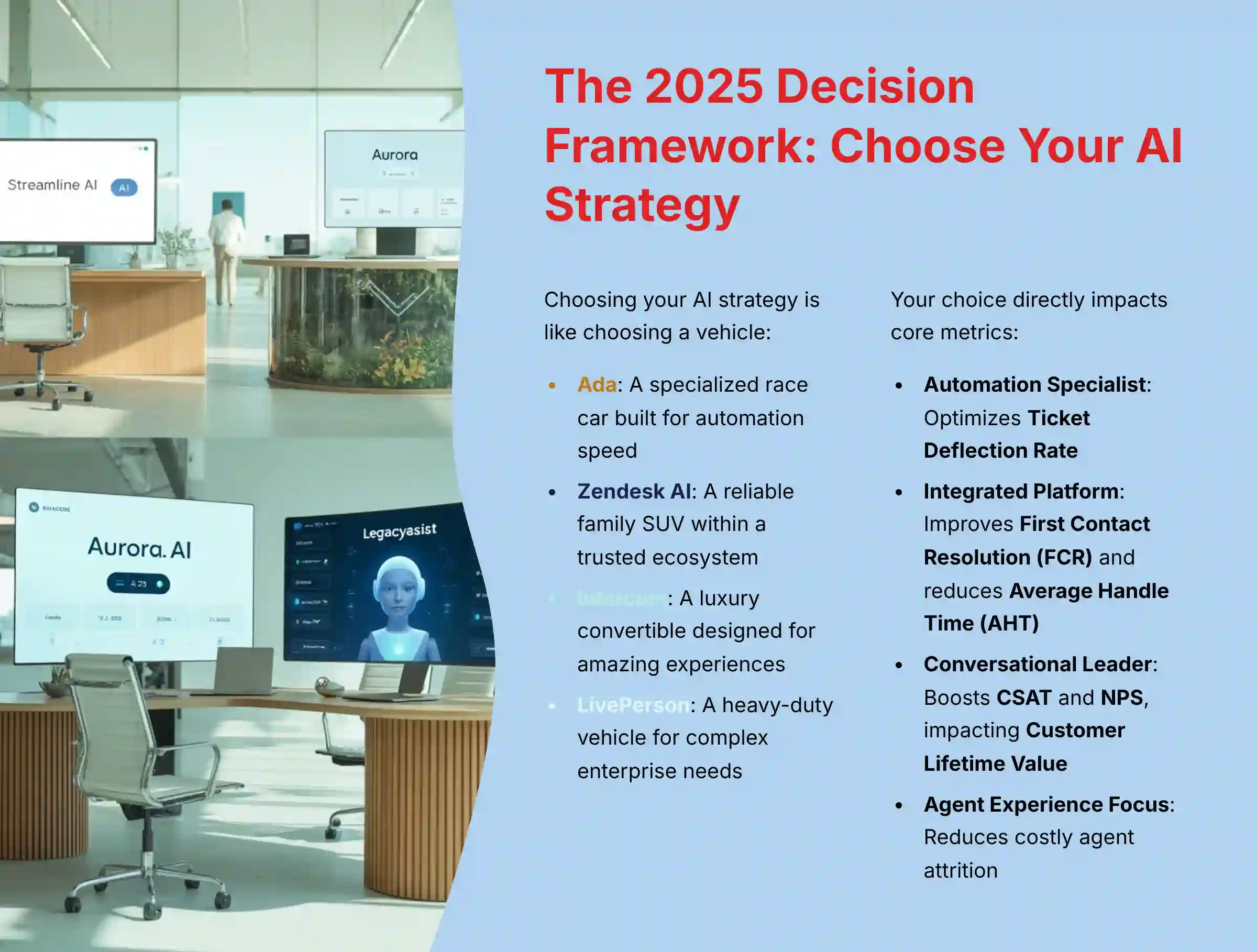
Choosing your AI strategy is like choosing a vehicle. Ada is a specialized race car built for one thing: speed of automation. Zendesk is a reliable family SUV that’s part of an ecosystem you already trust. Intercom is a luxury convertible, designed for an amazing experience. Each serves a different purpose.
Your choice of strategy will directly impact core contact center metrics. The Automation Specialist (Ada) is designed to optimize Ticket Deflection Rate above all else. The Integrated Platform Play (Zendesk AI) aims to improve First Contact Resolution (FCR) and reduce Average Handle Time (AHT) by empowering agents. The Conversational Experience Leader (Intercom) is built to boost Customer Satisfaction (CSAT) and Net Promoter Score (NPS), which in turn impacts Customer Lifetime Value (LTV). Finally, a focus on Agent Experience (AX) can lead to a measurable reduction in costly agent attrition.
The Automation Specialist (Ada)
This strategy focuses on maximizing ticket deflection above all else. The main goal is to contain and resolve as many customer queries as possible without human help. This approach is best for companies with high volumes of repetitive, transactional support requests, like in e-commerce or telecommunications. The risk here is purely financial, as Ada’s usage-based pricing can become very expensive if not managed carefully.
The Integrated Platform Play (Zendesk AI)
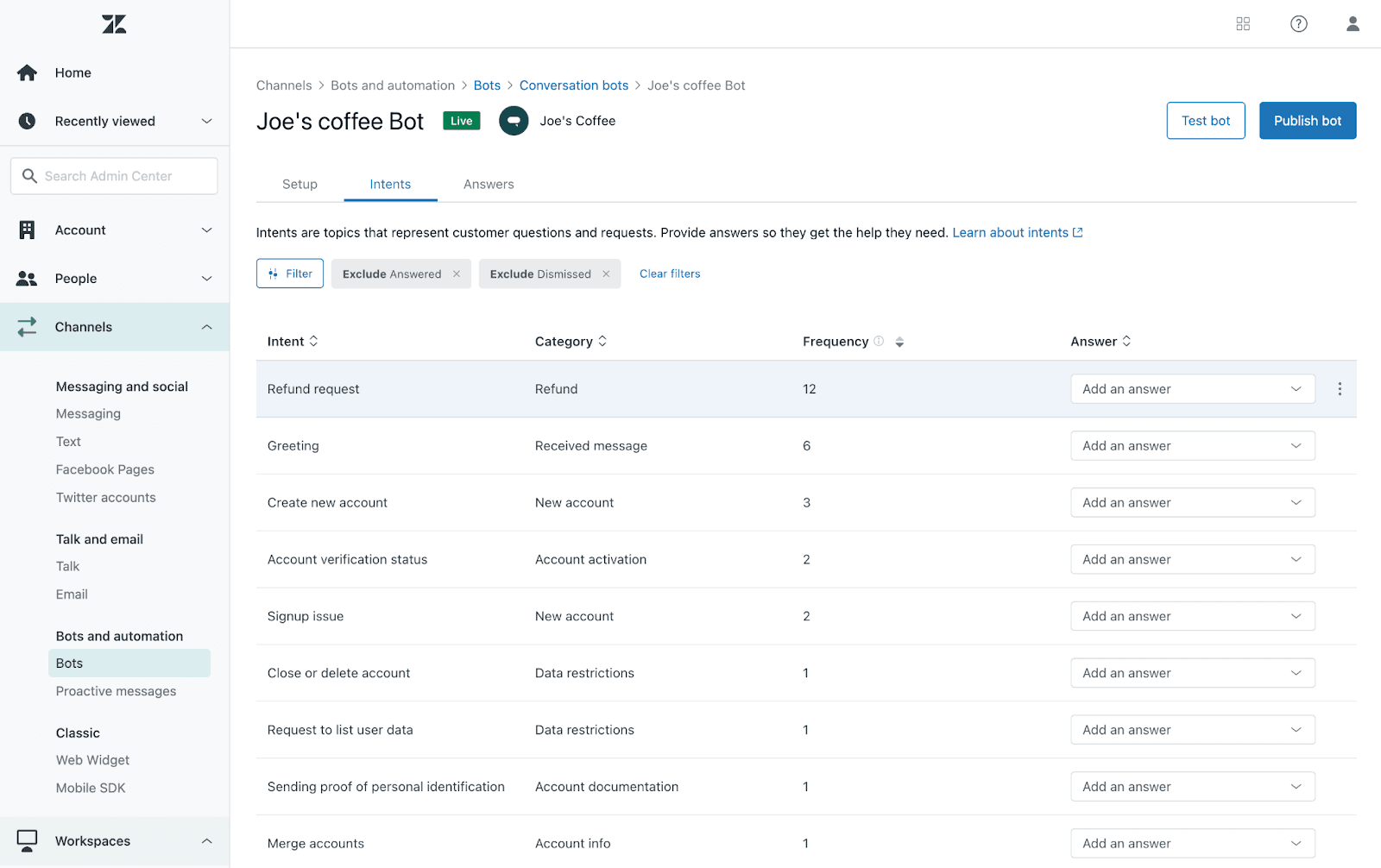
This strategy is about enhancing an existing ecosystem. It is the best choice for companies that already use Zendesk and prioritize a unified agent experience. With a single data model and predictable costs, it is the lowest-risk option from an operational and security standpoint. The AI here makes your current team more efficient rather than replacing them.
The Conversational Experience Leader (Intercom)
This approach uses support as a tool for growth. It works best for businesses where a great customer experience drives revenue and retention, such as in SaaS or FinTech. Intercom’s goal is to create proactive, intelligent interactions that feel personal and build loyalty. The primary risk is strategic and financial misalignment—investing a premium in CX for a business model that cannot directly monetize the enhanced engagement.
The Enterprise Orchestrator (LivePerson)
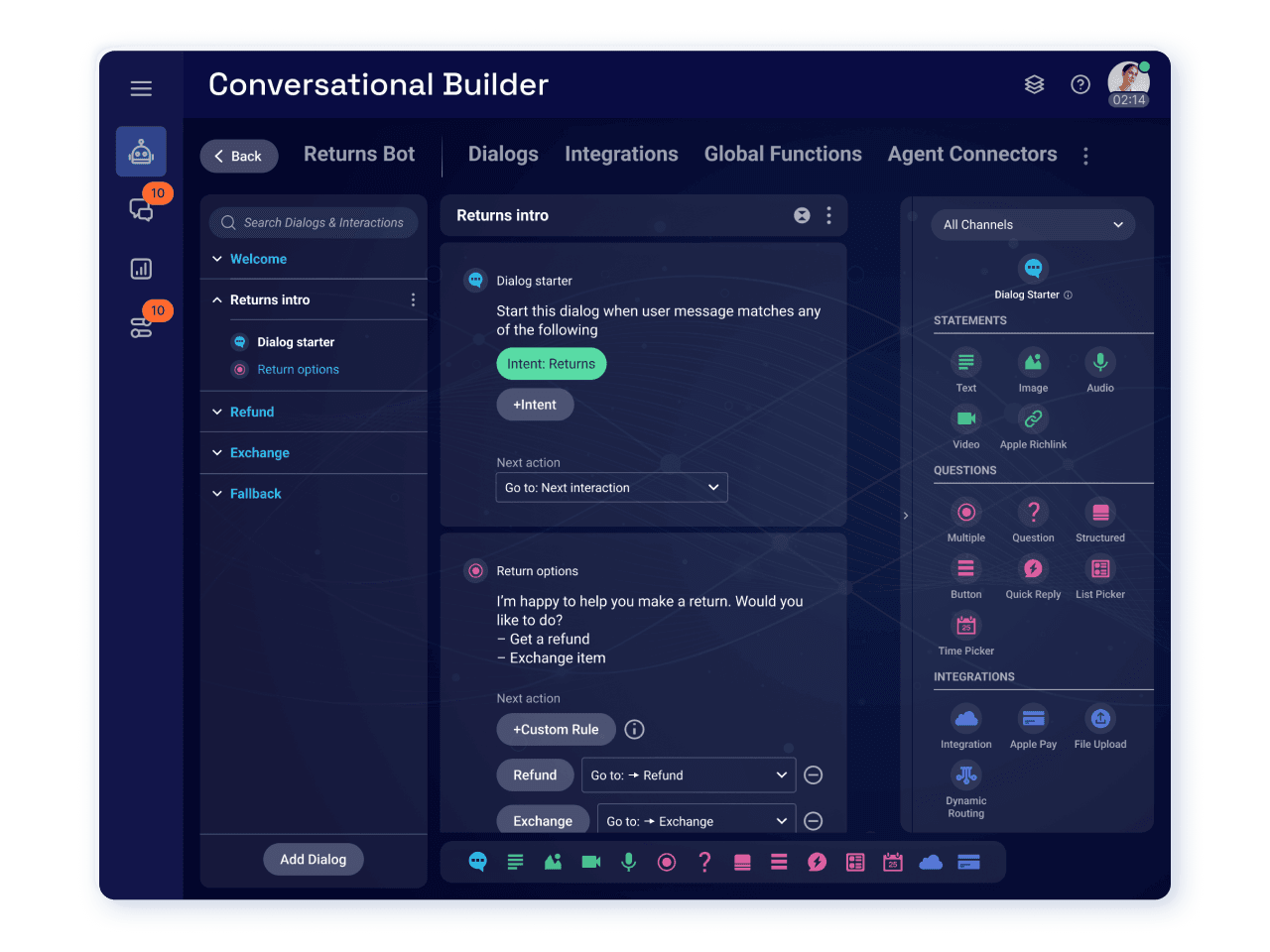
This strategy is for large, regulated organizations. It involves using a mature platform to manage automation based on strict business rules across many different channels. It’s ideal for complex workflows in industries like banking and insurance, where compliance is a top concern. The primary risk is implementation complexity and cost overrun, as these large-scale platforms require significant professional services and internal resources to deploy successfully.
Core Capabilities and AI Innovation Compared
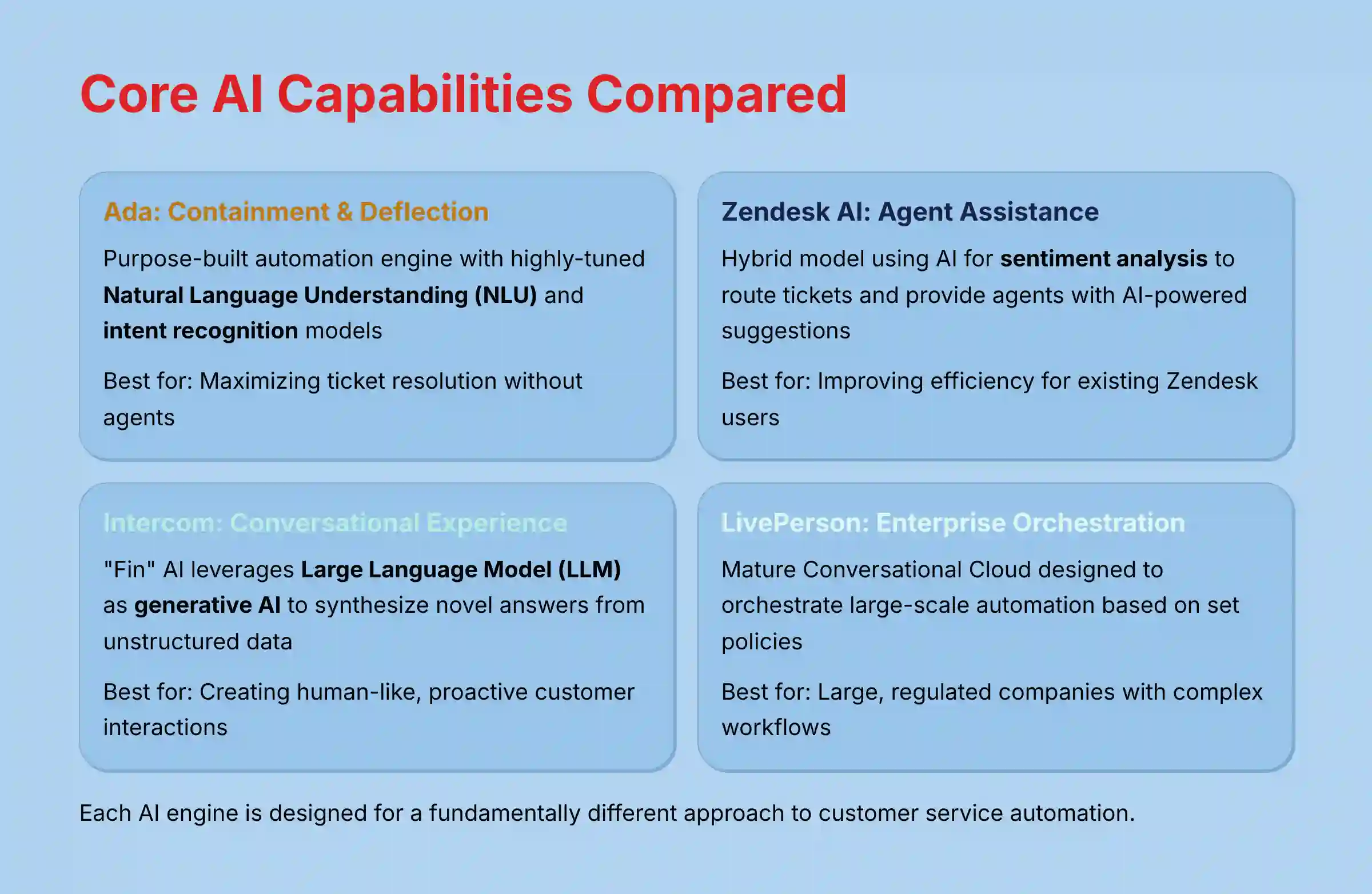
The AI engine inside each tool is designed for a different job. Ada is built to contain conversations. Zendesk AI is built to assist agents. Intercom is built to have natural, complex conversations with customers.
Beyond marketing terms, the “AI engine” in these platforms is powered by distinct technologies. Ada’s strength lies in its highly-tuned Natural Language Understanding (NLU) and intent recognition models, which are purpose-built to map user requests to pre-defined automation flows. This makes it incredibly efficient for known issues.
Intercom’s Fin, in contrast, leverages a Large Language Model (LLM), operating as a generative AI. This allows it to synthesize novel answers from unstructured data, a fundamentally different approach. Zendesk AI uses a hybrid model, applying AI for sentiment analysis to route tickets and providing agents with AI-powered suggestions, focusing on assistance rather than full autonomy. A technical due diligence cycle must validate which model best fits your use case complexity and data governance requirements.
LivePerson offers a mature Conversational Cloud. It is designed to orchestrate large-scale automation based on set policies, making it a reliable choice for big companies.
| Tool | Primary AI Goal | Key Innovation | Best For |
|---|---|---|---|
| Ada | Containment and Deflection | Purpose-built automation engine | Maximizing ticket resolution without agents |
| Zendesk AI | Agent Assistance and Efficiency | AI tools embedded in agent workspace | Improving efficiency for existing Zendesk users |
| Intercom | Conversational Experience | “Fin” AI reasons from unstructured data | Creating human-like, proactive customer interactions |
| LivePerson | Enterprise Orchestration | Policy-driven automation at scale | Large, regulated companies with complex workflows |
Dual Experience (AX and CX) Showdown: Agent and Customer UI/UX
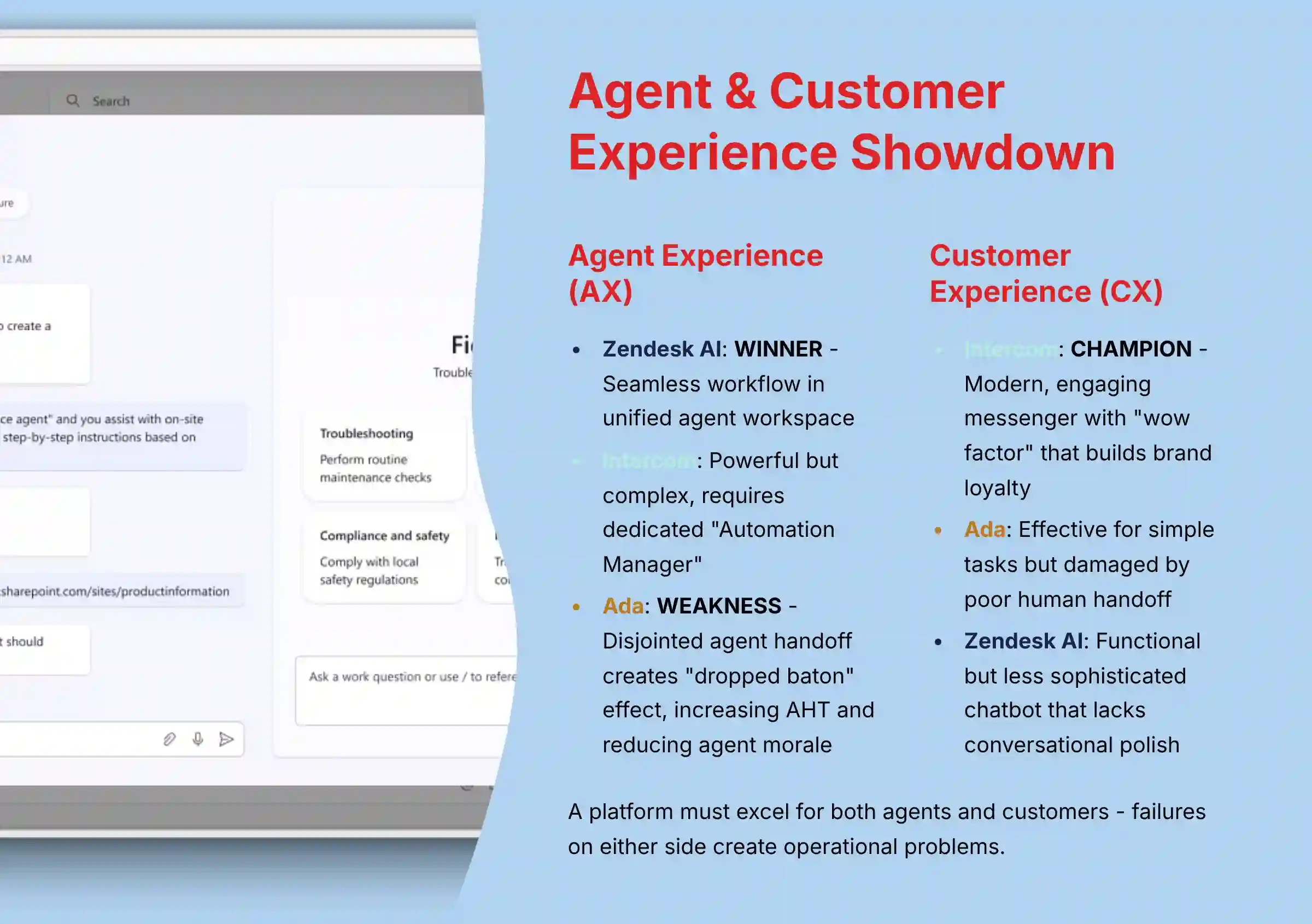
A platform must work well for two sets of users: your agents and your customers. A bad experience for either group creates problems. My testing reveals clear winners and losers in both Agent Experience (AX) and Customer Experience (CX).
Agent Experience (AX)
- Zendesk AI: This is the clear winner for AX. Because its AI tools are built directly into the Zendesk agent workspace, the workflow is seamless. Agents don’t need to switch screens, which makes them faster and more effective.
- Intercom: The platform is powerful, but it’s also complex. It often requires a full-time “Automation Manager” to get the most out of it. The agent experience is good but has a steeper learning curve.
- Ada: This is Ada’s biggest weakness. Users consistently report a disjointed agent handoff. The agent handoff in Ada can feel like a relay race where the runners drop the baton. The customer has to stop, pick it up, and start the race all over again with the human agent. Operationally, this translates directly to a higher Average Handle Time (AHT), lower agent morale, and a significant drop in CSAT scores for escalated issues, undermining the very efficiency gains the tool promises.
Customer Experience (CX)
- Intercom: Intercom is the champion of CX. Its messenger is modern and engaging, and its “Fin” AI can handle complex issues in a way that feels almost magical to customers. It creates a “wow” factor that builds brand loyalty.
- Ada: The customer-facing bot is effective for simple tasks. But the experience is badly damaged by the poor handoff to a human agent. This moment of friction can erase any goodwill the bot created.
- Zendesk AI: Its customer-facing chatbot is functional but generally considered less sophisticated than its competitors. It gets the job done for basic questions but lacks the conversational polish of Intercom.
YMYL CHECKPOINT: Security, Compliance, and Data Governance
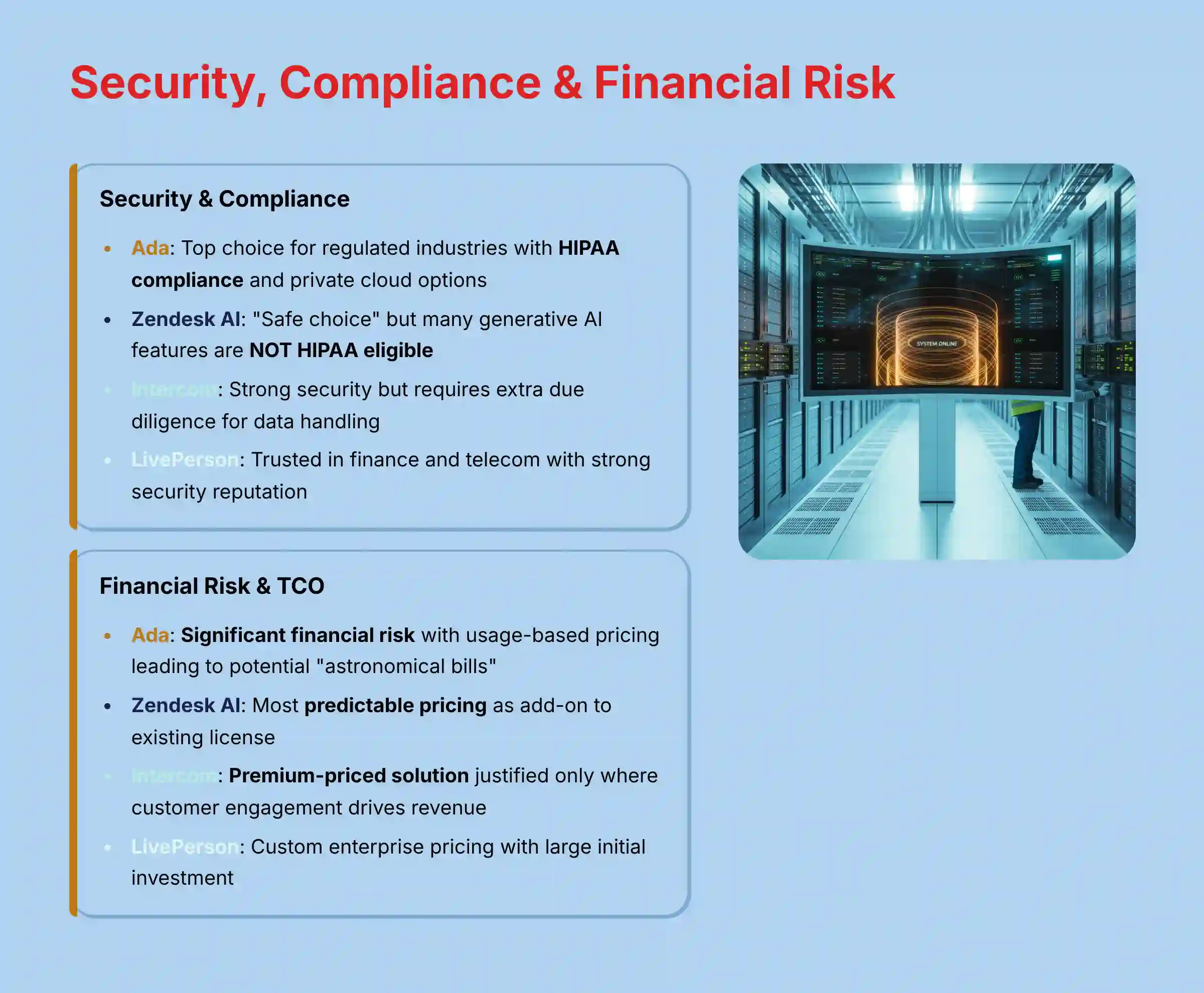
For any enterprise, security is not just a feature; it’s a foundation. A data breach can destroy customer trust and lead to massive fines. My assessment places a heavy weight on each platform’s security and compliance posture.
Beyond standard certifications, your CISO and Data Protection Officer (DPO) must scrutinize specifics. Key points for your security questionnaire should include:
- Data Residency: Can the vendor guarantee that all customer data will be processed and stored within a specific geographic region (e.g., EU or North America) to comply with data sovereignty laws? Ada and LivePerson often provide this as a premium feature.
- Automatic PII Redaction: Does the platform’s AI automatically identify and redact Personally Identifiable Information (PII) like credit card numbers or social security numbers from conversation logs and agent screens? This is a critical control for PCI DSS and GDPR compliance.
- Role-Based Access Controls (RBAC): How granular are the user permissions? Can you restrict access to sensitive customer conversations based on agent roles, teams, or specific security clearance levels?
All platforms here have essential certifications like SOC 2 Type II and are GDPR compliant. But the details matter. Choosing a vendor is often decided by the CISO (Chief Information Security Officer), not the Head of Support. A thorough, independent security review and data processing agreement (DPA) analysis is a mandatory step before procurement.
- Ada: It is highly praised for its enterprise security. Ada is a top choice for regulated industries like healthcare because it offers HIPAA compliance and options for private cloud deployments, which keep data isolated.
- Zendesk AI: This is the “safe choice” for most corporate IT teams. Its security model is mature and well-understood. As one IT Director told me in an interview, “Our CISO approved Zendesk AI quickly… It’s a known quantity.” However, it’s critical to note that while the core Zendesk Suite can be made HIPAA compliant with their “Advanced Compliance” add-on and a signed BAA, many of Zendesk’s flagship generative AI features are NOT HIPAA eligible. These include key features like Summarization, Tone Shift, and Expand, which are explicitly excluded from HIPAA eligibility and cannot be used with protected health information (PHI).
- Intercom: This platform faces the most questions due to its advanced generative AI. While it has strong security, legal teams often need extra months of due diligence to get comfortable with its data handling practices.
- LivePerson: It has a long-standing reputation for security in the finance and telecom industries. It’s a trusted partner for companies that cannot afford any risk.
| Tool | SOC 2 Type II | ISO 27001 | GDPR Compliant | HIPAA Compliant | Private Cloud Option |
|---|---|---|---|---|---|
| Ada | ✔️ | ✔️ | ✔️ | ✔️ | ✔️ |
| Zendesk AI | ✔️ | ✔️ | ✔️ | Partially (Excludes Generative AI Features) | ❌ |
| Intercom | ✔️ | ✔️ | ✔️ | Via BAA | ❌ |
| LivePerson | ✔️ | ✔️ | ✔️ | ✔️ | ✔️ |
YMYL ANALYSIS: Total Cost of Ownership (TCO) and Financial Risk
YMYL Advisory: The TCO models discussed are for strategic comparison. Due to the high financial stakes and variability of usage-based pricing, you must engage your finance team to model worst-case scenarios based on your specific historical volume data before signing any contract.
The price tag is only the beginning of the story. The true cost of a platform includes implementation, maintenance, and potential hidden fees. This is a critical “Your Money” consideration.
Ada
Ada presents a significant financial risk. Its pricing is based on usage, such as per resolution. Multiple users have reported “astronomical bills” after unexpected spikes in customer support volume. Consider this real-world scenario: An e-commerce company faces an unexpected product recall, and their daily support ticket volume triples for two weeks. With Ada’s per-resolution pricing, a projected $20,000 monthly bill could easily become a $50,000 invoice, creating a budget crisis that requires CFO-level explanation. While it can deliver a high ROI, it requires you to have a team member dedicated to managing its costs.
Zendesk AI
This platform offers the most predictable pricing. The cost is usually an add-on to an existing Zendesk license. This makes it a very easy business case to present to your CFO. It provides a clear path to efficiency gains without the risk of surprise bills.
Intercom
Intercom is a premium-priced solution. The high cost is only justified for businesses where customer engagement directly drives revenue, like in high-end SaaS. It is not a good fit for low-margin businesses.
LivePerson
Pricing for LivePerson is fully custom and negotiated at the enterprise level. It involves a large initial investment in both licensing and professional services for implementation. It is built for a different scale of business.
Strengths and Weaknesses: A Head-to-Head Analysis
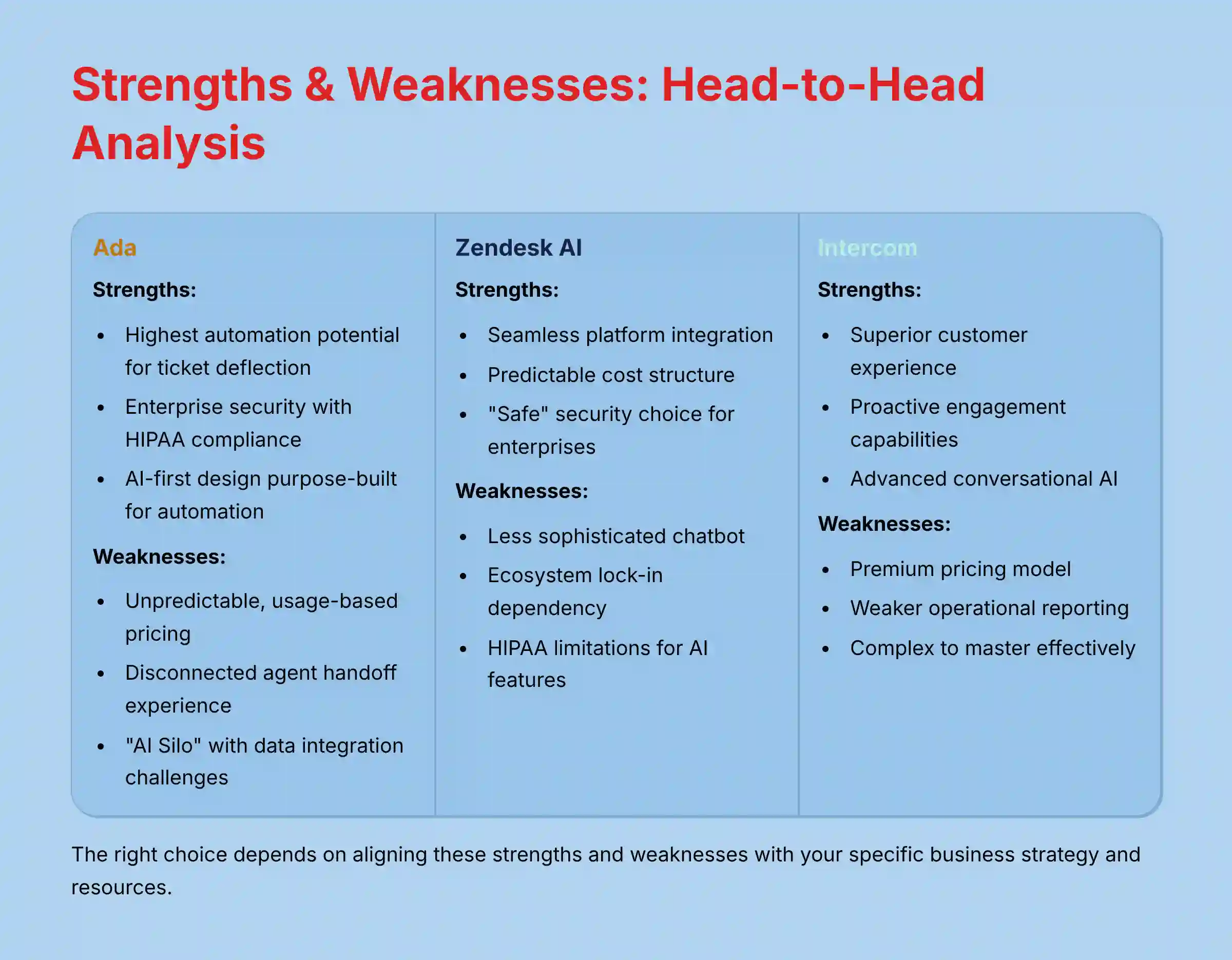
| Tool | Major Strengths | Major Weaknesses |
|---|---|---|
| Ada | 1. Highest Automation Potential: Best-in-class for ticket deflection. 2. Enterprise Security: Offers HIPAA compliance and isolated instances. 3. AI-First Design: Purpose-built for automation. |
1. Financial Risk: Unpredictable, usage-based pricing. 2. Disconnected Agent Handoff: Creates a poor experience. 3. “AI Silo” and Data Integration Challenges: The platform’s AI-first design can lead to an operational data silo. Conversation data doesn’t easily sync back to your central CRM, preventing the creation of a Unified Customer Profile. This requires significant custom development via limited API endpoints and webhooks, creating a data governance challenge and potentially violating the “single source of truth” principle for customer data. |
| Zendesk AI | 1. Seamless Platform Integration: Unified agent experience and data model. 2. Predictable Cost: Simple add-on to existing licenses. 3. “Safe” Security Choice: Well-vetted by enterprise security teams. |
1. Underwhelming AI: Chatbot is less sophisticated than competitors. 2. Ecosystem Lock-in: Value depends on being a Zendesk customer. 3. Feels Like a Feature: AI is an add-on, not a core product. 4. HIPAA Limitations: Many generative AI features are explicitly excluded from HIPAA compliance. |
| Intercom | 1. Superior Customer Experience: “Magical” AI and engaging messenger. 2. Proactive Engagement: Bridges support and sales to drive growth. 3. Advanced Conversational AI: “Fin” can reason from unstructured data. |
1. Premium Pricing: High cost can be prohibitive. 2. Weaker Operational Reporting: Less robust for managing agent SLAs. 3. Complex to Master: Requires a dedicated owner to configure well. |
Professional Use Case and Recommendation Matrix
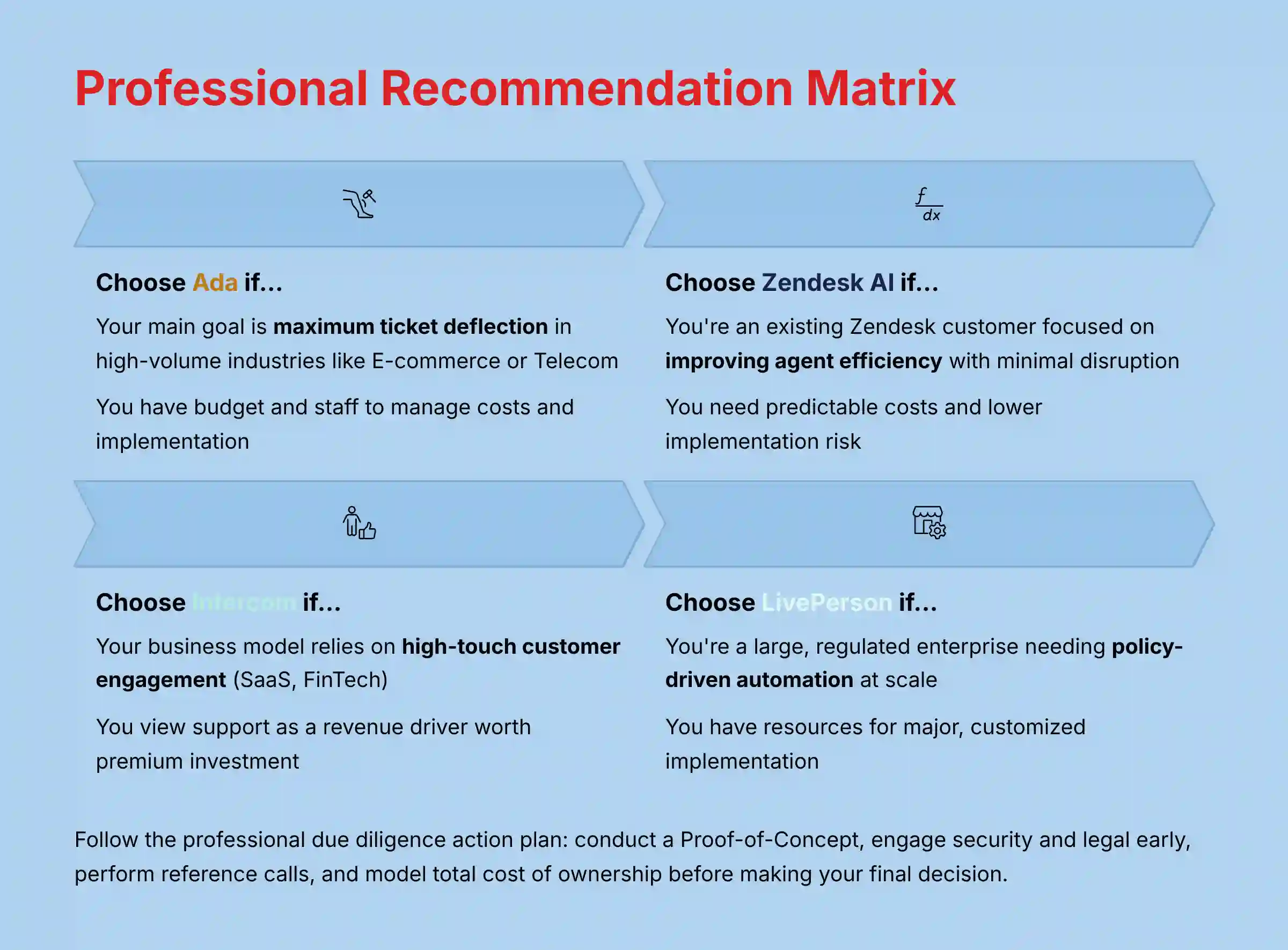
Your final choice should be based on your primary business goal. This is not about picking the “best” tool, but the right tool for your specific strategy.
- Choose Ada if… your main goal is maximum ticket deflection in a high-volume industry like E-commerce or Telecom. You must have the budget and internal staff to manage its cost and implementation.
- Choose Zendesk AI if… you are an existing Zendesk customer and your primary goal is improving agent efficiency with minimal disruption and risk. Note that if you’re in healthcare or handle PHI, you’ll need to carefully evaluate which AI features can be used in compliance with HIPAA.
- Choose Intercom if… your business model is built on high-touch customer engagement, like in SaaS or FinTech. You see support as a revenue driver and will pay a premium for a superior conversational experience.
- Choose LivePerson if… you are a large, regulated enterprise needing highly scalable, policy-driven automation and have the resources for a major, customized implementation.
Professional Due Diligence: A Mandatory YMYL Action Plan
This is a high-stakes decision. Do not rely on vendor demos alone. As a professional, you must conduct your own rigorous due diligence. Following this action plan will help you make a defensible, well-documented decision.
- Mandate a Proof-of-Concept (POC): Conduct a real-world bake-off. Give each vendor your actual knowledge base and a list of your top 20 most common customer questions. Measure their performance head-to-head.
- Engage Security and Legal Early: Involve your CISO and DPO from day one. You must demand and carefully review each vendor’s full SOC 2 Type II report, their standard Data Processing Agreement (DPA), and the results of their latest third-party penetration testing reports. Ask pointed questions about their data breach notification procedures, sub-processor lists, and how they handle customer data for training their AI models. A vendor’s transparency on these items is a strong indicator of their security maturity.
- Conduct Rigorous Reference Calls: Speak to at least two current enterprise customers for each vendor. Ask them about their Total Cost of Ownership (TCO) and specifically ask: ‘What was the difference between your projected cost in the sales cycle and your actual bill in your highest-volume month?’ Inquire deeply about the day-to-day reality of the agent-handoff experience.
- Model Total Cost of Ownership: Look beyond the license fee. Factor in implementation costs, the potential need for new roles like an “Automation Manager” for Ada, and model worst-case cost scenarios for any usage-based pricing.
Important Disclaimers:
Technology Evolution Notice: The information about Ada Top Alternatives and Competitors and AI Customer Care Tools tools presented in this article reflects our thorough analysis as of 2025. Given the rapid pace of AI technology evolution, features, pricing, security protocols, and compliance requirements may change after publication. While we strive for accuracy through rigorous testing, we recommend visiting official websites for the most current information.
Professional Consultation Recommendation: For AI Customer Care Tools applications with significant professional, financial, or compliance implications, we recommend consulting with qualified professionals who can assess your specific requirements and risk tolerance. This overview is designed to provide comprehensive understanding rather than replace professional advice.
Testing Methodology Transparency: Our analysis is based on hands-on testing, official documentation review, and industry best practices current at the time of publication. Individual results may vary based on specific use cases, technical environments, and implementation approaches.
Frequently Asked Questions (FAQs)
What is the main difference between Ada and Intercom’s AI?
The main difference is their purpose. Ada’s AI is built for structured automation to resolve issues without a human, focusing on containment rate. Intercom’s “Fin” AI is designed for dynamic, human-like conversations, using your knowledge base to answer complex questions it hasn’t been explicitly trained on.
Is Zendesk AI powerful enough to be a true Ada alternative?
It depends on your goal. For existing Zendesk users focused on making agents more efficient, yes, it’s a powerful and logical choice. But if your only goal is pure automation to deflect the maximum number of tickets, Ada’s specialized engine is currently more powerful.
Which tool is better for a company in the healthcare industry?
Ada is a very strong choice for healthcare. It offers explicit HIPAA compliance and private cloud deployment options. This level of security and data isolation is often a mandatory requirement for handling sensitive patient information. Zendesk AI has significant HIPAA limitations, as many of its generative AI features explicitly cannot be used with protected health information.
Why is Ada’s pricing considered a financial risk?
Ada’s pricing is often usage-based, meaning you pay per automated resolution. This model is unpredictable. If your support volume suddenly spikes (like during a product launch or a service outage), your costs can skyrocket unexpectedly, leading to budget overruns.
Can Intercom integrate with Salesforce as deeply as Zendesk AI integrates with Zendesk?
No. The native integration of Zendesk AI within its own ecosystem is deeper and more seamless. While Intercom has a good Salesforce integration, it cannot match the unified data model and agent workflow that Zendesk AI provides within its own platform.
What does the “disconnected agent handoff” in Ada mean for my team?
This is a practical and frustrating problem that directly impacts operational metrics. It means when the bot passes a conversation to a human agent, the agent often lacks the full context of what the customer already discussed. Customers have to repeat themselves, which increases frustration and makes the Average Handle Time (AHT) longer for your agents. This not only hurts CSAT scores but can significantly impact agent morale and efficiency.
Is LivePerson a good choice for a mid-sized business?
Typically, no. LivePerson is designed and priced for large, complex enterprise deployments with thousands of agents. A mid-sized business would likely find the platform too expensive and complicated for its needs.
How much technical skill is needed to manage these platforms?
Ada and Intercom often require a dedicated “Automation Manager” or a similar role to build and maintain effective workflows. Zendesk AI, on the other hand, is managed within the familiar Zendesk admin panel, making it easier for existing Zendesk administrators to learn and manage.
The Final Verdict: Our Expert Recommendation for 2025
In my professional experience, there is no single “best” tool. The best choice is the one that aligns with your specific business strategy and resources. This analysis of Ada Top Alternatives and Competitors shows a clear path for your decision.
If your goal is maximum automation, and you have the resources to manage the financial risk, Ada is a powerful engine. If you prioritize agent efficiency and predictable costs within a trusted ecosystem, Zendesk AI is the smart, low-risk choice. But if you view customer support as a growth driver and are willing to invest in a superior experience, Intercom is in a class of its own. Your final step should always be to follow the professional due diligence checklist to validate the right choice for your company.

Leave a Reply