Is Ada the Right AI Customer Support Platform for You?
Take This 2-Minute Quiz to Find Out!
Key Takeaways
- AI-Native Platform: Ada goes beyond standard chatbots to function as a complete AI agent capable of resolving complex customer inquiries end-to-end without human intervention
- Value-Based Pricing: Custom pricing models based on resolution volume and use case complexity rather than per-agent fees
- Enterprise Integration: Deep connections with CRM, helpdesk, and e-commerce systems enabling transactional resolutions
- Proven ROI Results: Organizations typically achieve 30-80% automation rates with 200-400% annual ROI within 6-12 months
- Strategic Implementation: 6-8 week structured deployment process with dedicated success team support
Ada represents a revolutionary approach to customer service automation, transforming how organizations handle customer interactions through AI-powered resolution capabilities. This comprehensive FAQ guide addresses the most critical questions customer support leaders ask when evaluating Ada’s platform for their operations.
Whether you’re considering implementing AI customer service for the first time or evaluating alternatives to your current solution, understanding Ada’s unique capabilities, pricing structure, and implementation process is essential for making an informed decision that drives measurable business outcomes.
What is Ada and how does it differ from standard chatbots?
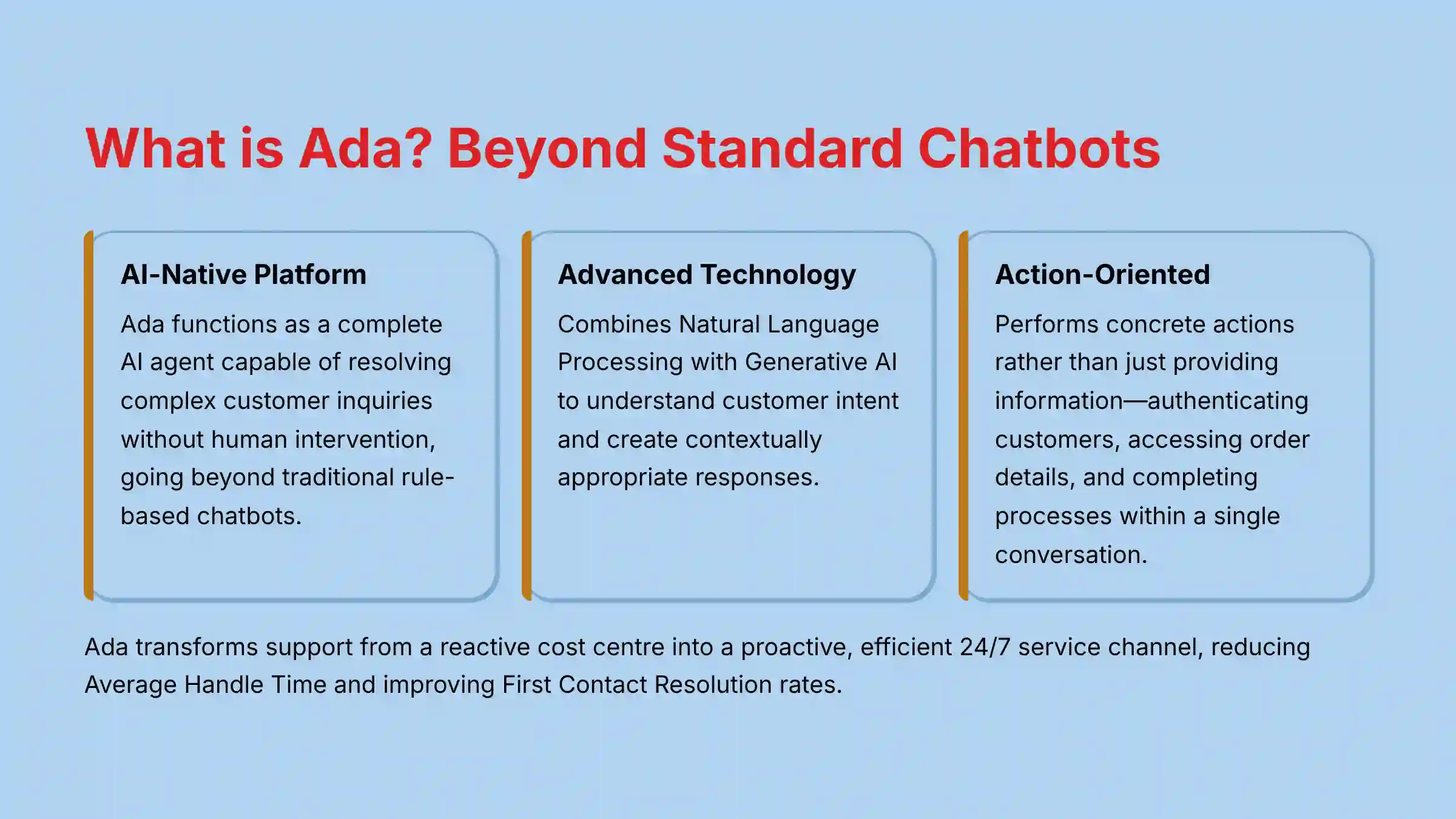
Ada is an AI-native customer service automation platform that goes beyond traditional chatbots by functioning as a complete AI agent capable of resolving complex customer inquiries without human intervention. Unlike basic rule-based chatbots that follow rigid if-then logic and primarily deflect simple questions, Ada employs sophisticated AI technology designed to understand, reason through, and fully resolve multi-step customer issues.
At its core, Ada combines advanced Natural Language Processing (NLP) to accurately interpret customer intent with Generative AI capabilities to create natural, contextually appropriate conversational responses. This technological foundation enables Ada to perform concrete actions rather than just providing information. For example, instead of merely explaining a return policy, Ada can authenticate the customer, access their order details from integrated systems like Shopify, initiate the return process, and confirm its completion—all within a single conversation flow.
The platform transforms customer support from a reactive cost center into a proactive, efficient 24/7 service channel. By automating complex resolutions that typically require human agents, Ada helps organizations scale their support operations while maintaining consistent customer experiences across all digital touchpoints. This automation-first approach significantly reduces Average Handle Time (AHT) and improves First Contact Resolution (FCR) rates, driving measurable improvements in both operational efficiency and customer satisfaction.
For organizations seeking detailed insights into Ada’s specific capabilities and feature set, our comprehensive Ada Overview and Features guide provides in-depth technical specifications and use case examples.
How does Ada’s pricing work for AI customer support?
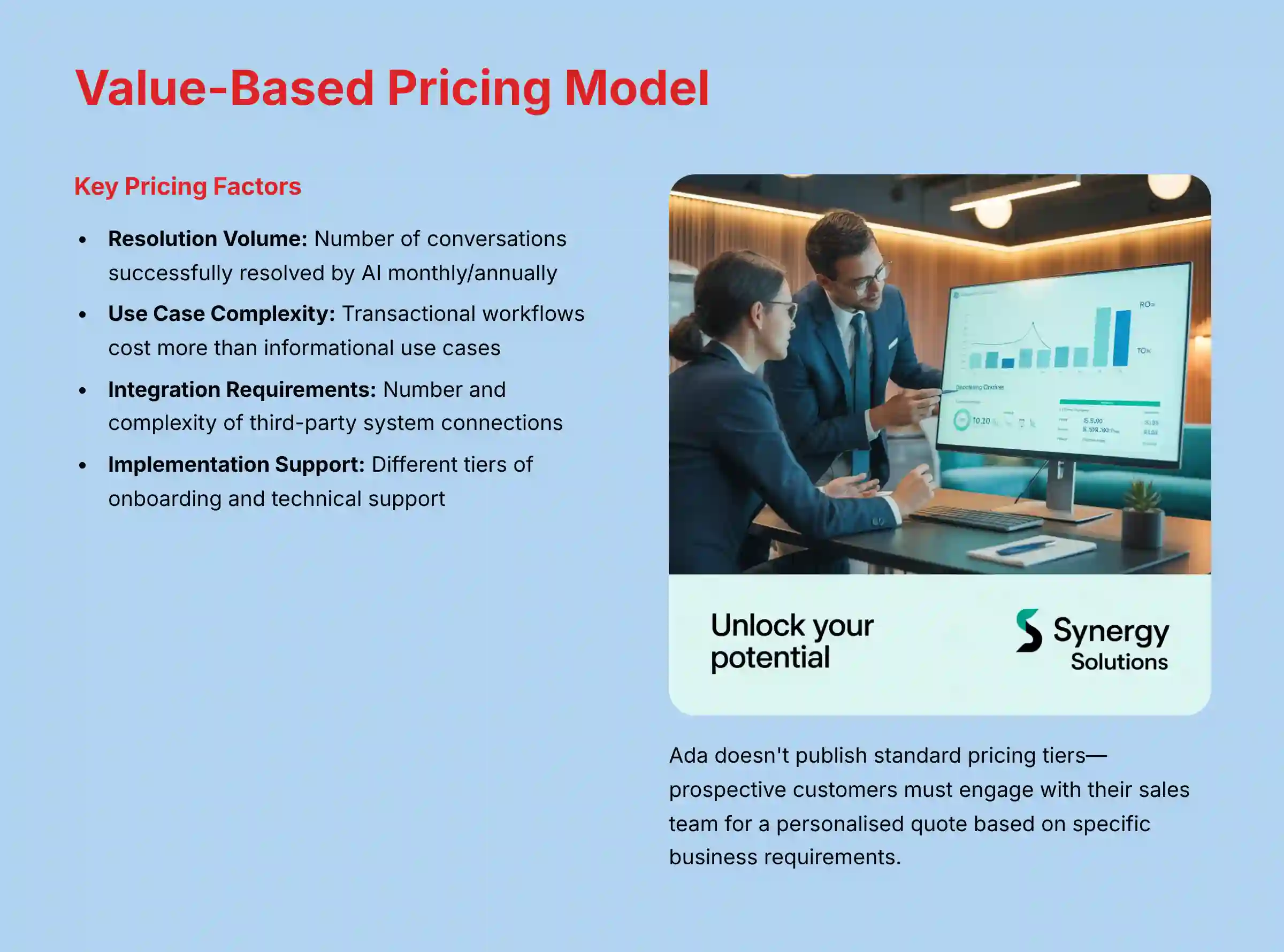
Ada utilizes a value-based pricing model customized for each client rather than standard per-agent or per-ticket pricing. The cost structure is primarily determined by two key factors: the volume of automated resolutions and the complexity of the use cases implemented. This approach means you’re paying for successful customer outcomes handled by the AI, not simply for software access.
The pricing framework considers several critical elements:
- Resolution Volume: The primary cost driver is the number of conversations successfully resolved by the AI on a monthly or annual basis
- Use Case Complexity: Implementing transactional workflows (processing refunds, managing subscriptions) costs more than informational use cases (answering basic FAQs)
- Integration Requirements: The number and complexity of integrations with third-party systems like Salesforce, Zendesk, or custom backends influences the total investment
- Implementation Support: Different tiers of onboarding assistance, dedicated success management, and ongoing technical support affect overall pricing
Organizations with high support volumes automating complex, transactional workflows will have different pricing structures than those automating simpler informational queries at lower volumes. Since Ada doesn’t publish standard pricing tiers, prospective customers must engage with their sales team to receive a personalized quote based on specific business requirements and resolution goals.
When preparing for pricing discussions, be ready to share your current ticket volume, the specific resolutions you want to automate, and your key business objectives (cost reduction, CSAT improvement, etc.) to receive an accurate proposal tailored to your customer support needs.
What types of companies benefit most from Ada’s AI customer support?
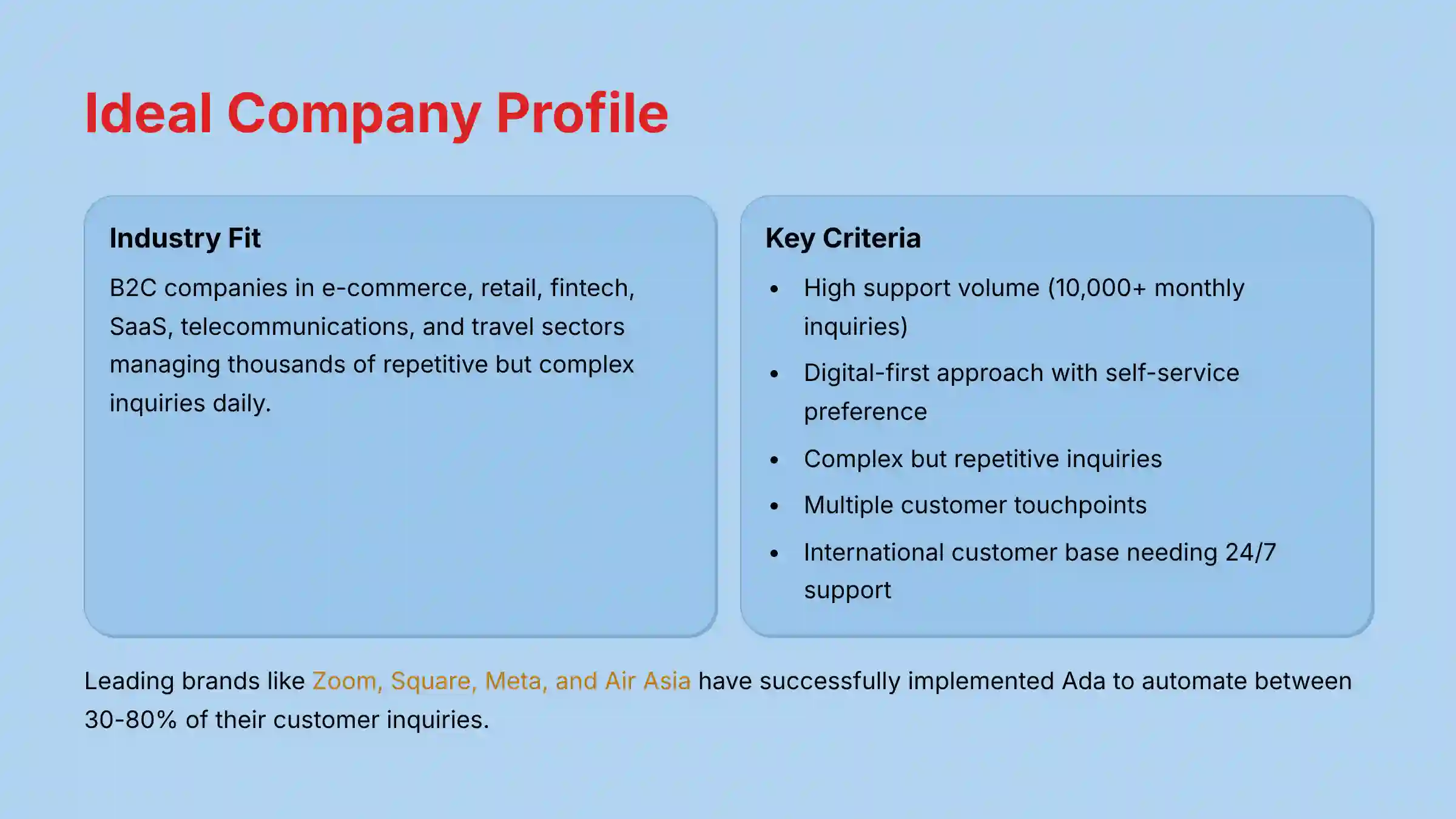
Ada delivers maximum value to B2C companies experiencing high volumes of customer interactions who need to scale support operations without proportionally increasing headcount. The platform is particularly well-suited for mid-market to enterprise organizations in industries such as e-commerce, retail, fintech, SaaS, telecommunications, and travel—sectors that typically manage thousands of repetitive but often complex customer inquiries daily.
Organizations see the greatest ROI from Ada when they meet several key criteria:
- High support volume handling 10,000+ monthly customer inquiries
- Digital-first approach with customers who prefer self-service options
- Complex but repetitive inquiries related to order management, account services, technical troubleshooting, and billing questions
- Multiple customer touchpoints requiring consistent experiences across web, mobile, and messaging channels
- International customer base needing 24/7 support across different time zones and languages
Companies transitioning from a reactive, agent-dependent support model to a proactive, automation-first strategy gain the most significant benefits. Ada’s true power emerges when deeply integrated with core business systems like CRMs (Salesforce, HubSpot), helpdesk platforms (Zendesk, Intercom), and e-commerce solutions (Shopify, Magento), enabling the AI to access customer data and take meaningful actions on behalf of users.
Leading brands like Zoom, Square, Meta, and Air Asia have successfully implemented Ada to automate between 30-80% of their customer inquiries, demonstrating the platform’s effectiveness for organizations with established digital customer engagement strategies and complex support ecosystems.
To see how Ada compares against other leading AI customer support solutions, explore our detailed Ada Top Alternatives and Competitors analysis.
How does Ada’s AI understand and resolve customer issues?
Ada employs a sophisticated multi-layered AI architecture designed to comprehend and act on customer needs beyond simple keyword matching. The platform’s proprietary AI engine has been trained on billions of customer service conversations, making it exceptionally adept at identifying true customer intent even when expressed in colloquial or ambiguous language.
The resolution process follows several interconnected stages:
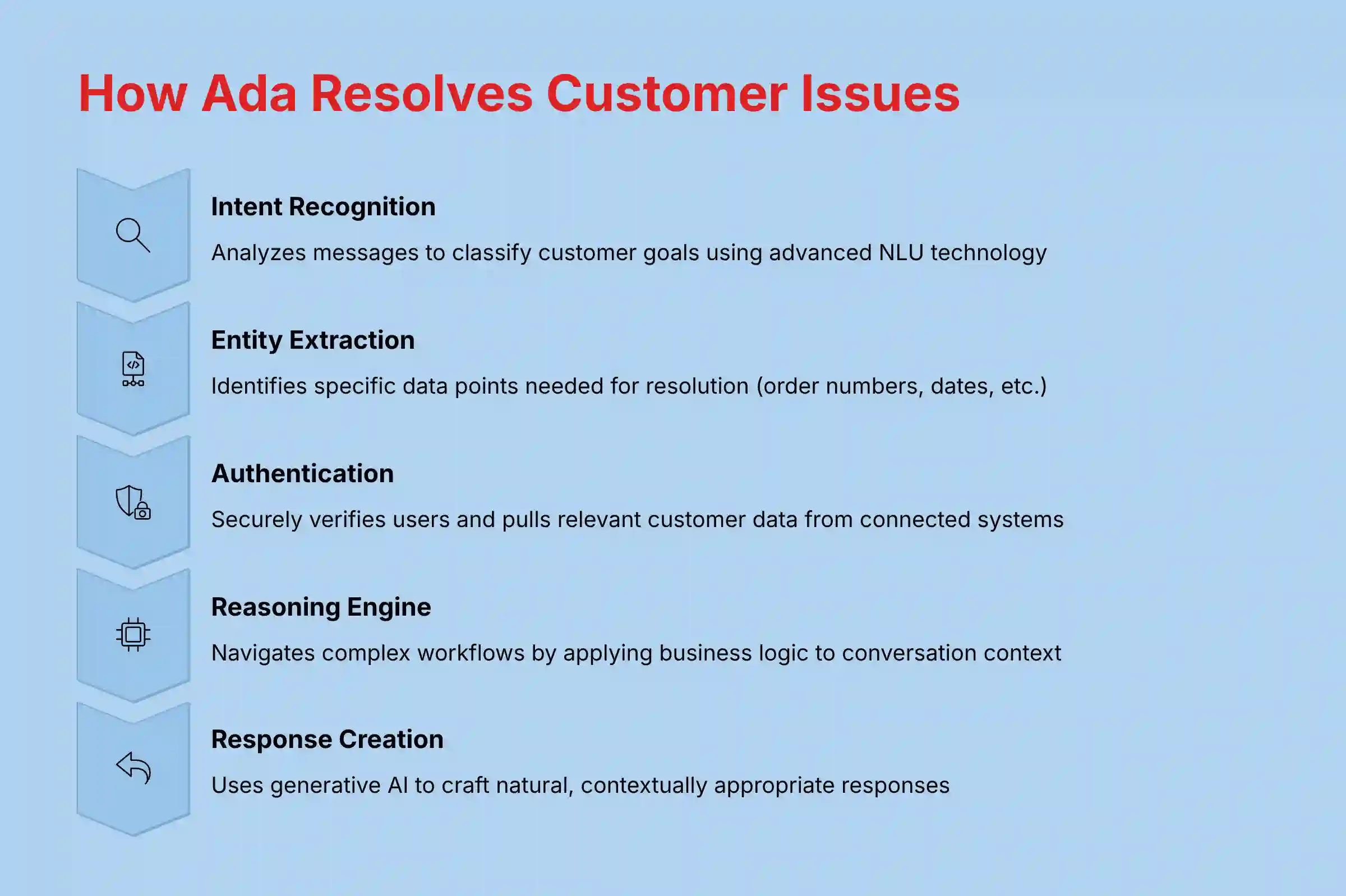
- Intent Recognition: The AI analyzes the customer’s message to classify their core goal (e.g., “track order,” “reset password,” “dispute charge”) using advanced Natural Language Understanding (NLU) technology that can interpret various phrasings of the same request.
- Entity Extraction: The system identifies specific data points within the conversation (order numbers, dates, product names) that will be needed to complete the resolution.
- Authentication & Data Collection: Through secure integrations, Ada can authenticate users via email or SMS verification, then pull relevant customer data from connected systems to personalize the interaction.
- Reasoning Engine Processing: Ada’s Reasoning Engine—the platform’s differentiating feature—navigates complex, multi-step workflows by applying business logic to the conversation context. For example, with a refund request, it checks the purchase date against return policy, verifies item condition if required, and triggers the appropriate refund process in the payment system.
- Generative Response Creation: Rather than using static templates, Ada employs generative AI to craft natural, contextually appropriate responses that guide customers through the resolution process with human-like dialogue.
This comprehensive approach enables Ada to handle the entire resolution lifecycle for a wide range of inquiries, delivering consistent, accurate, and efficient customer experiences at scale while maintaining the conversational feel of human interaction.
For hands-on learning about implementing Ada’s capabilities effectively, check our comprehensive Ada Tutorials and Usecase guide with step-by-step implementation examples.
How does Ada integrate with essential customer service systems?
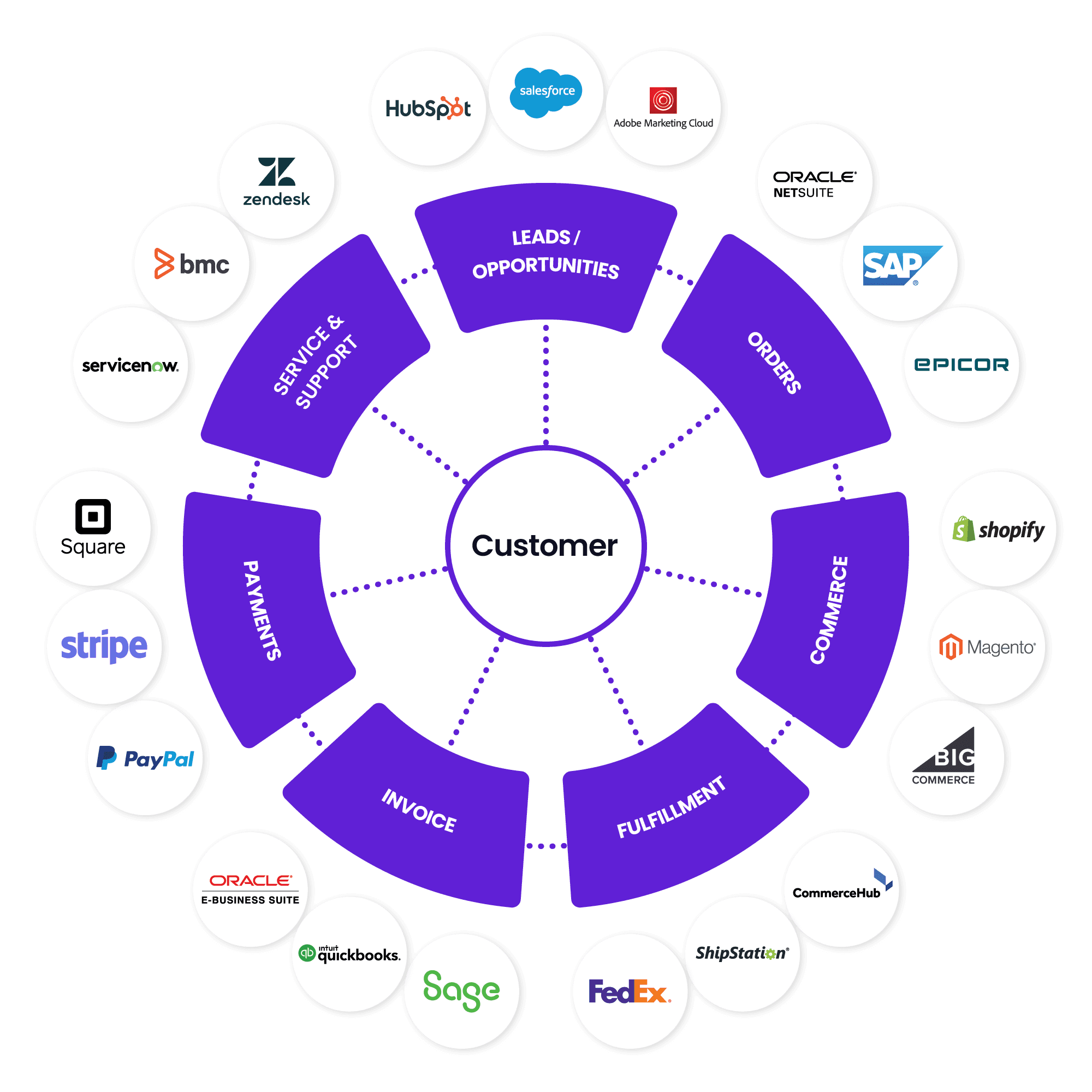
Ada functions as a central automation layer that connects deeply with core business systems rather than operating as an isolated chatbot. The platform offers extensive integration capabilities through both pre-built connectors for popular platforms and a robust API framework for custom implementations, enabling the AI to access data and perform actions across your technology ecosystem.
Key integration capabilities include:
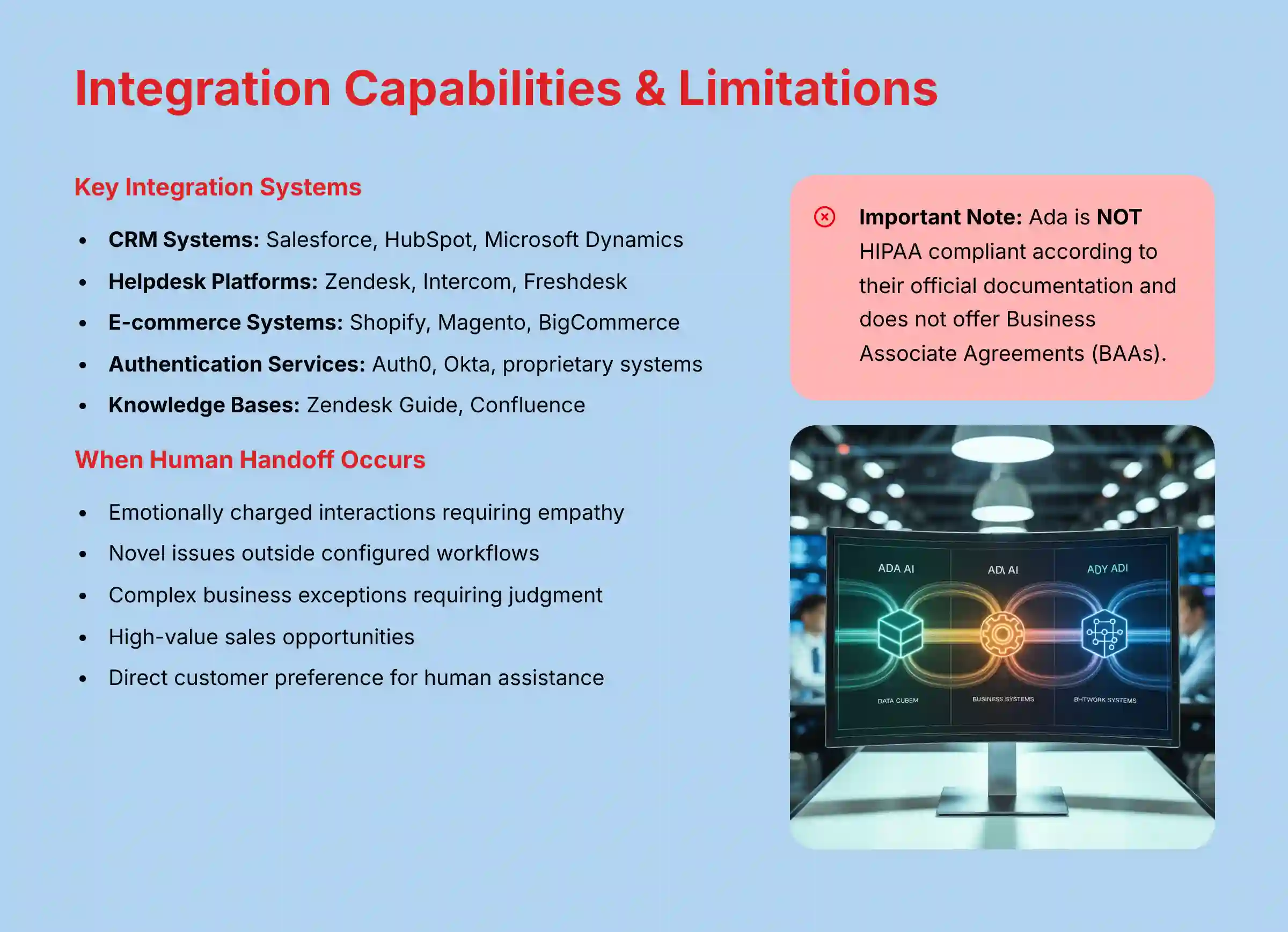
- CRM Systems (Salesforce, HubSpot, Microsoft Dynamics): Ada can create/update customer records, access customer history and status information, and synchronize conversation data back to the CRM to maintain a complete customer view.
- Helpdesk Platforms (Zendesk, Intercom, Freshdesk): These integrations enable seamless human handoffs with full conversation context, allowing agents to continue conversations without customers needing to repeat information. Ada can create detailed tickets with conversation transcripts, customer data, and attempted resolution steps.
- E-commerce Systems (Shopify, Magento, BigCommerce): Ada can check order status, retrieve tracking information, process returns or exchanges, and even handle refunds directly within the conversation interface, enabling complete transactional resolutions.
- Authentication Services (Auth0, Okta, proprietary systems): Secure customer identity verification enables Ada to handle sensitive account operations and personalize interactions based on customer profiles and entitlements.
- Knowledge Bases (Zendesk Guide, Confluence): Ada can pull content from existing knowledge repositories to maintain consistency across support channels and leverage existing documentation.
For proprietary systems, Ada provides RESTful APIs, webhooks, and SDKs that allow developers to build custom connections to legacy databases or internal tools. The platform’s Integration Builder offers a no-code interface for connecting to standard APIs, while more complex integrations can be developed using Ada’s developer tools.
The most successful implementations leverage these integration capabilities to automate complete resolution workflows rather than simply answering questions and creating tickets.
What are the limitations of Ada’s AI customer support capabilities?
While Ada is a powerful automation platform, it has defined boundaries and works best as part of a comprehensive customer service strategy that includes human agents for specific scenarios. Understanding these limitations is essential for setting realistic expectations and designing effective automation workflows.
Ada is designed to trigger human agent handovers in several key situations:
- Emotionally Charged Interactions: When customers express significant frustration, anger, or distress, human empathy becomes critical. Ada can detect emotional signals in language and escalate these sensitive conversations to agents trained in de-escalation and emotional intelligence.
- Novel or Undefined Issues: The AI excels at handling known, structured workflows but cannot improvise solutions for completely new problems it hasn’t been configured to handle. When faced with these edge cases, Ada collects relevant information before transferring to a specialist.
- Complex Business Exceptions: While Ada can handle multi-step processes, some scenarios require human judgment or authority beyond predefined business rules—such as approving exceptions to policies or handling VIP customers with unique requirements.
- High-Value Sales Opportunities: When conversations shift from support to significant sales opportunities (enterprise pricing discussions, major upgrades), Ada can identify these signals and route them to sales representatives to maximize revenue potential.
- Direct Customer Preference: The platform always provides clear options for customers to request human assistance at any point in the conversation, ensuring users maintain control over their service experience.
The most effective implementations view these handoffs not as automation failures but as strategic touchpoints where human expertise delivers maximum value. Leading organizations use Ada’s analytics to continually refine these escalation paths, gradually expanding automation capabilities while preserving human intervention for moments that truly benefit from it.
What security and compliance standards does Ada meet?
Ada maintains robust security and compliance frameworks designed for enterprise-grade deployments handling sensitive customer data. The platform implements comprehensive security measures and adheres to international standards to protect information integrity and privacy.
Ada’s security and compliance credentials include:
- SOC 2 Type II Certification: Ada has completed this rigorous third-party audit verifying the effectiveness of its security controls, data protection practices, and operational procedures over an extended observation period. This certification demonstrates Ada’s commitment to maintaining secure information processing systems.
- ISO/IEC 27001:2013: Ada complies with this international standard for information security management systems (ISMS), validating its systematic approach to managing sensitive company and customer information.
- GDPR & CCPA Compliance: The platform provides the necessary tools and processes to help organizations meet their obligations under these major privacy regulations, including data access, portability, and deletion capabilities.
- PCI DSS Compliance: For organizations processing payments, Ada’s platform can be configured to handle payment card information in compliance with Payment Card Industry Data Security Standards.
Important Correction: Ada is NOT HIPAA compliant according to their official documentation. Healthcare organizations handling Protected Health Information (PHI) should note that Ada cannot currently be used to process, store, or transmit PHI under HIPAA regulations. Ada’s official help documentation explicitly states that they are not HIPAA compliant and do not offer Business Associate Agreements (BAAs).
Additional security features include:
- Data Encryption: Both in transit (TLS) and at rest (AES-256)
- Automatic PII Detection: Built-in capabilities to identify and redact sensitive information
- Role-Based Access Controls: Granular permissions system to limit data access based on user roles
- Security Monitoring: Continuous threat detection and vulnerability management
Organizations in regulated industries should verify Ada’s current compliance status directly with the vendor before implementation and ensure it meets their specific regulatory requirements.
What is the typical implementation process for Ada?
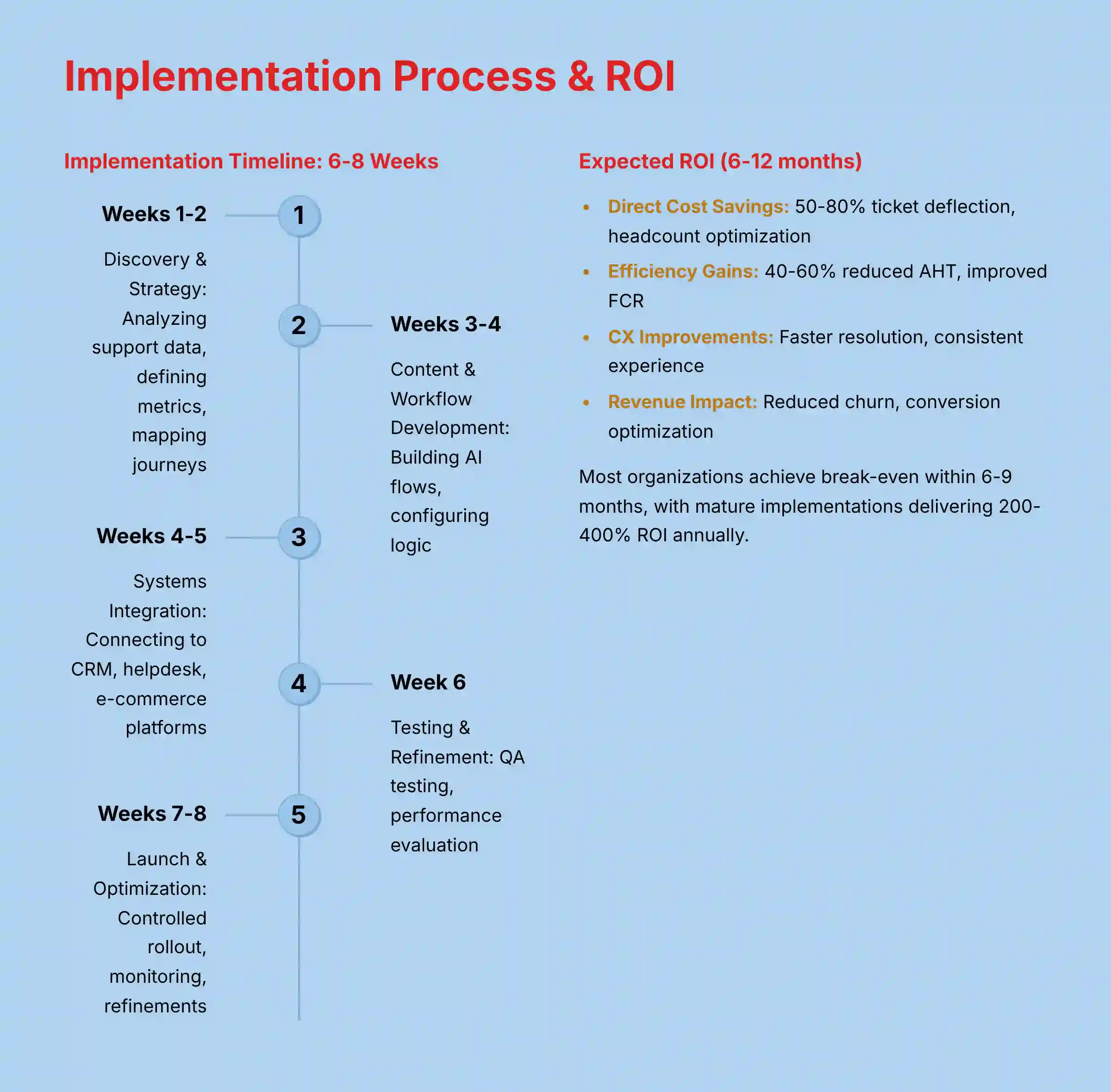
Ada’s implementation follows a structured methodology designed to deliver value quickly while building for long-term success. The typical deployment timeline ranges from 6-8 weeks for standard implementations, though complexity can extend this timeframe for enterprise-scale projects with multiple custom integrations.
The implementation journey consists of these key phases:
1. Discovery & Strategy (Weeks 1-2)
- Analyzing current support data to identify high-volume, high-impact use cases
- Defining success metrics and ROI expectations
- Mapping customer journeys and key resolution paths
- Creating an implementation roadmap with phased deliverables
2. Content & Workflow Development (Weeks 3-4)
- Building conversational AI flows for priority use cases
- Configuring business logic and decision trees
- Creating response templates and conversation paths
- Setting up proper escalation routes to human agents
3. Systems Integration (Weeks 4-5)
- Connecting Ada to your CRM, helpdesk, and e-commerce platforms
- Configuring authentication mechanisms
- Establishing data synchronization processes
- Setting up webhook triggers and API connections
4. Testing & Refinement (Week 6)
- Internal QA testing across all conversation flows
- User acceptance testing with support team members
- Performance testing for response accuracy and speed
- Iterative improvements based on test results
5. Launch & Optimization (Weeks 7-8)
- Controlled rollout to a percentage of customer traffic
- Performance monitoring and analytics review
- Conversation flow refinements based on real user data
- Full deployment and handoff to customer success team
The required resources from your organization typically include:
- Project Lead: Dedicated point person to coordinate internal resources (15-20 hours/week)
- Customer Service Subject Matter Expert: To provide support processes and knowledge (10-15 hours/week)
- Technical Resource: For integration work, often from IT or development team (5-10 hours/week during integration phase)
- Executive Sponsor: For strategic guidance and removing organizational blockers (1-2 hours/week)
Ada provides a dedicated implementation team including a Solutions Consultant, Technical Implementation Specialist, and Customer Success Manager to guide your team through each phase of the process.
What ROI can companies expect from implementing Ada?
Organizations implementing Ada typically achieve measurable ROI within 6-12 months, with the platform delivering value across three primary dimensions: operational cost reduction, efficiency improvements, and enhanced customer experience metrics. The most successful implementations see automation rates of 30-80% of total inquiries, depending on use case complexity and integration depth.
Key ROI components include:
1. Direct Cost Savings:
- Ticket Deflection: By automating 50-80% of repetitive inquiries, organizations significantly reduce the volume of tickets requiring human handling
- Support Headcount Optimization: Companies can either reduce staffing costs or redirect agent resources to higher-value activities
- After-Hours Coverage: Elimination of expensive overnight staffing or outsourcing costs by providing 24/7 automated resolution
2. Operational Efficiency Gains:
- Reduced Average Handle Time (AHT): Even for conversations that require human intervention, Ada collects information upfront, reducing agent handling time by 40-60%
- Improved First Contact Resolution (FCR): Automated workflows resolve issues completely on first contact, eliminating costly follow-ups
- Increased Agent Productivity: Agents freed from repetitive tasks can focus on complex issues requiring human judgment
3. Customer Experience Improvements:
- Faster Resolution Times: Average resolution time decreases from hours or days to seconds or minutes
- Consistent Experience: Standardized, accurate responses eliminate the variability of human agents
- Improved Customer Satisfaction (CSAT): Customers appreciate immediate, 24/7 resolution without waiting for human availability
4. Revenue Protection & Generation:
- Reduced Customer Churn: Faster issue resolution improves retention rates, protecting recurring revenue
- Conversion Optimization: Ada can identify and assist customers struggling with checkout processes
- Proactive Engagement: The system can identify upsell/cross-sell opportunities during support interactions
Companies typically measure Ada’s ROI using a formula that compares the total cost of ownership (platform fees, implementation, maintenance) against the combined value of operational savings, efficiency gains, and revenue impact. Most organizations achieve break-even within 6-9 months, with mature implementations delivering 200-400% ROI annually.
How does Ada scale to support large enterprise customer bases?
Ada’s platform architecture is engineered specifically for enterprise-scale deployments, capable of handling massive conversation volumes with consistent performance and reliability. The system is trusted by global brands managing millions of monthly customer interactions across multiple languages and time zones.
Ada’s enterprise scalability is built on several key technological foundations:
1. Cloud-Native Infrastructure
- Deployed on AWS with a microservices architecture that enables dynamic resource allocation
- Automatic scaling during traffic surges (like Black Friday or service disruptions)
- Multi-region deployment options for global organizations requiring data residency compliance
- Load balancing across distributed servers to maintain performance under heavy demand
2. Performance & Reliability
- Contractual SLA guaranteeing 99.9% uptime or higher for enterprise clients
- Multi-zone redundancy to prevent single points of failure
- Regular capacity planning and load testing to ensure performance during peak periods
- Real-time monitoring and alerting systems to identify potential issues before they impact customers
3. Enterprise Integration Capabilities
- API rate limiting and queueing mechanisms to protect backend systems during traffic spikes
- Stateless architecture allowing horizontal scaling of conversation processing
- Bulk data processing capabilities for organizations with massive customer databases
- Staged rollout capabilities to gradually increase automation across customer segments
4. Multi-Language & Global Support
- Simultaneous support for 100+ languages with consistent performance
- Content delivery network (CDN) integration for low-latency global response times
- Region-specific deployment options for data sovereignty compliance
- 24/7 enterprise support with global coverage for mission-critical implementations
For large enterprises, Ada offers dedicated infrastructure options with enhanced security, custom performance tuning, and advanced integration capabilities. The platform’s architecture can scale to handle billions of annual conversations while maintaining sub-second response times and high accuracy rates.
This enterprise-grade foundation ensures that as your customer base and support requirements grow, Ada can seamlessly scale with your business without performance degradation or reliability concerns.
What makes Ada different from competing AI customer support solutions?
Ada distinguishes itself in the crowded AI customer support market through several key differentiators focused on delivering complete automated resolutions rather than just deflecting simple inquiries. While competitors like Intercom, Zendesk, and Drift offer chatbot capabilities, Ada’s platform is purpose-built for end-to-end automation of complex customer interactions.
Key differentiating factors include:
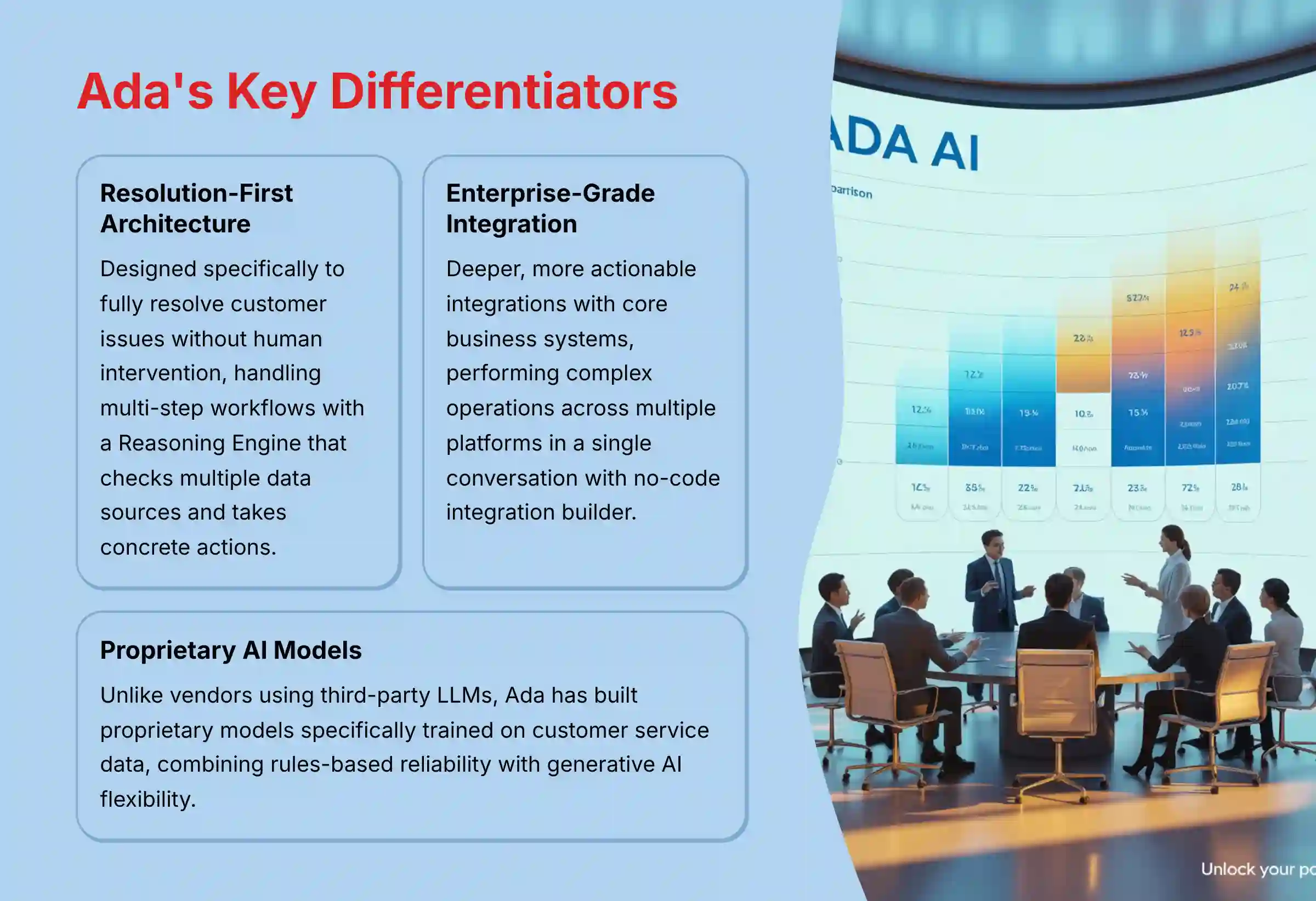
1. Resolution-First Architecture
- Unlike platforms that primarily focus on qualifying leads or routing tickets, Ada is designed specifically to fully resolve customer issues without human intervention
- The platform’s Reasoning Engine can handle multi-step, conditional workflows that require checking multiple data sources and taking concrete actions
- Performance metrics focus on resolution rate rather than just engagement or deflection metrics
2. Enterprise-Grade Integration Depth
- Ada offers deeper, more actionable integrations with core business systems beyond simple API connections
- The platform can perform complex operations across multiple systems in a single conversation (e.g., checking order status in an e-commerce platform, applying a credit in the billing system, and updating the customer record in the CRM)
- No-code integration builder allows business users to create powerful connections without developer resources
3. Conversation Design Expertise
- Ada’s platform includes advanced conversation design tools based on proven conversational AI best practices
- The company provides dedicated conversation designers during implementation to optimize customer interactions
- Automated conversation testing tools help identify and resolve potential points of customer confusion
4. AI Sophistication & Ownership
- Unlike vendors using third-party Large Language Models (LLMs), Ada has built proprietary AI models specifically trained on customer service data
- The platform combines the strengths of rules-based systems (reliability, security) with the flexibility of generative AI
- Continuous training on customer interactions creates industry-specific expertise that generic LLMs lack
5. Specialized Focus on Customer Service
- While competitors often offer chatbots as features within broader platforms, Ada focuses exclusively on customer service automation
- This specialization results in deeper expertise, more relevant features, and greater understanding of support-specific challenges
- The platform’s roadmap is entirely dedicated to advancing automated customer service capabilities
This focused approach has enabled Ada to achieve industry-leading automation rates for complex customer inquiries, delivering measurable ROI for enterprise organizations seeking to transform their customer service operations through AI.
For a detailed performance analysis and real-world implementation insights, read our comprehensive Ada Review examining its AI support capabilities.
Beyond Ada’s capabilities, it’s valuable to understand how it fits within the broader landscape of AI-powered customer support solutions. Our comprehensive guide to the Best 10 AI-Powered Customer Support platforms provides detailed comparisons and selection criteria for choosing the right solution for your organization.
For organizations ready to move forward with implementation, our detailed Ada FAQs section addresses additional technical and operational questions that arise during the evaluation and deployment process.

Leave a Reply